A new study warns that deep-sea mining noise in the Pacific’s Clarion-Clipperton Zone may disrupt marine life, urging transparency and a global moratorium on unregulated activities.
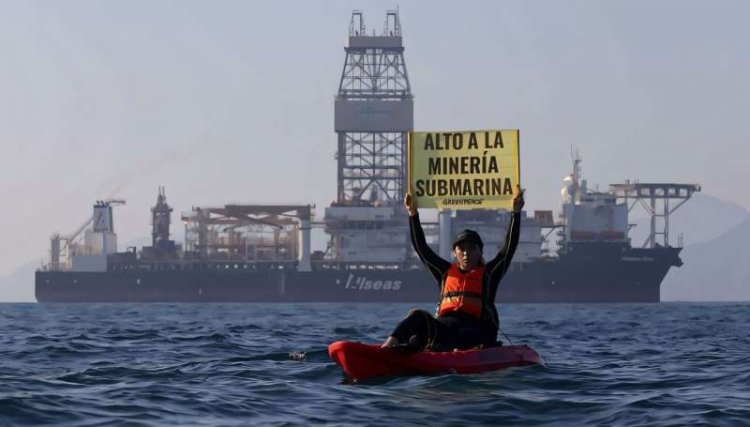
Experts are sounding the alarm on the unintended environmental threat of deep-sea mining sound pollution in the Pacific Ocean, specifically in the Clarion-Clipperton Zone (CCZ) — a huge stretch of seabed between Hawaii and Mexico where there is an abundance of mineral wealth.
A recent study, appearing in the Marine Pollution Bulletin, puts a warning out that noise from mining might disrupt essential marine processes such as communication, mating, navigation, and predator avoidance. This disruption might propagate throughout the marine food web and threaten the ecosystems on which Latin American coastal communities rely.
The research compared more than 2,800 scientific publications and concluded that the majority of species in the CCZ — most notably invertebrates, fish, and marine mammals — are sensitive to sound. Yet, noise pollution impacts have been studied in only 35% of such species, uncovering a secret connection in scientific research.
Sound-Sensitive Ecosystems
One-third or more of the CCZ's fish species may be soniferous and either emit or use sound, according to Lucille Chapuis, a marine bioacoustician with Australia's La Trobe University and co-author of the paper.
"They use it for all of those processes: communication, finding mates, avoiding predators, and finding food," Chapuis said. "If we introduce noise into the scenario, these functions can become masked or interrupted."
Though environmental damage may be possible, publicly available information on the noise created by active deep-sea mining is still not present. "There's literally no published data out there — it's all proprietary," said study co-author Travis Washburn of Texas A&M University. "We used coastal noise data as a rough estimate."
Global Political Action
The warning is an escalating wave of international concern. At the recent UN Ocean Conference in Nice, France, 37 nations launched the High Ambition Coalition for a Silent Ocean to fight underwater noise pollution with moves like quieter shipping and marine reserves.
UN Secretary-General António Guterres demanded regulation immediately, saying deep-sea mining could turn the ocean into a "Wild West" of lawlessness.
Calls for a Moratorium
The CCZ is the globe's biggest deep-sea minerals exploration area, rich with precious cobalt, nickel, manganese, and rare earth minerals—crucial for clean energy technologies. Though 31 exploration licenses have already been issued by the International Seabed Authority (17 in the CCZ alone), as yet no code exists for controlling commercial exploitation.
Latin nations, such as Peru and Mexico, are at the forefront of requesting a global moratorium on deep-sea mining pending further research to prevent any irreversible damage.
"These are cultures that we know nothing about," Mexican Center for Biological Diversity representative Alejandro Olivera stated. "We're risking eradicating organisms that we've yet to discover."
Peruvian ocean policymaker Daniel Cáceres emphasized that the threats are near and actual. "The noise waves could harm migratory species and regional food chains with ecological connections to Latin American shores."
The research highlights the necessity of immediacy in respect to transparency, objective analysis, and diligence in policymaking when managing deep-sea resources — something called for by scientists, conservationists, and policymakers alike.
Source Credit:
First published in: SciDev.Net | Author: Carmina de la Luz | Edited by: Lisa Lock | Reviewed by: Robert Egan
Photo Credit: Greenpeace
Journal Reference: Rob Williams et al, Marine Pollution Bulletin (2025). DOI: 10.1016/j.marpolbul.2025.118135
What's Your Reaction?