A recent study finds that PLA, a compostable plastic, breaks down in Indian soil without leaving harmful microplastics, unlike conventional plastics that continue to pollute the environment.
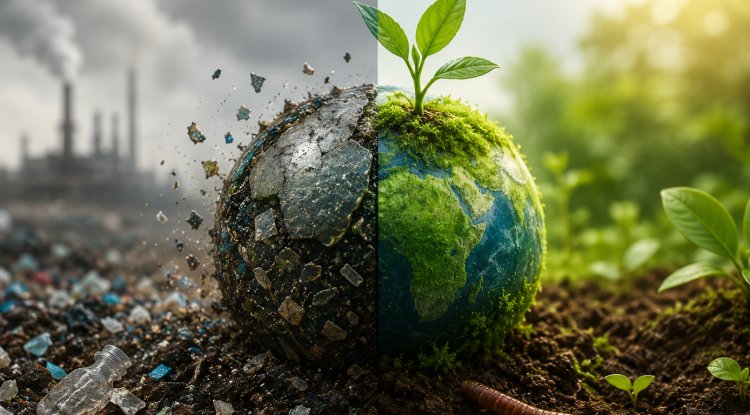
Plastic waste is a huge environmental problem and regular plastics which are petroleum-based fragmenting into microplastics that persist in soil and ecosystems.
The behavior of Polylactic Acid (PLA), a compostable polymer, in Indian soil conditions was studied recently in scientific research performed at one of the most prestigious academic institutions operating under the auspices of the Ministry of Chemicals & Fertilizers, Government of India. According to the results of the research, PLA biodegrades into less complex substances, leaving no trace of toxic microplastics, whereas conventional plastics, derived from fossil fuel sources, remain intact and pollute the soil.
In this scientific study, the soil samples were examined on a 30-day, 60-day, 90-day, 120-day, and 180-day period, and the researchers observed a continuous decrease in the number of particles of PLA microplastic present in the soil sample. Initially there were 287 particles/kg, which had reduced significantly to 18 particles/kg in 180 days.
Moreover, it was found that the deterioration of the PLA did not create any residue that could have been toxic in nature, since the concentration of heavy metals remained well within international safety standards. It was also evident from soil organism tests that the presence of PLA did not impact the biological functioning of the earthworm.
Providing scientific context, S K Nayak, Former Director General of Central Institute of Petrochemicals Engineering and Technology (CIPET), stated: “The recent study findings highlight a clear difference in how materials behave in the environment. Conventional plastics resist degradation and persist as microplastics in soil. In contrast, PLA undergoes breakdown under sunlight and soil conditions, followed by biodegradation. Within 180 days, it is largely converted into simple compounds, as confirmed by scientific analysis and biological testing.”
Vikram Bhanushali, President of the Indian Compostable Polymer Association (ICPA), said: “The study indicates that PLA-based materials can biodegrade under Indian environmental conditions without leaving harmful residues. These findings may support the role of compostable materials in specific applications where conventional waste management systems are less effective.”
Avantika Saraogi, Executive Director of Balrampur Chini Mills Limited, added: “There is scientific proof that materials like PLA can be recycled back into nature without creating any long-term environmental damage. In an era where India is gearing up for strict regulatory policies and environmental sustainability, the importance of utilising biodegradable products would increase even further. The future of plastics should be focused not only on minimising plastic waste but also developing materials that help in the recycling process within nature and that is the direction in which the industry is moving forward.”
The report evaluates PLA degradation under real-world conditions, including exposure to sunlight and soil ecosystems. Overall, the findings suggest that PLA can break down over time and integrate into natural systems, while conventional plastics continue to persist and accumulate.
What's Your Reaction?