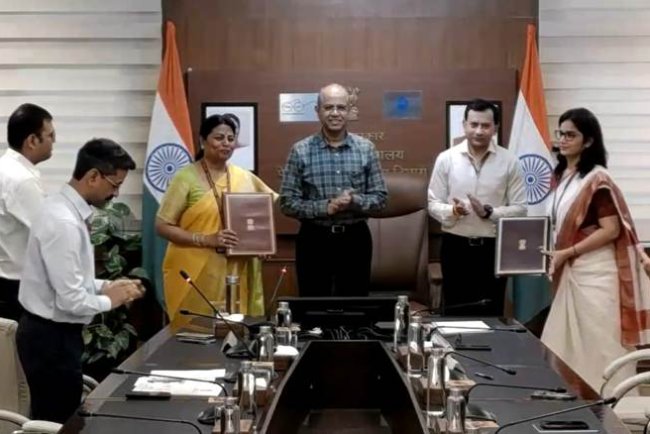
The Centre has signed MoUs with Rajasthan and Madhya Pradesh to implement governance and service delivery reforms under the extended Jal Jeevan Mission 2.0.
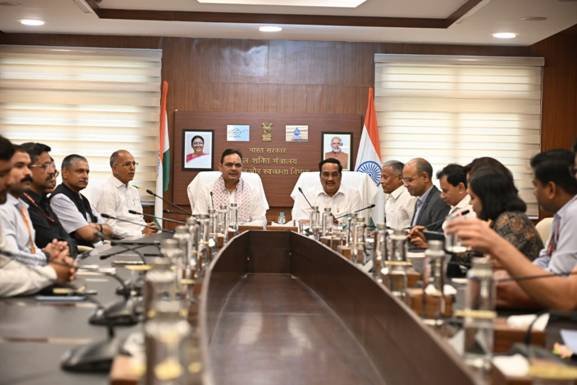
In a bid to strengthen rural drinking water services, Memorandums of Understanding (MoUs) under Jal Jeevan Mission (JJM) 2.0 were signed with the states of Rajasthan and Madhya Pradesh, marking the beginning of reform-linked implementation in these states in the extended phase of the Jal Jeevan Mission, which was approved by the Union Cabinet on March 10, 2026.
The MoU was signed in the forenoon in the presence of Union Minister of Jal Shakti C. R. Paatil, Chief Minister Bhajan Lal Sharma, and Minister of State for Jal Shakti V. Somanna. The ceremony was also attended by Kanhaiya Lal Choudhary, Minister of PHED, Rajasthan, along with senior officials from the Centre and the state government.
Senior representatives from the Department of Drinking Water & Sanitation (DDWS), including Secretary Ashok K.K. Meena and Additional Secretary & Mission Director Kamal Kishore Soan, participated in both signing ceremonies along with representatives from the Public Health Engineering Department (PHED) in Rajasthan and the Jal Nigam, Madhya Pradesh.
In the case of Rajasthan, the signing of the Memoranum of Understanding (MoU) occurred between Swati Meena Naik, Joint Secretary (Water) DDWS; Akhil Arora, Additional Chief Secretary, PHED Rajasthan. In the case of Madhya Pradesh, the signing was between Swati Meena Naik and P.Narahari, Principal Secretary, PHED Madhya Pradesh.
During his remarks to the audience, Minister C.R. Paatil discussed recent sessions on parliament regarding the Jal Jeevan Mission. He stated "the guiding principles for all activities conducted under Jal Jeevan Mission will be quality, transparency and accountability. Furthermore, states must adhere to these guiding principles to maintain the functionality of their assets long after the completion of JJM projects."
He provided an example of various challenges facing each of the states including, but not limited too, varying degrees of water scarcity in some regions like Rajasthan as opposed to varying hydro-geological conditions such as found in different parts of Madhya Pradesh. He said that if states implement JJM effectively and within the required timeframes they will increase women's access to clean sources of drinking water while reducing the burden on rural households.
Chief Minister of Rajasthan Bhajan Lal Sharma reinforced his support of timely implementation as well as adherence to structural reforms associated with JJM 2.0 specifically with an emphasis on quality and sustainability of rural drinking water systems.
Madhya Pradesh Chief Minister Mohan Yadav said that state will adopt the reform framework and focus on improving the governance systems and service delivery including efforts towards providing continuous access to drinking water supply and making the sustainability of the schemes long term. The 11 structural reform areas in the memorandum of understanding (MoU) are designed to improve governance, institutional capacity, and sustainability, and include the following areas:
- Institutional Architecture for Drinking Water Governance
- Service Utility Framework for Rural Water Supply
- Technical Compliance and Efficient Scheme Implementation
- Citizen‑Centric Water Quality Governance
- Source Sustainability and Water Security Framework
- Digital Data Governance in Rural Drinking Water Systems
- Participatory Governance through Jan Bhagidari
- Capacity Building Framework
- Human Resource and Skilling Ecosystem
- Operational and Financial Sustainability of Water Supply Schemes
- Research, Innovation and Knowledge Ecosystem
The MoU outlines a Gram Panchayat-led, service-based model of rural water governance. Completed piped water supply schemes are to be handed over to Gram Panchayats or village-level committees through a process referred to as “Jal Arpan.”
It also provides for the use of a Decision Support System (DSS) platform for planning at district and Gram Panchayat levels, integrated with national water datasets. Village-level assessments under “Jal Seva Aankalan” will be conducted to evaluate service delivery, with outcomes to be made available through the Meri Panchayat application.
The agreement also includes provisions for observing “Jal Utsav” at national, state, and local levels. As part of this, National Jal Mahotsav 2026 began with a nationwide “Jal Arpan” on March 8 and is scheduled to conclude on March 22, observed as World Water Day. A national-level event held on March 11 was attended by President Droupadi Murmu.
The extension of the Jal Jeevan Mission till December 2028 aims to shift focus towards service delivery, functionality, water quality, sustainability, and community participation in rural water supply systems.
What's Your Reaction?