Rajkot transformed a legacy waste dumping site into a green urban forest under the Swachh Bharat Mission.
Multiple policies, schemes, and regulations have already been implemented to reduce the burden on landfills. The green (wet waste/biodegradable) and blue (dry waste/non-biodegradable) dustbin concept is the simplest step individuals can take to start managing their waste responsibly, right at their doorstep. This initiative has proven to be a game changer—Indore is a prime example, where effective waste segregation takes place before the waste even reaches landfills or dumping yards.
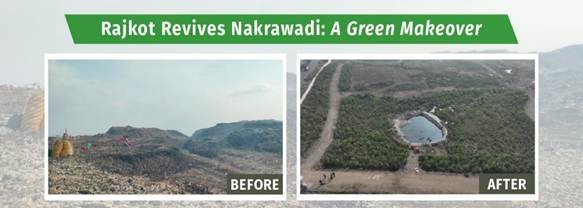
While cities like Indore are tackling waste at the source, others are addressing the damage already done. Just a few years ago, the Nakrawadi dumping ground in Rajkot was a grim reminder of the situation of unmanaged urban waste-a mountain of 16 lakh tonnes of legacy garbage accumulated over decades. Today, that very site tells a different story: resilience, transformation, and hope. Spread over 20 acres, the landfill is now an urban forest greening around 2.35 lakh native trees, which were planted following Miyawaki Technique.
This dramatic transformation was more than mere cleaning. It was an opportunity to reimagine how waste management could be in modern India. The winds of change began blowing with some silent yet powerful proclamation at the national level. With the dawn of the Swachh Bharat Mission in 2014 and then the frill of the Solid Waste Management Rules in 2016, the very voice of India seemed to be rising against a zero-waste-to-landfill approach. Now, with SBM-U 2.0 in tow and the declaration of "Lakshya Zero Dumpsite" mission, cities would be shoulder-to-shoulder, facing the tough challenge of clearing and reclaiming their old waste sites.
Rajkot took the challenge head-on.
Every day, the city produces about 700 tonnes of municipal solid waste. For years, it all ended up at the Nakrawadi site. But under the Rajkot Municipal Corporation’s leadership, the city turned the tide. A detailed survey kickstarted the process, followed by sophisticated segregation using advanced machinery. Waste was sorted into categories: refuse-derived fuel (RDF) was sent to a waste-to-energy plant in Jamnagar, inert materials were safely disposed of in a secured landfill, and around 50,000 tonnes of semi-compost were reused to level land and nourish the soil.
Yet, the transformation was far from easy. Segregating mixed, compacted waste posed technical hurdles. Workers dealt with foul odors and pollution; monsoon rains stalled operations. The area’s soil needed serious recovery, and greenery needed water—lots of it. So, the city laid a 12-kilometre pipeline to bring treated water from the Gauridad Sewage Treatment Plant, established water-harvesting ponds, and installed drip irrigation to keep things sustainable.
The outcome? A living example of a circular economy in action.
Not only has the project reclaimed lands, but it has also attempted to create an oxygen-giving public space conducive to biodiversity and also potentially climate-friendly measures in fewer greenhouse gases. Other climate actions are RDF for energy, afforestation, and reduced pressure on fresh water resources.
But it is not just an environmental impact. On a social level, it has united the community: Local self-help groups and volunteers contributed to shaping the space, which now stands as a symbol of pride. Economically, the city saves more from less waste management and from selling residues; even ecotourism is a possibility.
Rajkot's enhancement of Nakrawadi stands for a cleanup plus a pathway to urban India.. A model that proves land once lost to waste can be reclaimed, revived, and reborn into something truly life-giving.
What's Your Reaction?