Six youth-led startups win the Youth Co:Lab National Innovation Challenge 2026 for developing sustainable solutions in circular economy, green fashion, food systems and water conservation.
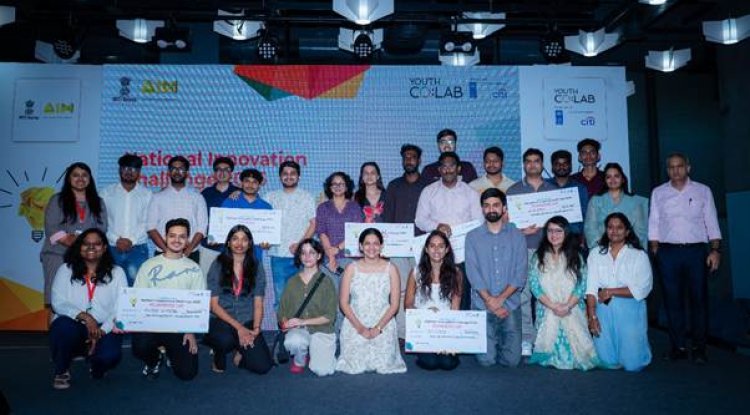
Six youth-led startups from different parts of India have been selected as winners of the 8th edition of the Youth Co:Lab National Innovation Challenge 2026 for developing solutions focused on sustainability, including circular economy innovations, sustainable textiles and fashion, and sustainable food systems and water conservation.
This challenge is being jointly led by the United Nations Development Programme (UNDP) India in collaboration with Citi Foundation and Atal Innovation Mission (AIM), with T-Hub Foundation implementing it.
The Youth Co:Lab National Innovation Challenge is designed to assist young innovators who are working on ideas related to the United Nations Sustainable Development Goals (SDGs). The number of applications that were submitted for this program this year is in excess of 350 in total.
After the initial selection process, 50 startups were chosen for the National Springboard Programme, a three-month virtual capacity-building programme. The startups received support from 16 industry mentors and domain experts while developing their business models and solutions.
The start-ups which participated were in three major sectors, which are Sustainable Textiles & Fashion, Circular Economy Innovations and Sustainable Food Systems and Water Conservation. The selected 50 start-ups showcased their ideas in front of the jury in the National Innovation Dialogue that took place on 4 June 2026. On completion of the assessment process, 20 start-ups went ahead to participate in the Regional Immersion Bootcamp at T-Hub, Hyderabad from 15 to 19 June 2026.
The five-day program consisted of mentoring sessions, masterclasses, site visits and meetings with investors, governmental officials, sustainability experts, and entrepreneurs.
After jury assessment on 18 June, six startups emerged as winners. Out of the six startups, three startups became winners and received seed grants worth ₹3.5 lakh each, while the other three startups who were runners up received seed grants worth ₹2.2 lakh each.
Meraj Faheem, CEO, Telangana Innovation Cell (TGIC), Government of Telangana, said, " We are proud to have been part of this journey and remain committed to nurturing ecosystems that enable young changemakers to transform ideas into meaningful impact."
Prateek Deshmukh, Program Director, Atal Innovation Mission, NITI Aayog, said, “India does not have a startup problem. India has a distribution problem. A distribution of capital, too concentrated in Bangalore and Delhi. A distribution of mentorship, too thin in Tier-3 and the North-East. A distribution of opportunity, too narrow for women, persons with disabilities, and founders from socially disadvantaged backgrounds. Programmes like Youth Co:Lab exist to fix that distribution problem.”
Angela Lusigi, Resident Representative, UNDP India, said, “One of India's greatest resources is its youth dividend. With nearly 65 percent of the population under the age of 35, the country's ability to meet its development and climate goals will depend on how effectively we support young innovators to turn ideas into action. More than 350 startups stepped forward with solutions to some of the most pressing challenges of our time, from waste and water scarcity to unsustainable production systems. More than 40 percent of the selected ventures are women-led, demonstrating the diversity of talent driving India's innovation ecosystem. With the support of our partners, we are proud to invest in a generation that is actively building a better future.”
The event also included panel discussions on topics related to building inclusive innovation ecosystems and the role of investors and institutions in supporting young entrepreneurs.
The first discussion, titled "Inclusion as Infrastructure: Building Innovation Ecosystems That Work for Everyone", was moderated by Pankaj Vaish, Head, Startup for GCCs, T-Hub. The panel included Shravya Kanithi, Senior Professional for Learning and Inclusion; Manabendra Sanyal, CEO, Youth Aid Foundation; and Vyjayanti Vasanta Mogli, Development Professional and Member of the Supreme Court of India constituted Justice Asha Menon Advisory Committee.
Another panel discussion, "Betting on Youth: What Investors and Institutions Look for in the Next Generation of Impact Founders", was moderated by Vitasta Tiwari, Innovation Lead, AIM.
What's Your Reaction?