Researchers at the University of Michigan found that particles released from laboratory gloves can be mistaken for microplastics, potentially leading to higher pollution estimates in some studies.
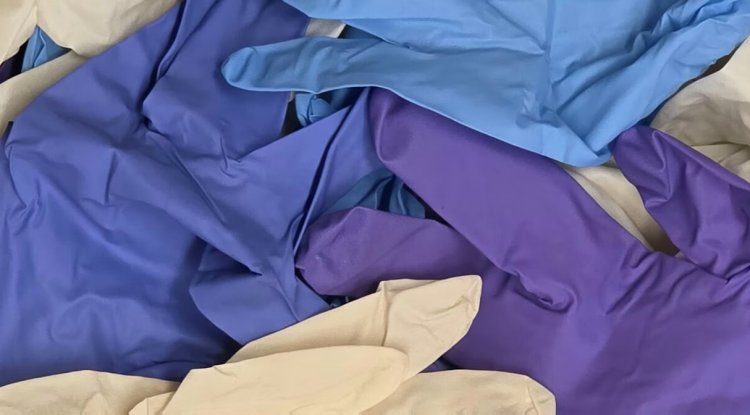
The scientists at the University of Michigan have discovered that certain measurements of microplastic pollution can possibly be much higher than the quantity of the pollutant because the particles of the laboratory gloves can also be considered microplastics.
While the scientists conducted their research on the aerial microplastic pollution in Michigan, they registered more than 1,000 times higher levels compared to those in other studies. Such an observation made the scientists start investigating the possible contamination of their samples.
Their investigation pointed to laboratory gloves. The gloves contained stearate salts, substances used during manufacturing to help gloves separate from moulds. Contact between the gloves and laboratory equipment transferred these particles onto sample surfaces.
Stearate salts are not plastics, but they closely resemble polyethylene, one of the most common plastics found in the environment. Because of this similarity, laboratory instruments can sometimes identify stearate particles as microplastics.
Many studies use vibrational spectroscopy to identify microplastics. The method measures how particles interact with light and matches the results to known chemical signatures. Since stearate salts and polyethylene have similar structures, they can produce similar readings.
This means some particles originating from gloves may be recorded as microplastics even though they are not plastic.
The researchers tested seven types of laboratory gloves to determine how often this could happen. They found that glove residue could contribute more than 7,000 particles per square millimetre that may be incorrectly identified as microplastics under commonly used testing methods.
Many of these particles measured less than five micrometres in size. Small particles are often the focus of health and environmental studies because they can move more easily through living tissues and ecosystems. If contamination affects measurements in this size range, it could influence estimates reported in scientific studies.
The researchers stressed that their findings do not challenge evidence showing that microplastics are present in water, soil, air, and food. Instead, the study examined how contamination during laboratory work can affect the accuracy of measurements.
To reduce the risk of contamination, the researchers recommend avoiding gloves during microplastic analysis when safety requirements allow. Where gloves are necessary, they suggest using products that do not contain stearate additives.
The study also points to a long-standing issue in microplastic research: different sampling and testing methods can produce different results, making comparisons between studies more difficult.
What's Your Reaction?