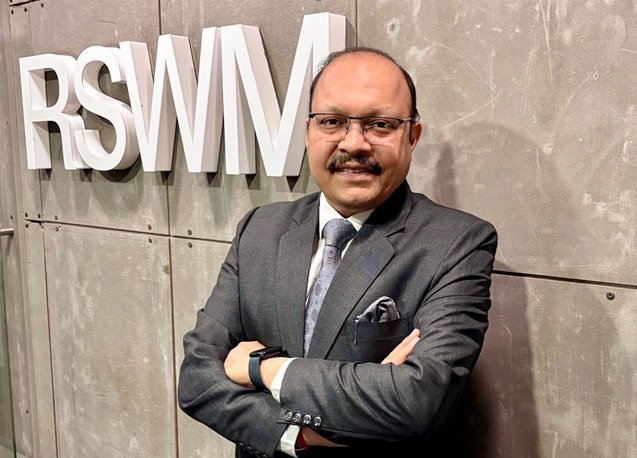
Sustainability Should Be India’s Advantage, Not A Challenge: Rajeev Gupta, JMD, RSWM

With renewable energy now covering around a quarter of its consumption and expansion plans underway, the company aims to nearly double its green energy share in the near future, says Gupta
Sustainability Should Be India’s Advantage, Not A Challenge: Rajeev Gupta, JMD, RSWM

In an exclusive interview during the launch of its Sustainability Report, Rajeev Gupta, Joint Managing Director of RSWM Group, spoke about how the company is shaping sustainability in India’s textile industry. The 2024-25 Sustainability Report shows RSWM making significant progress in green energy, recycling, and social initiatives, even as global trade faces uncertainty from tariffs and fluctuating demand. With renewable energy now covering around a quarter of its consumption and expansion plans underway, the company aims to nearly double its green energy share in the near future.

Excerpts: 

In the Sustainability Report 2024-25, the company showed that the RSWM Group is scaling up its green energy and consumed 101.76 million KW from solar and wind. Do you have any plans to increase this capacity further?
Currently, renewable energy provides around 30.8% of our overall energy. We have two expansions in the pipeline, a 10 MW behind-the-meter solar venture and a 25 MW partnership with a leading renewable supplier. By the end of this financial year (or early next year), we expect 45% of our energy consumption to be green.

How much sustainability is important for your business today?
Extremely important. Europe is very conscious of sustainability. They have their own compliance standards for sustainability. In fact, every country follows a different standard, and it sometimes becomes a challenge—every country has a different certification, a different requirement. But we fulfil all the compliances for every country. When it comes to brands, they expect us to have certain certifications, and without those, they discard the project. So, you need to have clear rules for European buyers on sustainability. I think it’s even more important now that the Indian textile industry goes strongly for sustainability so that we create our advantage rather than letting sustainability become a challenge.

We believe India should treat sustainability as an advantage, not a hurdle. RSWM began this journey three years ago, well before many others, and today we are positioned to show brands that we are serious about ESG.

Could you elaborate on your recycling initiatives?
Around 6.5 million PET bottles are recycled daily, leading to 43,250 MT of PET bottles being recycled in the year FY 2024-25. About half of this is used in-house across our spinning operations. The process involves processing and cleaning bottles into flakes, melting them, and spinning them into fibre. Added to our expanding renewable energy foundation, this makes recycling at RSWM both sustainable and energy efficient.

How do you source and process organic cotton?
India is one of the largest producers of organic cotton, so we source locally. The main difference is that no pesticides are used, which makes it safer but also more challenging to spin. Organic cotton fibres are shorter and less mature, requiring slower processing and higher waste levels. Despite these difficulties, organic cotton and BCI cotton are increasingly preferred by global brands.

What about your water use and zero discharge policy?
Water use has increased with higher production, rising to about 16.53 lakh litres from 13.65 lakh litres, but our zero liquid discharge policy remains intact. Almost 99% of water is reused in processes. Even as new knitting capacity is added, we are committed to ensuring that efficiency keeps improving.

RSWM reported CSR impact on 2.44 lakh beneficiaries. What are the key programmes?
Our CSR is focused on education, food security, and water. Through the Jawahar Foundation, we support child education and run the Swabhiman Bhoj initiative, which provides meals at ₹1 across 11 kitchens in Rajasthan.

We also run drinking water projects in water-scarce areas, and support elderly care homes and liberal arts schools. Beyond the mandated 2% CSR spend, our promoters are personally involved in these initiatives, ensuring long-term social impact.

How do you compare with other textile players on sustainability?
It's difficult to directly compare, as each company reports its numbers differently. But we feel we're ahead of many peers, with our early adoption of sustainability practices, investment in renewable energy, huge recycling, and long CSR roots.

With solid advances in green energy, recycling, and social causes, RSWM is working hard to establish sustainability as a key strength for the textile trade across the world. With uncertainty driven by tariffs and international demand, the company is banking on ESG leadership to create trust among world brands and ensure its long-term growth.

What challenges are Indian textile exporters currently facing in international markets, and how is RSWM affected?
There are two big concerns. First, global demand is weak because of wars and mixed economic sentiment. Second, the tariff environment is uncertain. The US has imposed tariffs of up to 50% on Indian textiles, while Sri Lanka and Bangladesh face about 20% tariffs. Customers are now opening their order books and evaluating products based on duty costs.

This situation has created a lot of confusion among buyers, including European customers, who are becoming as demanding as US clients. Fortunately, RSWM is less impacted than others because around 60% of our revenue comes from yarn, knitted fabric, and denim, which we sell to garment makers rather than exporting finished garments directly. Still, since many of our Indian customers export to the US, the effect is felt indirectly.

What's Your Reaction?

like

dislike

love

funny

angry

sad

wow