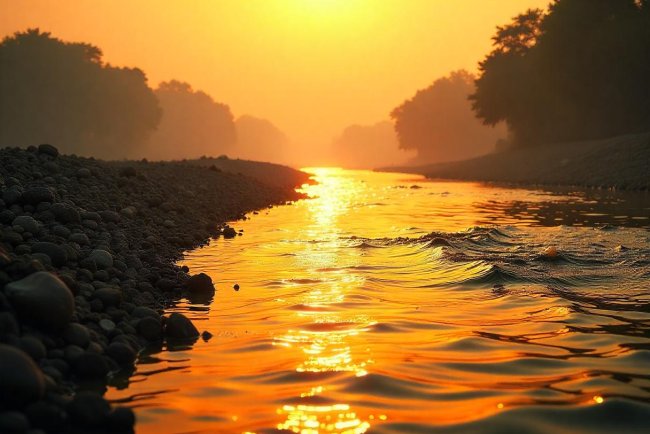
The Tamsa River on the UP–MP border holds ecological and spiritual significance. Once sacred, now under threat from pollution, its revival through scientific, cultural, and community action is crucial for India’s sustainable future.

Small rivers are disappearing quietly all over India — and along with them, ecosystems, livelihoods, and histories. Almost 60% of India's small rivers and seasonal streams are disappearing every year, choked by pollution, suffocated by encroachments, or torn apart by capricious monsoons, a composite view of national and independent hydrologists has found. Among them is Tamsa River, a seasonal rivulet that is found in the Kaimur Hills of Madhya Pradesh, flows through Uttar Pradesh, and ultimately joins the Ganga.
While humble in comparison to the majesty of Ganges or Yamuna, the Tamsa says a great deal about a pattern of ecological unconcern. It is illustrative of the manner in which India's "lesser" rivers are being overshadowed by the shadow of their more illustrious brethren — and losing out with profound effects.
Witnesses from the Riverbank
"Previously, summers before 2020 saw Tamsa trickle spasmodically. Now it nearly disappears. Our wells run dry, crops wither, and we are forced to rely on tankers," grieved an eastern Madhya Pradesh farmer.
2022 satellite imagery is the same. A hydrologist analyzing land-use patterns observed, "The encroachments are everywhere, the riverbanks are stripped bare. Unless there is timely development of check-dams and recharge pits, the groundwater level in the region will continue to decline."
The warnings are not anecdotal alone. In August 2024, a national river quality report sounded the alarm: of 328 India-wide river-monitoring stations, 141 (43%) reported high levels of poisonous heavy metals — arsenic, cadmium, chromium, lead, mercury, and nickel — many times above safe limits. Tributaries such as Tamsa are no exception. They are actually more susceptible because they have minimal control and low priority in mainstream conservation schemes.
A Small Stream, a Large Role
The Tamsa is a seasonal stream, perhaps, but one with a disproportionate role in the hydrological well-being of the area. It drains monsoon runoff from the Vindhyan and Kaimur plateaux and irrigates the farming of eastern Madhya Pradesh and southeastern Uttar Pradesh. It supports microclimates and groundwater recharging mechanisms in an environment that otherwise is semi-arid with seasonal but reliable water shortage.
A Way Forward: Restoration Not Reinvention
While the reaction to the deterioration of the Tamsa has been in many ways piecemeal, there are promising indications of fresh commitment. Selective actions along its way are:
1)Desilting river sections to revitalize natural flow
2)Building check dams strategically to manage runoff and recharge groundwater
3)Setting up rudimentary filtration units to purify village-level sewage before discharge
These are supplemented by wider, state-enforced water-saving programs. But most analysts warn, top-down, capital-driven programs are inappropriate for such rivers as the Tamsa. What they propose are rooted, localised policies attuned to the seasonal and ecological nature of the river.
The solution, they contend, does not lie in reinventing but in restoring — through:
1)Micro-watershed management, adapted to the contours and requirements of each region
2)Conservation works like contour bunding to hold rain and avoid erosion
3)Recharging of aquifers at the community level, making groundwater levels adequate to sustain base flow in dry periods
Greening the Margins: Nature-Based Solutions for the Long Term
More and more environmental planners and scientists are advocating nature-based solutions as a long-term sustainable option compared to grey infrastructure. Some of them include green buffer strips and urban biodiversity corridors along the Tamsa banks. They are able to:
1)Improve climate resilience of regions of the country increasingly exposed to heatwaves and unstable rainfalls
2)Stop soil erosion from pummeled, denuded banks
3)Provide habitat and corridors for indigenous fauna and flora, restoring biodiversity
Planned dispersal of native vegetation will recreate the river's edge, avoid land degradation, and stir the ecological memory of the Tamsa — a living archive of the regional environment.
Conclusion: The Quiet Power of Small Rivers
The Tamsa is not necessarily a brilliant mark on cartography of national waters or a hero in grand interlinking plans, but the tale represents much more widespread malaise: the institutional neglect of India's minor streams. These streams — which were the lifeblood of rural economies and nature — are slowly disappearing beneath the triple burden of city growth, policy loopholes, and environmental stress.
But the tale does not have to finish on hopelessness.
With the proper mix of scientific know-how, local engagement, and political will, a river such as the Tamsa can be restored to health. It is not a romantic illusion — it is a strategic imperative. It is a question of securing climate security, agricultural productivity, and the well-being of future generations.
It is not a matter of hanging on to the past. It is a matter of securing the future.
What's Your Reaction?