Turning Waste into Wealth: India’s Green Push in Biogas
Government and NDDB are promoting eco-friendly cattle waste management through biogas initiatives, financial support, and sustainable models across states.
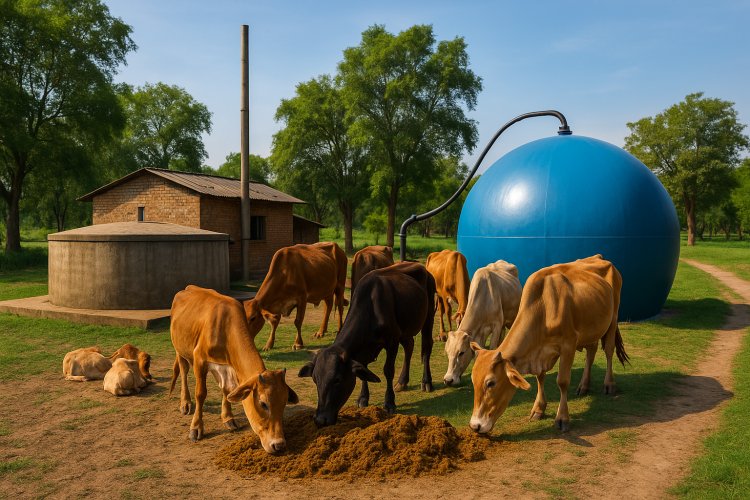
The Central Pollution Control Board (CPCB) has released revised guidelines in July 2021 to assist cow shelters (gaushalas) and dairy farms in dealing with their environmental footprint. The guidelines address several concerns such as how to deal with cattle dung safely, handle solid and liquid waste, ensure air quality, and determine where these farms must be in urban, semi-urban, and rural regions. The prime objective is to promote sustainable practices in the handling of cow dung and wastewater.
Cattle waste is being utilized in a sustainable manner through practices such as composting, generation of biogas or compressed biogas (CBG), and generation of dung cakes or dung wood as fuel. Such practices lower the pollution and make the wastage useful.
In order to enable farmers to embrace these solutions, the Government has initiated various schemes. For instance, the Animal Husbandry Infrastructure Development Fund (AHIDF) offers financial assistance in the form of interest subvention for farmers and industries to establish waste management facilities, biogas plants, and processing units for cow dung and urine.
Another significant effort is the GOBARdhan scheme, a cross-government initiative to transform organic waste such as cattle dung and agricultural waste into biogas or CBG. It consolidates various departments and initiatives under a single umbrella for promoting cleaner and more efficient utilization of waste. Equally, the SATAT program, initiated in 2018 by the Ministry of Petroleum and Natural Gas, promotes the use of CBG as a cheap and eco-friendly fuel in accordance with India's biofuel policy. The Ministry of New and Renewable Energy is also operating a biogas program under its National Bioenergy Programme to promote clean energy at the village and community level.
The National Dairy Development Board (NDDB) is also working towards encouraging green practices in the dairy sector. It collaborates with governments, dairy cooperatives, and other organizations to develop effective models for scientifically managing manure. Some of the models implemented are the Zakariyapura Model, where biogas units are established at household levels; the Varanasi Model, where a large biogas plant is used to run a dairy plant; and the Banas Model, where cow dung is converted into compressed biogas for use on a larger scale.
All these models reveal how cow dung can be converted into clean energy and organic fertilizer and bring economic as well as environmental advantages. Several states are now implementing these models with the assistance of local dairy cooperatives. To spread these efforts even further, NDDB has entered into agreements with 25 dairy cooperatives across 15 states to implement sustainable waste management jointly. NDDB has also introduced a special financing scheme that facilitates the installation of biogas and CBG plants and equipment to process slurry. The plan also offers rewards through carbon credit schemes, whereby farmers and cooperatives can be rewarded for their contribution to the environment.
What's Your Reaction?