The Great Hornbill is a keystone species in Northeast India whose decline is silently disrupting forest ecosystems and livelihoods, highlighting the urgent need for community-led conservation.
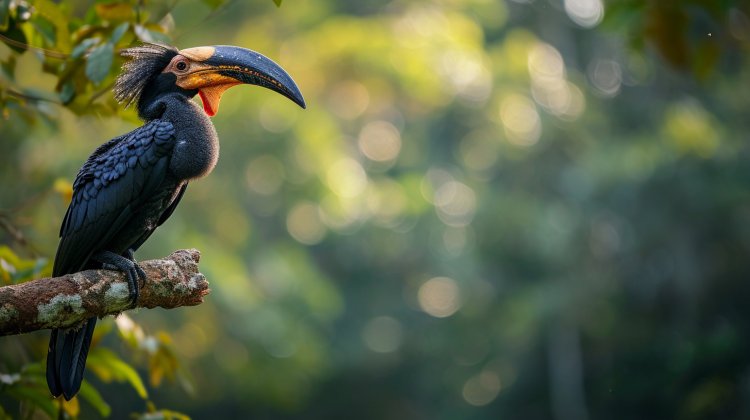
Walk through the forests of Assam and Arunachal Pradesh in the early morning and you might hear a Great Hornbill making growling deep 'gok' or 'rroh' sounds from some corner in the canopy. If lucky, you can also see one land on a fig tree to gulp the fruit and disappear into the dense forests heading for its next food venture!
The Great Hornbill (Buceros bicornis) also called as Kaao Dhanesh/Pakaitora/Homrai in different states of the North Eastern parts of India, is not just another beautiful bird but an architect of forests. In the dense mixed forests of the Eastern Himalaya, hornbills are among the most important seed dispersers alive. They swallow large fruits whole and carry the seeds in their gut across kilometers away where no wind, no primate, no smaller bird can reach. Some of those trees produce timber. Some hold together hillsides above villages. Some regulate the stream flows that farmers downstream rely on in dry months. But once the hornbills are gone, all these systems come down spiraling as they have no way to regenerate. A single hornbill can disperse seeds of over 80 plant species in a single foraging season making it a critical species for ecosystem regeneration.
Ecologists call such species “Keystone species” - the term coined in the 1960s by zoologist Robert Paine. They are often not the most numerous, not necessarily the loudest but very critical to the existence and health of an ecosystem. Their removal can lead to irreversible changes to the ecosystems and affect its health and longevity. And in the Eastern Himalayas, one such keystone species i.e. the Great Hornbill are slowly disappearing.
Ask the Adi communities who live near it and they will tell you the same thing: the hornbills have stopped coming. While this may not sound alarming to people from the outside and people would file it under the ambient noise of environmental concern suggesting one more species in decline or another forest under pressure, communities know what’s unfolding in the local ecology - for them it's an early warning system that requires immediate attention.
In Nagaland, where the Wokha and Mokokchung districts still hold some of the last viable hornbill breeding populations in the country, local hunters once tracked hornbills for their ivory-yellow casques and feathers prized for ceremonial dress and for sale. Conservation work over the past decade including community-based programs that reframed hornbill hunters as ‘hornbill guardians’ has produced measurable results. The Nagaland Hornbill Festival was initially seen as a tourism vehicle but it quietly became one of the most effective instruments of attitudinal change in tribal conservation history. Numbers have improved in pockets. But the larger picture remains troubling. Habitat fragmentation driven by expanding monoculture agriculture and road construction through frontier forest is severing the corridors these birds need to breed and forage. A hornbill pair needs a large, old tree with a suitable cavity for nesting but trees that are their habitat and often take over a century to grow are felled in an afternoon leading to their displacement.
When these birds disappear, the forest does not announce it. The change is quiet and cumulative. The large-seeded trees like figs, nutmegs, laurels begin to fail to regenerate in areas distant from their parent trees. Forest composition shifts. More light-demanding, smaller-seeded species, spread by wind or other carriers take over. The canopy starts thinning. Carbon storage starts declining. Microhabitats that other species depend on like the cavities, the shade, the specific leaf litter start deteriorating. And then the species that depended on those conditions begin to disappear too.
This is what ecologists call a trophic cascade - an ecological “domino effect” wherein the loss of one functional group from the ecosystem triggers failures in systems that seem unrelated. In the Eastern Himalayas and across the states of Assam, Arunachal Pradesh and the surrounding belt we see this logic play out not only in forest ecology but in the economics of communities that live inside and alongside these forests. Forest-dependent livelihoods like honey collection, wild vegetable harvesting, medicinal plant gathering etc. depend on forest structure. A simplified forest produces less whereas a species rich forest produces more and communities notice this first even if they rarely have the scientific vocabulary to describe what is happening.
In conservation, we often see biodiversity loss being treated as a future problem however, the hornbill framing cuts through that. These birds live for 40 to 50 years and their absence from a nesting site is not an abstraction rather it is measurable, observable and felt within a generation. When a family in a Mishmi village in Dibang Valley tells you that their grandfather's forest had hornbill calls every morning and theirs does not, it is scientific evidence in the form of longitudinal data delivered without a spreadsheet. A 2019 study in Nature Sustainability put some structure around what these communities are sensing: the removal of functionally important species like seed dispersers, apex predators, large herbivores can trigger ecosystem regime shifts faster than gradual habitat loss alone. The loss of key functional groups, such as dispersers, top predators, or large herbivores, may lead to regime shifts much quicker than habitat degradation alone. A seemingly untouched forest can be functionally degraded long before indicators of canopy cover reveal - the canopy might look healthy but the birds that made it are not.
The Eastern Himalayas are part of what biologists call a global biodiversity hotspot which is one of 36 regions on Earth where species richness and threat coincide at exceptional levels. The region holds over 10,000 plant species, roughly 700 bird species and hundreds of mammals, reptiles and amphibians, many that can’t be found anywhere else. It is also one of the fastest-changing landscapes on the subcontinent, absorbing the pressures of infrastructure expansion, climate shifts, agricultural conversion and growing human populations simultaneously. In this context, the hornbill is a particularly useful indicator because it requires large intact forest to survive. Where hornbills persist, the forest is likely still functional. Where they do not, something has already broken.
What the hornbill's story argues for is landscape-scale thinking – protecting not just individual species or individual reserves but the connected corridors, the buffer zones, the community forests and the customary land-use practices that hold the larger system together. In the Northeast Indian context, this means working with tribal governance structures i.e. the village councils, the community forest institutions, the customary law frameworks that have managed these landscapes for generations. The most durable conservation outcomes in this region have not come from exclusionary protected areas rather from arrangements where communities have a stake, a voice and a benefit. The hornbill survives in patches because some communities decided it was worth having around. That decision wasn't natural or automatic. It was made through conversation, through changed practices, through the slow and unglamorous work of building relationships between conservationists and the people who actually share land with these animals. Flagship species conservation should be grounded in exactly this logic. It is not enough to count birds; rather it is necessary to understand the full system – the trees they need, the communities that live alongside those trees, the land tenure arrangements that determine whether those trees stand or fall. Hornbills are not separable from any of this. Their fate is tied to governance, to economics, to cultural identity and to whether the people who share their forest have any reason to keep it standing.
The Adi community still hopes that someday the hornbills may yet return to it. The bird still flies above the Brahmaputra valley. The trees it plants are still there. The streams those trees protect are still running. The window is narrow, but it is still open. What happens next will depend less on new ideas than on whether existing ones like community stewardship, shared governance, lived relationships with the land are taken seriously enough to be supported. The hornbill’s absence is not yet permanent. But its return will require a choice, made again and again to keep the forest standing for reasons that go beyond the bird itself.
What's Your Reaction?