Study finds American robins reduce activity instead of fleeing as wildfire smoke affects their behaviour and health.
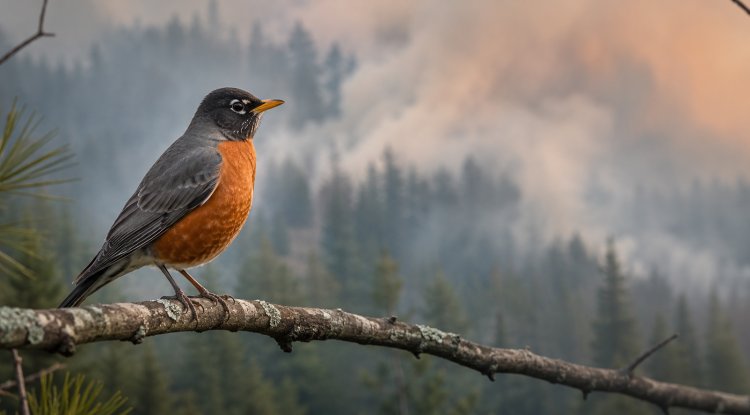
Oregon State University research indicates that wildfire smoke, wildlife behaviour, American robins, animal health and climate change are all closely tied in ways that go against earlier thinking about the impact of poor air quality on animals. The study revealed that during wildfires, American robins did not immediately vacate smoke-filled areas, but instead changed their behaviour to minimise the negative effects of smoke.
The study, published in the journal Integrative and Comparative Biology, analysed how wildfire smoke affects animal movement and behaviour. The results offer further clues about how wildlife reacts to the effects of increasingly intense and frequent wildfires in many parts of the world, where animals are increasingly exposed to long durations of toxic air.
Study Challenges Assumptions About Wildlife Responses
Jamie Cornelius, an ecophysiologist in Oregon State University’s College of Science, led the study, with researchers from the University of California, Los Angeles (UCLA) and Cornell University joining as partners. The American robin was one of the few species studied in detail to gain insight into behavioural responses to wildfire smoke.
The researchers say there is a growing awareness that wildfire smoke is a common environmental disturbance, but little is known about its effects on animal behaviour.
“Wildfire smoke is a growing phenomenon throughout the world, but hasn’t garnered much attention as a factor influencing animal behavior,” Cornelius said. Animals likely developed strategies to cope with smoke exposure, but “what the strategies are and how they might impact health outcomes remains largely unknown.”
Robins Reduced Activity Rather Than Leaving
To understand the birds’ response, scientists captured 21 adult American robins in fire-prone habitats across Oregon. The birds were fitted with data-transmitting bands, allowing researchers to track their movements during the 2023 and 2024 wildfire seasons.
The researchers initially expected the robins to adopt a “go” strategy by flying away from smoky environments. Instead, the birds generally remained in smoky areas while reducing their movement as smoke exposure increased.
“Robins in the post-breeding season, who are not associated with a nest location, did not simply depart when it got smoky,” said Cornelius. “Instead they changed their behavior to decrease activity, no doubt to minimise the effects of smoke inhalation, and turned in different directions depending on the wind direction.”
Researchers observed that as wildfire smoke moved into an area, the robins altered their travel patterns, moving shorter distances and adjusting their direction rather than leaving in search of cleaner air.
Wind Direction Influenced Bird Behaviour
The study also showed that birds were sensitive to smoke density. Robins did not significantly change their direction relative to the wind under light smoke conditions. However, as smoke became denser, they were more likely to orient themselves with the wind, a behaviour that appeared to minimise smoke exposure.
Researchers believe this behavioural shift may reduce the amount of smoke inhaled while allowing the birds to remain in familiar habitat.
“If it gets worse, it’s not impossible that the robin might leave,” Cornelius said.
She added that robins may move away from very dense smoke through longer-distance movements and suggested that smoke levels during the study may not have been severe enough to trigger a full “go” response.
Researchers Propose ‘Stay, Shift, Go’ Model
The study proposes a new framework to categorise wildlife responses to wildfire smoke. Animals may either “stay” and continue normal activities despite smoke exposure, “shift” by modifying their behaviour to reduce exposure, or “go” by relocating to areas with cleaner air.
The researchers suggest that mobility and movement abilities may influence which strategy an animal adopts. Different species may also respond differently depending on their physiology and ecological needs.
Smoke Exposure Creates Widespread Hazards
Wildfire smoke is a complex mixture of gases and fine particulate matter that can be harmful when inhaled or ingested. Animals close to fires face immediate threats from flames and extreme heat, while many others are exposed to hazardous smoke across vast distances.
Fine smoke particles can remain suspended in the atmosphere for long periods and travel hundreds or even thousands of miles, exposing wildlife far from the original fires.
Questions Remain About Animal Responses
Researchers say the findings raise broader ecological questions. Changes in prey behaviour caused by smoke exposure may influence predator behaviour, even if predators are not directly responding to smoke. Such behavioural changes could have cascading effects throughout ecosystems.
Cornelius said several important questions remain unanswered, including whether all animals can detect wildfire smoke, what smoke levels trigger behavioural changes, and whether responses vary depending on habitat, season, age, life stage or evolutionary history.
“Even though research on animal responses to wildfire smoke has accelerated as climate change alters fire regimes, there is a lot we don’t know,” she said. “But emerging evidence definitely suggests that animal health is impaired by acute exposure to smoke.”
The study was conducted by researchers from Oregon State University, UCLA and Cornell University. Additional contributors included OSU research associate Alex Jahn and graduate students Dorothy Zahor and Ken Glynn. The research received funding from the National Geographic Society, the National Science Foundation and the La Kretz Center for California Conservation Science.
What's Your Reaction?