Experts at the India-Germany Climate Talks said women must be placed at the centre of India's clean energy transition, calling for greater representation in policymaking, innovation, entrepreneurship and community-led energy solutions.
Women have been increasingly playing an important role in the renewable energy transition in India, but it is believed that they are still under-represented when it comes to leadership, finance, technology and policy making. While India continues its rapid transition to renewables, panellists at the recent India-Germany Climate Talks reiterated that it is crucial for any equitable transition that a gender perspective be taken into consideration and not only the beneficiaries.
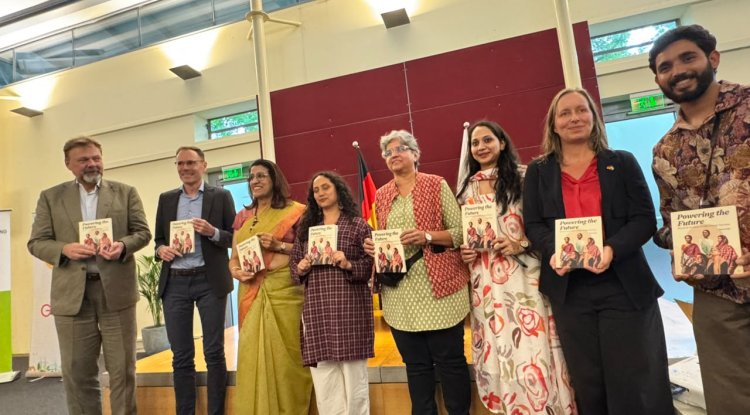
The discussion took place during the launch of the publication Powering the Future: Women at the Heart of India's Energy Transition, authored by Neha Saigal, Co-founder of Intertidal Lab and Climate & Care Initiative, Bengaluru, and published by Heinrich Böll Stiftung (hbs), New Delhi. Through stories from Odisha, Punjab, Jharkhand, Maharashtra and Tamil Nadu, the book highlights how women are driving sustainable energy solutions while arguing that gender should become a core pillar of India's climate and energy policies.
Speaking about the publication, Saigal said India is experiencing multiple energy transitions shaped by local realities rather than a single national transition. While the country has made significant progress in renewable energy, she argued that women continue to remain largely invisible in discussions around policy, finance and governance despite being central to the transition.
"We need to move beyond speaking of a single 'energy transition' and recognise that India is experiencing multiple energy transitions, each shaped by local realities and the lived experiences of its communities. A just transition is not only about moving away from fossil fuels, but about ensuring we do not recreate existing inequalities as we build a cleaner energy future."
She noted that women are often viewed as passive beneficiaries of energy programmes instead of active participants shaping India's energy future.
"Women are the architects of this transition and they are doing it very, very silently and so therefore we don't hear about it enough."
Drawing from the stories shared in the book, Saigal pointed out the way women in India are using clean energy for economic empowerment and community development as well as revealed loopholes in policies already in place. She made mention of an entrepreneur from Odisha whose poultry farm has been booming after the adoption of solar energy, but at the same time raised a question regarding the reason behind women not having access to the technology that helps them in economic empowerment.
Saigal also stressed that policy decisions should be guided by the lived experiences of women rather than assumptions made from the top down.
"Listening is a really, really important thing that policy needs to do in order for this transition to be people-centred and to take everyone along."
Dr. Priyadarshini Karve, Founder of Samuchit Enviro Tech and CEO of the Clean Energy Access Network, said the energy transition is not only about replacing fossil fuels with renewable energy but also about recognising how people use energy in their everyday lives. She argued that women make many of the household energy decisions in India, yet their experiences rarely influence energy planning.
Reflecting on how her journey in clean cooking began, Karve said she realised that household energy remains one of the least understood areas of the energy transition despite posing enormous engineering challenges.
"I realised that designing a cookstove, a practical operating cookstove for a woman's kitchen, is actually a bigger scientific challenge than designing a car engine or even a rocket engine. Because in a car engine or a rocket engine, the fuel is standardised. Whereas for a cookstove, every day the fuel is slightly different. But the heat required to do the cooking in a short time period has to be the same."
She said the solution cannot simply be to replace traditional cooking fuels with cleaner alternatives because cooking technologies serve multiple purposes in rural households.
"A solution for the cooking energy problem cannot just focus on better efficiency and reduction in smoke emission. It has to actually be a device which allows the person in charge of cooking to cook what she wants to cook and feed her family."
Karve further explained that traditional cookstoves provide far more than cooking.
"Although we call this device a cookstove, it is not doing only cooking. It is also the water heater. It is the space heater. It is for processing food."
Advocating decentralised renewable energy, she said policymakers should rethink how success is measured.
"The outcome has to be that everybody has access to clean energy at an affordable price. As long as that outcome is scale, it does not matter whether it is one million small enterprises that are operating, or it is one megawatt system."
Karve said decentralised energy systems also create an opportunity to bring more women into the clean energy workforce.
"This is a great opportunity for women to step up and take up these new roles."
She added that formal training programmes often fail to attract women because of household responsibilities, whereas community-based, hands-on training has proven more effective in helping women acquire skills and build businesses around clean energy technologies.
Dr. Amrita Rana, Radiologist, Director of Rana Diagnostics and Founding Member of Clean Air Punjab, highlighted how women-led initiatives can accelerate both clean mobility and climate action when backed by supportive policies and institutions.
Sharing the experience of launching a women-led electric mobility initiative in Punjab, Rana said the biggest obstacle was not the technology itself but convincing people that women were ready to lead.
"The biggest challenge was not EV, but the biggest challenge was building trust."
She said her organisation conducted door-to-door campaigns to identify women interested in driving electric vehicles, helped them access subsidies, formed self-help groups, arranged driving lessons, assisted with licensing and provided continuous support throughout the process.
The initiative, she said, demonstrated that when the right support systems exist, women are willing to enter sectors traditionally dominated by men.
Rana argued that women should play a greater role in shaping climate and energy policies because they are among those most affected by climate change.
"Women have to be at the centre of the table while making decisions, because they are the ones who suffer the climate change most."
She also called for a shift from creating opportunities to building systems that enable women to succeed.
"Women are not waiting for opportunities, they are waiting for systems that will lead them."
During the discussion, care work and community leadership were also highlighted as some elements that current economic and energy models ignore, although they are crucial for the society. According to Saigal, care work and community leadership need to be integrated into the new green economy paradigm, whereas Karve believed that decentralized renewable energy presents an option to come up with local solutions rather than central ones.
Throughout the discussion, speakers agreed that India’s clean energy transition cannot be individually judged in terms of how many gigawatts were deployed and how much carbon emissions were reduced, but also how equally the gains from the process are distributed. The participants suggested that it would be imperative to have increased engagement of women in leadership, entrepreneurial, financing, research, and policymaking roles.
As India moves towards its clean energy goals, the panellists concluded that a truly just transition will depend not only on technological innovation but also on recognising women's knowledge, lived experiences and leadership as central to building a sustainable energy future.
What's Your Reaction?