Africa's Great Green Wall is restoring degraded land across the Sahel through sustainable land management, helping combat climate change, improve food security and create millions of jobs.
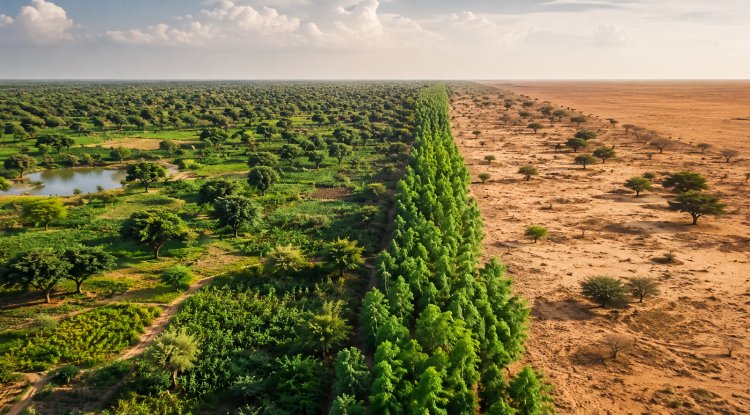
Spanning the width of the entire continent of Africa, the Great Green Wall is fast proving itself to be one of the biggest environmental restoration initiatives ever attempted by humans. As an attempt to stop the advance of desertification and improve people’s lives in the process, the programme stretches a whopping 7,968 km from Senegal to Djibouti.
From being just a row of trees, the programme has evolved into a plan to restore the environment through sustainable agricultural practices and proper water use as well as through planting trees.
Restoring millions of hectares of degraded land
The introduction of The Great Green Wall project was initiated by the African Union in 2007 due to the growing threat of desert encroachment, low productivity, and persistent droughts in the Sahel region. Long-term goals of this project include the rehabilitation of about 100 million hectares of degraded lands by 2030, creation of ten million employment opportunities, and absorption of about 250 million tons of carbon.
As per estimates from the project itself, millions of hectares have been already restored within the participating nations, and locals have noted improved soil quality, vegetation and increased productivity.
The Sahel, which is a semi-arid area situated south of the Sahara Desert, has been found to be among the most susceptible areas that are facing impacts of climate change. Warming and unpredictable rainfall and drought have exacerbated the land degradation problem.
Due to the reduced fertile lands, there is little agricultural productivity and food shortage, making people uncertain about their economic status. As per environmentalists, the need for ecosystem restoration is not only to conserve biological diversity but also to make future climate resilience possible.
The project, although described as “the wall of trees spanning 8,000 km,” entails more than just planting trees. The act of restoration includes not only the restoration of natural vegetation but also the restoration of degraded agricultural lands, water conservation, and sustainable agriculture adapted to the area.
In addition, the community is encouraged to plant drought-resistant crops, manage soil effectively, and create new sources of income.
International support boosts the project
The Great Green Wall project has received support in terms of finance and technology from various international organizations such as the UN, the World Bank, the African Development Bank, and the European Union.
In 2021, international partners promised more than $19 billion for the accelerated development of the Great Green Wall project because of its ability to solve problems related to climate change, biodiversity loss, and rural poverty.
How the project benefits communities
Experts believe that the project could bring about economic and social gains through the improvements in food production, provision of water, and creation of jobs in rural Africa. The restoration of the landscapes will also assist in reducing forced migration that results from environmental degradation and boosting the local economies.
A global model for nature-based climate action
With countries around the world looking for ways to solve their climate change problems on a larger scale, the Great Green Wall has emerged as a prime example of an initiative for the large-scale restoration of ecosystems. Despite facing problems of insufficient funds, political instability and diverse progress among different countries, the project keeps growing through collaborations with international organizations and government initiatives.
With the success of its 2030 targets, the Great Green Wall might emerge as one of the biggest environmental restoration projects in the world.
What's Your Reaction?