Union Environment Minister Bhupender Yadav said India's transition to electric mobility should be supported by green growth, resilient infrastructure, stronger manufacturing, charging infrastructure and circular economy practices while addressing an ASSOCHAM conference in New Delhi.
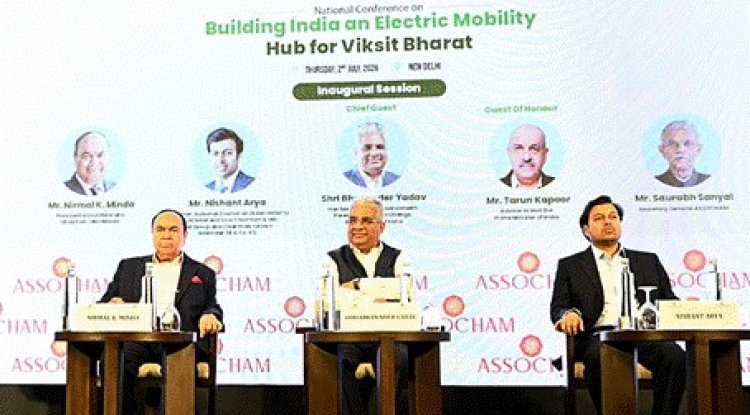
Union Environment Minister Bhupender Yadav on Wednesday said India's transition to electric mobility should be guided by green growth, resilient infrastructure, transparent governance and circular economy principles to ensure environmental sustainability.
Speaking at the Associated Chambers of Commerce and Industry of India (ASSOCHAM) National Conference on 'Electric Mobility: Building India an Electric Mobility Hub for Viksit Bharat' in New Delhi, Yadav said the shift to electric vehicles is linked to industrial development, manufacturing and employment, in addition to reducing emissions.
The conference gathered policymakers, automakers, technology companies and industrialists for discussions on steps required for the growth of electric vehicles in the country. The main topics of discussion included policy consistency, charging infrastructure, localization of production, battery supply chain, funding and technological innovation.
According to Yadav, there should be investments in manufacturing facilities along with the Indian government's efforts towards electric mobility. He stated that the aspect of environmental sustainability needs to be kept in mind.
The Minister highlighted that there are steps taken by the government to simplify the process of obtaining environmental clearances. He informed that approvals have been digitized via the PARIVESH platform, rationalization of compliance conditions, and efforts have been made to facilitate business operations along with maintaining environmental standards.
He also stated that the need is to move away from a linear process of production towards the concept of a circular economy with an emphasis on reuse and recycling. As per Yadav, the growth of electric mobility should be supported by adequate charging facilities, domestic manufacture of EVs, critical mineral security, battery recycling, and resource efficiency.
Collaboration between various industries, policymakers, and institutions will play an important role in scaling up the electric mobility industry and strengthening manufacturing capacity in India. He maintained that maintaining the balance between economic development and environmental conservation will continue to remain an important objective for India in its journey towards electric vehicles.
The event also saw deliberations on enhancing the manufacturing of electric vehicles in India and the supply chain to support growth going forward. The participants came up with the conclusion that stable policies, investments in the charging network, localization, battery supply chains, financing, and technology advancements were key in promoting electric vehicles.
What's Your Reaction?