Cardiff Scientists Reveal Wet Wipe Pollution Levels in UK Rivers
Cardiff University scientists have developed a model estimating that 100kg of wet wipes enter the Taff River annually, contributing billions of microfibres to UK water systems. The study identifies key pollution pathways and calls for targeted action to reduce environmental impacts.
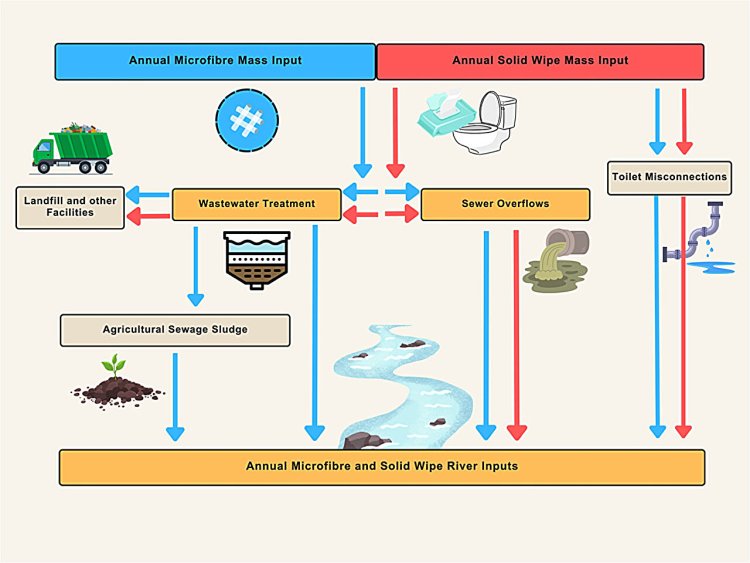
Researchers at Cardiff University created the first combined mathematical model to determine the amount of wet wipe pollution flowing into UK river systems. The research in the Water Research journal is carried out on the lower Taff River in Wales and demonstrates that approximately 100 kilograms of solid wet wipes are pumped into the river section each year. The study seeks to measure the quantity of plastic, natural, and regenerated fibres into river systems as a consequence of inappropriately dumped wet wipes.
Using wet wipe disposal data combined with emissions-based modelling, scientists estimated the contribution of wet wipe microfibres into freshwater systems. Their research indicates that the lower Taff catchment alone is receiving around 11,912 grams of natural fibres (6.5 billion fibres), 1,531 grams of regenerated fibres (42.6 million fibres), and 2,670 grams of plastic fibres (7.8 million fibres) annually. From their results, it indicates that wet wipes are a key source of pollution despite being treated through wastewater treatment works.
Cardiff University's model takes into account both laboratory-test data of wastewater networks and microplastic discharges. The model isolates and follows nine major avenues by which rivers are entered by wet wipes, solid and microfibre. These include sewer overflows, toilet misconnections, as well as soil runoff, among others. Misconnections of kitchen or toilet plumbing, particularly in specific regard, accounted for up to 16% of all river emissions of solid wet wipes.
Though the vast majority of flushed wet wipes—virtually 99%—are transferred to treatment works and subsequently on to landfill or other disposal facilities, large quantities find their way into river catchments. Of these discharges, the model indicates that plastic wet wipes are most common. Each individual in the UK contributes up to a maximum of 33 plastic and four cellulosic (biodegradable) wet wipes to the waste stream per annum across the country. This translates into release of about 268,520 natural fibers, 1,668 regenerated fibers, and 323 plastic fibers into water bodies every year per capita.
If scaled up to the Taff River size, the model calculates some 7,054 kg of plastic wipes and 784 kg of cellulosic wipes get washed away annually. That is equivalent to some 1.5 million plastic and 165,000 cellulosic wet wipes. The scientists point out such levels of pollution can be harmful to aquatic organisms and water quality.
The study attempts to bridge the knowledge gap about transportation and the destiny of wet wipes in urban sewerage systems. With the development of a predictive model, it is hoped that the decision-makers and environmental authorities will have answers at their disposal to implement accordingly. Despite public awareness campaigns citing concerns about flushing wet wipes, the act of improper disposal is still common. The findings report that not flushing is not enough and that comprehensive understanding of emission routes is necessary in order to plan more effective management.
Comparison to emissions of wet wipes with clothes-washed microfibres is also informative. While fibre emissions from clothing during washing clothes have long been an accepted source of microplastic contamination, this research indicates that wet wipes are equally important as a source, especially for urban catchments.
These researchers created a multidisciplinary research group of scientists from the School of Biosciences, the School of Chemistry, and the School of Engineering of Cardiff University. Through their collaboration, it has become possible to develop a stronger model considering real conditions such as different wastewater infrastructure and population behaviors.
The research confirms that wet wipes remain a significant environmental problem, with long-lasting effects on river quality. It demands the creation of specific policies and equipment to lower emissions, like enhanced waste infrastructure, greater public awareness, and even potentially product reformulations to avoid shedding microfibre.
Source:
Courtesy Cardiff University
Study: Estimating Flushed Wet Wipe Emissions into Rivers by Thomas Allison et al., published in Water Research (2024). DOI: 10.1016/j.watres.2024.122733
Edited by Gaby Clark | Reviewed by Robert Egan
© 2025 Science X Network
What's Your Reaction?