Delhi has launched a ₹15,000-crore EV policy to reduce pollution through subsidies, stricter regulations and a massive expansion of charging infrastructure.
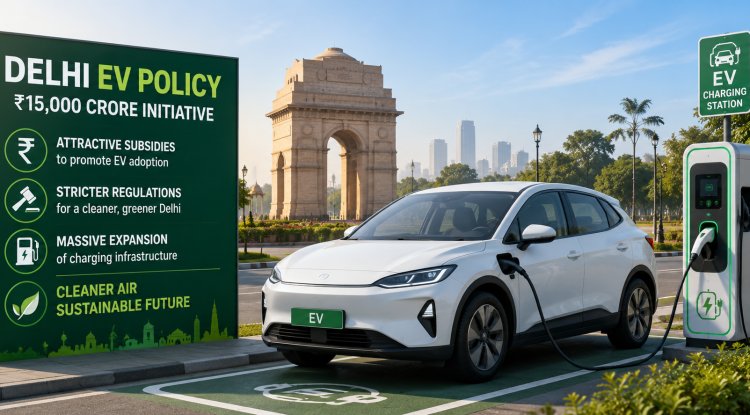
For years, Delhi has battled hazardous air pollution, with vehicle emissions remaining one of its biggest challenges. Now, the capital is making its strongest push yet towards cleaner transport. The Delhi government has unveiled a new Electric Vehicle (EV) Policy backed by a proposed ₹15,000-crore investment, aiming to transform the city's transport system and make electric mobility the new normal by 2030.
This policy focuses on those vehicles which are responsible for a significant portion of the pollution in Delhi. According to government estimates, about one-third of the emissions from vehicles come from commercial vehicles that are used to carry goods, and almost 46% come from motorcycles and auto-rickshaws. Thus, this policy addresses not private but rather more emission-intensive vehicle categories.
The government is offering financial incentives to accelerate the adoption process for different categories of vehicles. Up to ₹30,000 worth of incentives can be claimed for the purchase of an electric two-wheeler within the first year, after which it will decrease in the coming years. Electric three-wheelers may qualify for up to ₹50,000 subsidy, and N1 commercial electric trucks may claim up to ₹1 lakh incentives.
The policy also rewards owners replacing older, more polluting vehicles. Those scrapping BS-IV or older vehicles can receive additional incentives ranging from ₹10,000 for two-wheelers to ₹50,000 for commercial trucks, encouraging the retirement of ageing vehicles from Delhi's roads.
However, the new policy is not only about incentives but also on stricter rules. From January 1, 2027, only electric three wheelers and N1 category of vehicles can be registered in Delhi. In addition, from April 1, 2028, even two-wheelers can be registered provided that they are of the electric variety. Even school bus services have been included in the ambit of this policy, with a target of making 10 percent of them electric within two years’ time.
One of the biggest barriers to EV adoption remains charging infrastructure. To address this, the Delhi government plans to install 32,000 public charging stations over the next four years with financial support from both the state government and the Centre's PM e-Drive initiative. A dedicated online portal will also be introduced to simplify subsidy claims and improve transparency for buyers.
Interestingly, this policy gives almost no scope to hybrids. Unlike several other states which still offer incentives to hybrid cars, Delhi has decided to concentrate only on BEVs to push for a swift shift towards emissions-free transportation.
According to industry experts, the policy could dramatically alter Delhi's mobility ecosystem, provided that it is successfully carried out. Even though environmentalists have received the new policy with open arms, concerns from transportation operators include the timing of the shift to electric vehicles as well as costs to small commercial vehicle owners.
As India tries to fulfil its broader climate and clean mobility objectives, the new EV policy in Delhi might be considered an important pilot project in urban areas. If it succeeds, it might become a model for other Indian cities as well.
What's Your Reaction?