A joint FAO-WMO report warns that rising temperatures are reducing crop yields, increasing agricultural losses and threatening food security, with India among the countries most vulnerable to extreme heat.
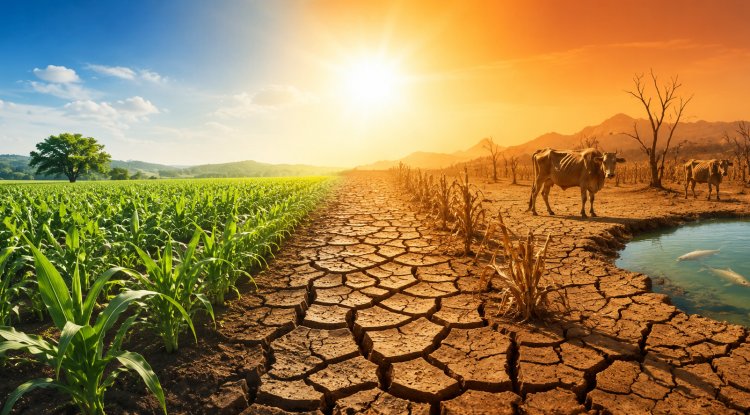
Extreme heat is rapidly becoming one of the biggest threats to global food production, putting crops, livestock, fisheries, and the livelihoods of billions of people at risk, according to a joint report by the Food and Agriculture Organization (FAO) and the World Meteorological Organization (WMO) released in April 2026.
Temperatures above 30°C are already impacting the yields of major crops, the report says. For every 1°C of warming, maize, wheat and soybean yields decline by 7.5 per cent, 6 per cent and 6.8 per cent, respectively. In the future, potential declines in maize and wheat yields could be as high as 10 per cent per degree of warming.
The warming trend is referred to as a “risk multiplier” for agriculture, and it intensifies droughts, raises the risk of wildfires, and creates broader impacts. Heat can nearly triple agricultural losses when it occurs at the same time as other hazards, like drought. This is especially important for India, as of July 1, 2026, 41.2 per cent of the country's area was experiencing drought or near-drought conditions.
India is one of the countries at risk. The average loss of working due to heat stress for Indian agricultural labourers in 2024 is 648 hours, which is equal to 54 days of work. In the event of higher levels of emissions, the wet bulb temperature (WBT) is likely to exceed the safety threshold for outdoor activities in some parts of the Ganga and Indus River basins.
Vulnerability is also growing in livestock. In the cattle meat and milk sector, annual losses are estimated to be nearly $40 billion in the high-emissions scenario and are reduced by nearly one-third in the low-emissions scenario.
The effects of heat stress have cost the world around seven years of agricultural productivity since 1961. Since 1992, an estimated 21.8 billion tonnes of carbon dioxide equivalent (CO₂e) emissions have been generated from the expansion of cropland across 110 countries to offset production losses caused by heat.
The report suggests immediate investment in climate-smart crop varieties, early warning systems, new planting schedules and more efficient water management – but warns that without strong emissions reductions, adaptation measures will not be enough.
What's Your Reaction?