Sameer Varma, Executive Director at ColdStar Logistics, the bigger problem starts after harvest. In an interview with ResponsibleUs, he discusses how India's cold chain isn't just a logistics challenge
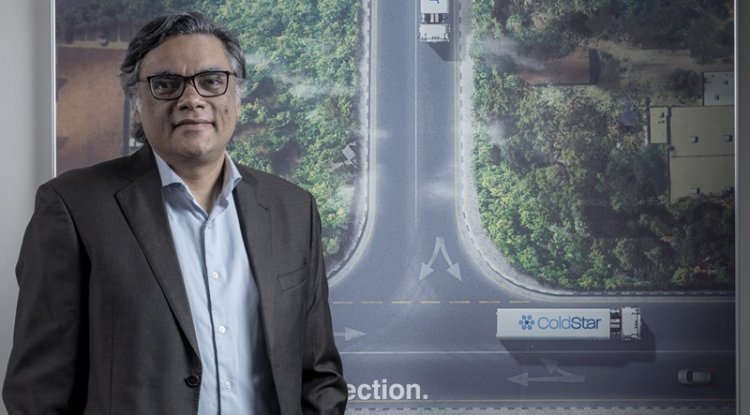
India grows enough fruit and vegetables to feed millions, yet a significant share never makes it to the market. The conversation around food security usually begins with production, but for Sameer Varma, Executive Director at ColdStar Logistics, the bigger problem starts after harvest. In an interview with ResponsibleUs, he discusses how India's cold chain isn't just a logistics challenge. It's a question of water, climate, farmer incomes and how the country values what it grows.
Interview Excerpts:
India loses somewhere between 30 and 40 per cent of its perishable produce before it even reaches the consumer. You've spent years inside this system. What actually causes that loss — is it the absence of infrastructure, or is it that the infrastructure we have isn't being used right?
Honestly, it's both. However, if I had to choose between them, I would choose underutilisation as the bigger issue at present.
We have cold storage space that remains unused in some pockets, and produce is rotting thirty kilometres away. The inequality is very noticeable. A large proportion of the installed capacity is commodity-specific, specifically potato, and is not useful for the huge diversity of horticulture production that India actually has. Thus, you get a statistical capacity that has nothing to do with functional availability.
However, the lack of infrastructure is also a reality, especially at the origin. In the majority of the Indian farming areas, there are negligible cooling facilities at the farm gate. The first few hours after harvest are most crucial in determining shelf life, and these hours are virtually unmanaged. What we have is a system that was built for storage and transport and not really built for harvest.
Fixing utilisation is a planning and commercial problem. Capital, land, power and political will at the gram panchayat level are needed for fixing origin infrastructure. That is the longer and tougher road.
Cold chain is often talked about as a post-harvest problem. But farmers in most parts of India have no access to any cooling facility within a reasonable distance of their fields. Where does the real break in the chain happen — at the farm gate, on the road, or somewhere further down?
The chain ends at the farm gate. All that follows is consequence. If a farmer has produced crops at the hottest part of the day in a temperature of 40 degrees and he has no choice but to put them on an unrefrigerated truck within an hour, the biological clock is already ticking. The chain of events begins with temperature abuse in those first hours, which leads to increased respiration, microbial activity, and moisture loss, and can't be undone by cold storage downstream. While you can help to slow the deterioration, you cannot reverse it. The stretch of road adds to this.
Horticulture logistics in India are still largely dependent on unrefrigerated trucks, many of which operate overnight to beat the traffic at check posts and the produce is stacked under tarpaulins. The main reason for the lack of reefer penetration on secondary and tertiary routes is not a technology issue; it is an economics issue. For a small farmer or aggregator, who may be on a razor-thin profit margin, the freight rate difference between reefer and non-refrigerated trucks can be three to four times. So, the break is at the farm gate, but the road continues to break it down further.
When you drive through rural India, you still see tomatoes and onions piled on open trucks in the summer heat. What would it take — practically, not theoretically — to change that picture in the next ten years?
Three things in order. First, aggregation. The basic issue of small and marginal farming is that no one farmer produces enough to make it worth the investment in a reefer truck or a pre-cooling facility. Farmer-producer organisations, cooperatives or organised aggregators are required who can bring enough volumes to ensure the economic viability of temperature-controlled logistics. If there is no aggregation, the unit economics do not work.
Second, public pre-cooling infrastructure at the mandis and APMC yards, not cold storage, just pre-cooling. The government has a role here that the private sector alone cannot play, as the returns are diffuse and long-cycle. If you could ensure a farm-gate cooling touch point within 15-20 kilometres of each of the main production clusters, then you would alter the logistics calculus overnight.
Third, and this is the slow one. Freight rate reform. Refrigerated and unrefrigerated transport cost differential should be reduced by means of better utilisation, backhauling and technology. In India, the reefer trucks are currently returning empty about 50% of the time. Once you solve the backhaul problem, the economics begin to work because you're bringing the rate differential down.
People think of food wastage as a supply chain problem. But a kilo of wasted tomatoes also represents the water, the soil, the labour, and the energy that went into growing it. Do you think the industry has started to seriously reckon with that embedded cost, or is it still largely invisible in how we price and plan logistics?
Still largely invisible. The logistics industry (including cold chain) charges on a cost per km or cost per pallet basis. The embedded resource cost of the product being carried is not included in that calculation. A reefer truck carrying pharmaceutical products and a reefer truck carrying mangoes are priced the same way, but the cost of the loss of a kilogram of mangoes (the water, the soil microbiome, the farmer's labour, the agrochemical inputs, etc.) is not calculated.
Sustainability requirements are starting to be requested from logistics partners by big food companies that have sustainability requirements. However, this discussion is still taking place at the CSR and reporting level, not yet at pricing, procurement or planning levels in any significant way. There will be a reckoning, but not so much because of conscience as regulation. When the extended producer responsibility system begins to take effect for food loss, the embedded cost will become very visible, very soon.
Cold chain infrastructure itself consumes significant energy — refrigerated warehouses, reefer trucks, controlled atmosphere storage. How do you balance the environmental cost of running the cold chain against the environmental cost of not running it?
The math for the net environmental impact is far from even. The carbon footprint of a well-maintained cold chain is much less than the carbon footprint of the production, loss and then reproduction of the food it preserves. If you think that about one-third of all food produced around the world is lost or wasted, and about a quarter of the world's GHG emissions are related to food production, the cold chain becomes less of an environmental burden and more of an environmental necessity.
But the way the cold chain is operated is a big deal, however. Indian cold chain industry continues to rely on diesel reefer units and grid power from coal-based sources. We are actively researching natural refrigerants with much lower GWP than traditional HFCs and solar at ColdStar. The shift is taking place, but it must speed up. The issue is not if we need a cold chain, but how do we decarbonise the cold chain we are creating.
India's agricultural sector is one of the largest consumers of freshwater in the world. If better cold chain infrastructure could prevent even 20 per cent of current produce loss, what does that mean in real terms for water conservation? Has anyone actually tried to put that number on the table?
Very few people have, and it is one of the least explored aspects of the cold chain debate. When you do the math, the numbers are truly astounding. By conservative estimates, India is losing between 90 and 100 million tonnes of food every year. The amount of water in a kilogram of produce can also vary significantly from crop to crop.
For example, a kilogram of tomatoes needs about 180 litres of water, while a kilogram of mangoes needs ten times as much. When you multiply those numbers by the volume of loss per year, you're talking about billions of cubic metres of water being drawn, used and then lost with the produce.
If produce loss could be reduced by 20 per cent, it would save the water equivalent of several large water projects, on a rough estimate. That framing has not made its way into the policy discussion in any serious manner. The issue of water security is spoken about in a different silo, and food security in another, while cold chain is completely in another. There's a need in the industry to connect the three conversations, a need for the government's nodal ministries to commission the same, and a need to put a credible number on the table. The data exists. The synthesis does not.
The government has pushed schemes like the Pradhan Mantri Kisan Sampada Yojana to build cold storage capacity. In your experience, has that investment reached where it's actually needed, or has it been concentrated in areas that were already relatively well-served?
The truth is that it's been spotty. I don't want to downplay that; schemes such as PMKSY have injected capital into the sector and have created real capacity that wouldn't otherwise be available.
However, the geographic focus of that investment has often been along existing infrastructure, existing power supply, and existing commercial activity. States such as UP, Punjab and Maharashtra have been the biggest beneficiaries, whereas the north-eastern states, tribal horticulture belts and coastal fishing communities, where the cold chain is most lacking, have not been adequately served.
This is due to a structural cause. Project developers need to provide equity and debt in subsidy-linked schemes. Developers follow the risk-return equation, and that's where the infrastructure is. You get incremental capacity in the right areas, not foundation capacity in the wrong areas. To correct this, not only is it necessary to increase subsidies, but also to use other instruments such as viability gap funding, government-guaranteed offtake or direct public investment in origin infrastructure. If there is a de-risking of the first-mover risk, the private sector will follow. Otherwise, the capital will focus on where it has been focused.
Small and marginal farmers — who make up the majority of India's agricultural workforce — generally can't afford to use even the cold storage that exists. How do you make the cold chain economically accessible, not just physically present?
This is actually moved by two levers: proximity and aggregation. The farmer is unable to access a cold store within two hours of harvest, whether by distance or by the cost of transport, then it is effectively not accessible, whatever the tariff. Physical presence is a required but not sufficient condition. Collective access is the model that has proven to work, where it has been tested. The unit economics are transformed when farmer-producer organisations negotiate aggregated storage contracts on behalf of their members.
A smallholder will be trying to fill up a cold store; instead, you have an FPO providing a consolidated volume that can negotiate a rate. The cold store is utilised, and the farmer is able to access it at a viable cost. Cooperative and FPO strengthening is thus not a rural welfare programme; it is cold chain infrastructure policy by another name.
In addition, there are innovations in financing that require scaling. There are collateral instruments in the regulatory frameworks that allow the farmer to store produce and borrow against it, instead of selling at post-harvest price troughs, but they are not widely used. By doing so, we address the access issue and also the distress sale issue that is a direct cause of farmers' low income during the harvest season.
There's been a lot of talk about integrating cold chains with the larger logistics grid — railways, highways, last-mile delivery. Where is that integration genuinely happening, and where is it still mostly on paper?
The most interesting story at the moment is rail. The most significant integration effort that we have seen in recent years is Indian Railways' drive towards refrigerated freight, the Kisan Rail and the perishables express corridors. It’s not perfect. Turnaround times are longer than trucking, the last mile from door-to-door is not addressed and the reefer wagon fleet is still limited in size compared to demand. But the direction of travel is true and the investment of money is real. The economics are strong where it is effective. Bulk horticulture from production clusters to consumption centres on established routes. Highway integration is occurring commercially, and is being driven by the private sector. PM Gati Shakti and the multimodal logistics parks programme have laid a framework and we are witnessing the co-location of cold storage and reefer staging areas with logistics parks along major corridors. That's true infrastructure integration.
In the top 8-10 cities, the cold chain for e-commerce and quick commerce is a reality. It also breaks down quickly, beyond that. The 'cold chain to consumer's door' narrative, which is successful in Singapore or Germany, is not yet successful in Tier 2 and Tier 3 India. It's the frontier, and it's not just about vehicles; it's about distributed micro-fulfilment with temperature control, which is a density of demand that most secondary cities are not yet ready to handle.
IoT sensors, real-time temperature monitoring, data-led route optimisation — these sound like the future of cold chain. But a lot of India's cold chain still runs on human judgment and older infrastructure. How wide is the technology gap between the top end of the industry and the rest of it?
The chasm is large and growing. The organised cold chain operators, who cater to the pharmaceutical companies, big food processors and export customers, are running at an international standard in the top 25 per cent of the Indian cold chain operators. Real-time temperature logging, automated excursion alerts, route optimisation with traffic and temperature models, blockchain enabled traceability – these are live deployments, not pilots.
Most of the sector is still using manual temperature logs, driver judgment and periodic spot checks. The driver of a reefer truck is making decisions on thermostat settings based on experience and intuition, not data, between a mandis and a wholesale market in a secondary city. This is not bad in itself. It is the skill of good operators that builds good intuition but it is not scalable. It is not auditable and thus it is not sufficient for food safety compliance as the regulations become more stringent. The technology is cost-effective. Today, a GSM-enabled temperature data logger is very cheap. The barrier isn't the cost of the hardware; it's the lack of a requirement. Any government scheme will be less effective in closing this gap than will large customers who require temperature data as a condition of business. It is already the case in the pharma sector. It is now starting to emerge from organised food retail. The change will be quick when it comes from the mandi system and the cooperative sector.
Controlled atmosphere storage has been transformative in markets like Europe and parts of Southeast Asia, extending the shelf life of produce without heavy chemical intervention. What's stopping wider adoption in India — is it cost, awareness, or something more structural?
All three in a specific order. The capital cost of a controlled atmosphere facility is significantly higher than the capital cost of a conventional cold storage facility, and the tariff premium that must be recovered by the facility is hard to sell in a market where farmers are price sensitive and other facilities, albeit less effective, are cheaper. However, there is a level of awareness beneath cost. For many of the farmers and traders whose produce would benefit most from cold storage, this type of storage has never been encountered, nor do they have a frame of reference for the shelf-life extension it provides, and therefore cannot value it appropriately. The biggest structural issue is market linkage. Cold storage is most useful when there is a chain of custody that can provide commercial benefits by having a longer shelf life, such as moving produce to a distant market or retaining it for a price window. Historically, the mandi system and its spot-price logic in India have not been able to incentivise the planned, supply-managed distribution that is essential to cold chain economics. Contracts, forward pricing, and organised buyers who will pay for the quality difference are required. In those places where the modern retail and export avenues have provided such conditions, cold chain has grown. For example, Apples in Himachal, grapes in Nashik. The problem is that such conditions are applicable to a small proportion of India's horticulture production.
You work with some of the largest food companies in India. When they come to you with sustainability targets — reduced emissions, lower wastage ratios — what does the conversation actually look like? Is it driven by genuine commitment or is it still largely a compliance exercise?
It is very much reliant on the people across the table. We have some substantive and operationally engaged discussions with large food companies, especially those with international shareholding or export exposure.
They pose specific questions like what is the energy intensity per pallet per kilometre in our shared network? Are there any ways to redesign the routing to minimise cold breaks? When will our refrigerant transition be? Those conversations have internal champions who have budget authority, and they result in real change in how we work together. But a significant amount of the conversation happens because of ESG reporting obligations, not because of any real action plan.
The sustainability team is posing questions to the procurement team to which they have not been briefed. The targets are real “net zero by a set year, zero food waste to landfill” but the operating model that would achieve those targets has not been redesigned. The logistics contract is still in negotiation, and it's just on a rate basis.
The two groups are beginning to merge, albeit slowly, which is something I like. The sustainability report and logistics contract are harder to sustain as the reporting of Scope 3 emissions gets tougher and more public. That will be forced over the next three to four years. And, quite frankly, our role is to be ready when it happens and to have the data, the green infrastructure and the service models that enable our customers to credibly close that gap.
Climate change is already disrupting harvest cycles and making temperature management harder. Extreme heat events are becoming more frequent. How is the cold chain industry preparing for a future where the baseline conditions it was designed for may no longer hold?
The truth is, preparation is inconsistent and generally inadequate. Our infrastructure, the warehouses, the insulation, the refrigeration specification, everything we've built is based on historical temperature curves that we are now surpassing. If the ambient is 20 degrees Celsius, a reefer unit is designed to operate at 2 to 8 degrees. When the ambient is 44 degrees, it's a completely different operating load, as is now the case in parts of north India this summer.
The equipment is more stressed, more energy is being used, and more often it is failing. These are not predictions, but what we are already experiencing in our own business. The industry reaction is starting. The specifications of refrigeration equipment are being revised. Insulation requirements for warehouses are under review.
Some of the more forward-looking players are using 2035 and 2040 temperatures instead of historical averages for stress testing their infrastructure. Climate-adjusted design has become a standard consideration at ColdStar for any new facility. However, the sector is not yet systematically considering climate resilience. The reliability of the power grid is another vulnerability that there is no single-company solution to, and it is particularly problematic during extreme heat events when there is the greatest demand for the cold chain. That means investment in the grid and policy. Climate resilience for cold chain will have a hard ceiling until that is fixed.
Coastal and flood-prone regions of India are also some of its most productive agricultural zones — West Bengal, Odisha, parts of Kerala. These areas are increasingly vulnerable to climate events that can knock out infrastructure. Is cold chain resilience planning part of the conversation in those regions?
Not adequately. The marine and aquaculture supply chain is one of the most time-sensitive in the entire food value chain, with a four-hour power outage in a shrimp processing plant destroying the catch of the day.
These are operators who know what the consequences of cold chain failures are on a personal level. But the resilience planning, like backups of generation, flood-proofed infrastructure, and distributed storage to prevent single points of failure, is hit-or-miss. The cold chain system for fish and horticulture in West Bengal is facing chronic power instability and flood risk and the solution adopted is mostly to keep running diesel generators and bear the periodic losses, instead of structurally redesigning the system. The business case for resilience is less clear-cut in situations where margins are already low.
The State of Odisha has indeed taken steps towards disaster preparedness in general and some of them have been directed towards food infrastructure, but not the cold chain. There have been more substantive discussions on infrastructure resilience in Kerala since the floods in 2018, and awareness in the fishing and spice export sectors.
However, awareness has yet to be matched by capital allocation to the magnitude of the risk. The industry needs to commission and act on climate risk mapping for cold chain infrastructure, including identifying those facilities in flood plains, those on grids with high outage frequency, and those outside of landfall-risk zones. We've not done that systematically yet.
India has committed to net zero by 2070 and has significant renewable energy ambitions. How much of the cold chain sector is actually moving towards solar-powered or green-energy-backed operations, and what does the economics of that transition look like right now?
Movement is genuine but focused in the organised sector. The economics of rooftop solar is indeed compelling for large cold storage operators and integrated logistics players, and the power load of cold storage is high and consistent, with a typical payback period of 6-8 years with a simple installation. We have planned solar to be a significant part of our energy use for our warehouse, and we are growing it systematically at ColdStar.
The challenge is the smaller-scale, more fragmented part of the sector, the single commodity cold stores, the small reefer fleet operators, the rural primary processing units, where access to capital is limited, and there is less opportunity to structure a solar financing deal. They are not against solar, but they can't get the capital on terms that make sense on their balance sheets and in their lender relationships.
The change-over is slower on reefer trucks. Electric refrigerated transport can be used, but the range restrictions and charging infrastructure shortage currently only allow for the use of electric refrigerated transport in urban and peri-urban transport. The 300-kilometre intercity run is the backbone of the agricultural logistics in India, which is still not in the practical operating envelope of the electric reefer. It's a problem that's 5-10 years down the road, and it needs to be addressed with both technological advancement and public charging station investment. While the 2070 target is possible in the cold chain, the sector will require much greater policy push to get to the 2070 target than current trends.
India aspires to be a major food exporter — of fruits, vegetables, marine products, and dairy. But without a world-class cold chain, a lot of that ambition hits a wall at the port gate. How far is India from having the cold chain infrastructure its export ambitions actually require?
The export cold chain in India has a strong presence in certain corridors and commodities, such as Alphonso mangoes to the Middle East, Nashik grapes to Europe, shrimp and seafood from the Andhra and Gujarat coast. Those supply chains are stress-tested by demanding buyers and are internationally competitive.
However, they are corridors, not a network. Their infrastructure is not easily transferable to other produce or other production areas. The port-side infrastructure, including the cold chain facilities at major ports, reefer plug points for containers, and phytosanitary inspection and processing facilities, has improved but is still a constraint. The delay in customs clearance and the uncertainty of inspections put pressure on produce that has been well handled along the supply chain.
A quality loss can occur if a consignment of mangoes is kept in perfect condition from the orchard to port but is not properly managed during an inspection hold. To compete at the volume that India's export aspirations require, we must move beyond port-side infrastructure to an integrated cold chain from the farm to port, have quicker and more predictable compliance clearance processes and build brands at the category level that can command the premium prices that warrant premium cold chain investment. The competition is mainly price-based for Indian produce at present. There, a world-class cold chain is a dream, not a business requirement. To do that, you need to change the market positioning first.
The conversation around food security in India tends to focus on production — growing enough. But if a third of what's grown is lost before it's eaten, that's effectively a food security problem disguised as a logistics problem. Do you think policymakers have made that connection clearly enough?
Not sufficiently and not uniformly. There are individual policymakers and officials who are very well aware of this linkage — the Planning Commission documents of more than a decade ago made the case very strongly, and the more recent NITI Aayog documents have kept it alive. However, the institutional structure is against it.
The Ministry of Agriculture is responsible for agricultural production. The Ministry of Food Processing Industries, Ministry of Commerce and Ministry of Road Transport are the two ministries that have the cold chain and logistics between them. The political commitment of food security is shared by the Ministry of Consumer Affairs and the Food Corporation of India.
Those silos don't communicate very well, and the end result is that the production mandate and the loss-prevention mandate are never in the same hands. The result is that India continues to invest heavily in agricultural inputs, irrigation and yield improvement, but under-invests in the post-harvest infrastructure that determines what of this improved yield actually reaches a plate. The marginal rupee invested in post-harvest cold chain is likely to be a better bet than the marginal rupee invested in additional input subsidies at this stage of the development curve from the perspective of food security ROI.
The industry needs to make that argument and do it with numbers, in a more convincing and consistent way in the policy arena.
If you could change one thing — one policy, one investment, one mindset — to meaningfully shift where India's cold chain is in the next decade, what would it be?
Mindset. And in particular, the attitude that cold chain is an expense, not an investment. All other levers, including policy, capital, and technology, are limited by this upstream belief.
When a trader sees a reefer truck and calculates the freight premium as pure cost, he puts the produce on an open vehicle. If a state government plans a food processing park without pre-cooling, as it is not a revenue-generating asset, the entire scheme fails to perform. If a large food company is only interested in the rate of its logistics contract, and not the assurance of temperature, it will push the market towards the lowest-cost provider, not necessarily the best. The whole industry, the government, and the farmer-facing institutions would have to collectively change their mindset to view cold chain as a value preservation mechanism, rather than value creation, and the allocation decisions would change.
The farmer who stores will receive a better price than the farmer who sells at harvest. The exporter who invests in the cold chain has market access and not competition. The government, which invests in pre-cooling facilities, does not lose food, which it has already paid for through subsidies on inputs and MSP. When you consider the value being preserved, the economics of cold chain investment are good. The issue is that it's not always in the accounting. If the accounting changes, the behaviour changes.
You have been inside this industry long enough to have seen it change — and to know where it hasn't. What gives you genuine confidence that India can build the cold chain infrastructure it needs? And what keeps you up at night?
The pace of organised retail, e-commerce and consumer demand is what gives me confidence. The end customer is now the most powerful player in this system, and end customers in India now want quality, traceability and freshness, which they didn't 10 years ago. That demand is driving cold chain investment from the consumption end of the chain, up the chain, in a manner that no government scheme has ever been able to achieve from the production end of the chain. The 10-minute delivery window of quick commerce in Mumbai and Bangalore has more cold chain engineering than most cold chain corridors sponsored by the government. If the demand for a product is very strong, then the infrastructure is also very strong. The organised food market in India is also seeing a rapid growth in market demand.
I can't sleep at night because of the middle, and the large and unstructured, price-sensitive part of the Indian food economy that links small farmers to local markets and serves the majority of the nation. There's no big corporate driving investment, no demanding international buyer, no ESG target creating accountability in that segment. It is based on the margin pressure and habit. The cold chain in that segment won't happen on its own, it will need public investment, creative regulation and patient capital. The political economy of public investment in cold chain infrastructure, compared to, say, farm loan waivers or fertiliser subsidies, is very poor. The middle, the kilometres and the tonnes in between the organised and the unorganised is where India's cold chain story will finally be written. And at this moment, it's the part of the story that I'm least sure of.
What's Your Reaction?