Prime Minister Narendra Modi has flagged off India's first hydrogen-powered train on the Jind–Sonipat route, marking a major milestone in the country's clean mobility and green hydrogen ambitions.
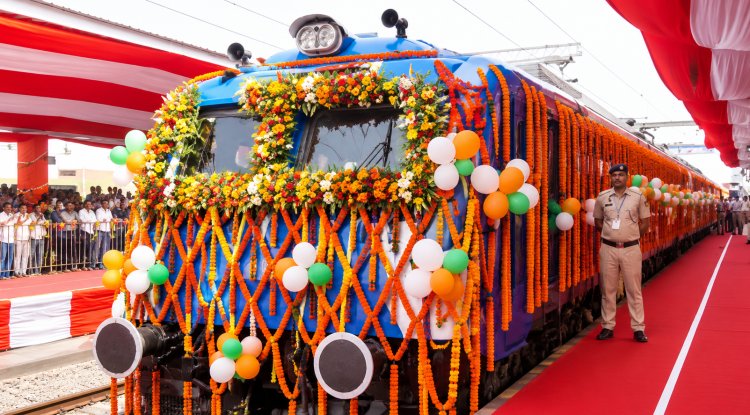
India on Friday celebrated an important step in its clean transportation with the launch of its first hydrogen train and becoming one of the few countries that have introduced hydrogen fuel-cell technology for their railways. Prime Minister Narendra Modi flagged off the train at Jind railway station in Haryana on the 89-km stretch of Jind-Sonipat route under Northern Railway. This is India's first Hydrogen Train reflects the country's commitment to sustainable mobility and world-class railway infrastructure.
The launch is expected to strengthen Indian Railways' decarbonisation efforts and support the government’s National Green Hydrogen Mission. Trains using hydrogen as fuel have been seen as a viable means of transport where full electrification is not possible due to economic reasons or otherwise.
The train has been manufactured through indigenous technologies in the collaboration between the Research Design and Standards Organisation (RDSO), Integral Coach Factory (ICF), Chennai and Medha Servo Drives. It is an important “Make in India” project related to green transportation. Besides, there is a massive hydrogen storage and refuelling facility in Jind.
The train is a combination of 10 coaches made up of two hydrogen fuel cell-powered power cars and eight passenger coaches. Both power cars combine to produce a traction power of 2,400 kW, making it one of the highest-powered hydrogen fuel cell-powered train combinations in the world. It can seat about 2,600 passengers and has been designed to have a top speed of 110 km/h, but an operational speed of 75 km/h.
Unlike diesel locomotives, the hydrogen-powered train creates electricity using fuel cells. In this case, hydrogen and oxygen are used to generate electricity. The only thing that comes out from this process is water vapor and heat, which means that no carbon is emitted by the vehicle.
The train is equipped with multiple safety systems designed to detect hydrogen leaks, flames, smoke and abnormal temperature or pressure levels. Railway officials said the safety architecture has been developed to meet stringent operational standards for hydrogen-based transport.
The hydrogen train will halt at 12 stations between Jind and Sonipat, including Jind City, Pandu Pindara, Lalit Khera, Bhambeva, Ishapur Kheri, Butana, Khandrai, Gohana, Rabhra, Lath, Mohana Haryana and Barwasni.
The project comes as Indian Railways continues to achieve its aim of become net-zero carbon emitters. In the last ten years, Indian railways have extensively increased their railway electrification process, and this has reduced the usage of diesel within their networks. The use of hydrogen trains will serve as an alternative transport solution in areas that cannot be electrified using overhead lines.
With the launch, India joins a select group of countries including Germany, France and China that have introduced hydrogen-powered trains as part of their low-carbon transport strategies. Railway officials view the project as a pilot that could shape future deployment of hydrogen-powered rail services across the country if the technology proves commercially viable.
What's Your Reaction?