Manav Rachna University transformed nearly eight tonnes of kitchen waste into compost and liquid fertiliser, showcasing a campus-led circular economy model built on community participation
There is a particular image that Dr. Anandajit Goswami keeps returning to when he talks about why this project exists: cows on the roadside, chewing plastic. It is not a statistic he cites, or a slide from a sustainability report. It is a discomfort that never quite leaves him.
"The pain of that visual creates an urge to generate something which is far more aesthetic for the legacy of the future," says Goswami, Director of the Manav Rachna Centre for Peace and Sustainability (MRCPS), when asked what pushed his team to build a full waste-management system on campus rather than run another one-off awareness drive. Awareness campaigns, he says, are designed to make people aware. What his team wanted was something more durable — a way of making waste itself into something with value, rather than something to be managed and forgotten.
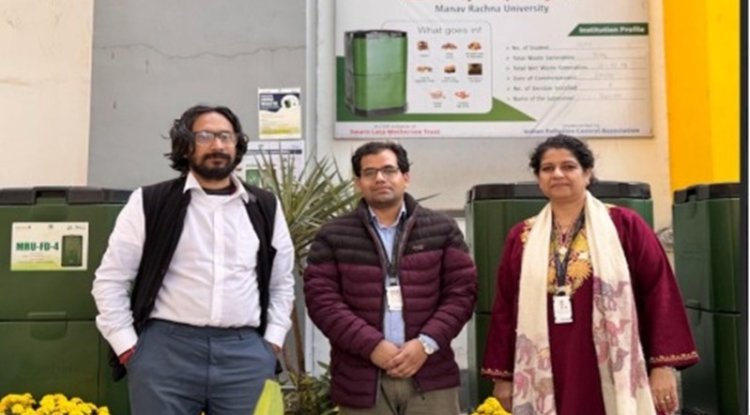
That instinct is now a working system. Over six months, Manav Rachna University's campus diverted close to eight tonnes of kitchen waste — mostly vegetable peels and food scraps from its hostel mess — away from the landfill. The waste went instead into six Aerobin composters, a technology first developed in Australia, and came out the other end as 1,154 kilograms of compost and 419 litres of leachate. The project has since been recognised by the Municipal Corporation Faridabad and won the Best University Practice award from the Indian Pollution Control Association. It has also produced a commercial compost product, Manav Bhumitra, now being sold to households across Faridabad and Delhi NCR.
But the numbers, as the three people who built this system are quick to point out, are only part of the story. The harder, less quantifiable part is what it took to keep a composting habit alive on a campus for six months without it quietly dying, the way such projects so often do.
### The people who actually run it
Prof. (Dr.) Pragati Chauhan, Associate Director at MRCPS, is candid about what usually kills these initiatives. "Composting technology is not new, and many institutions have tried segregation only to let it fade away," she says. What she believes made the difference at Manav Rachna wasn't the technology at all — it was who was given ownership of it.
From the outset, the university's housekeeping staff and gardeners weren't simply told to run the bins. They were trained to become, in Chauhan's words, custodians of the Aerobins — the people responsible not just for doing the work but for teaching others how it's done. "That empowerment gave them dignity and pride, and it turned the process from a temporary project into a lasting practice," she says. "It's not a top-down instruction; it's a responsibility they carry with conviction."
That shift didn't happen without friction. Chauhan describes the unglamorous reality behind the eight-tonne figure: segregation errors in the kitchen, the daily grind of collection, the need to check that waste wasn't disturbing the air funnel inside each bin. None of it was solved with a system upgrade. It was solved by showing up. "We were present with them through almost every harvesting and sieving process, handholding at each step so they felt supported rather than burdened," she says. Mistakes, when they happened, were treated as something to learn from rather than something to assign blame for.
What surprised her most, looking back, wasn't a number or a milestone. It was the housekeeping staff themselves. "Initially, we thought they'd just 'do the job.' Instead, they became trainers, eager to teach peers and even outside communities about composting," Chauhan says. "It showed us that sustainability isn't just about technology or numbers — it's about people finding meaning in the process."
### Borrowing a bin, and rethinking it
The Aerobin itself arrived at Manav Rachna through an unlikely route — introduced by the Indian Pollution Control Association with support from Motherson, after the technology had already been piloted in Resident Welfare Associations around Delhi NCR. Dr. Vinayak, who led the technical adaptation of the system on campus, says those early community pilots taught the team where the real bottleneck would be: not the bin, but the sorting. "Waste segregation remained the biggest challenge in those community settings," he says.
At the university, where the hostel mess alone generates 65 to 80 kilograms of kitchen waste a day, the same design proved workable almost immediately. "The Aerobin setup is neat, compact, and requires minimal interference once installed," Vinayak says, adding that its structure — layering food waste with dry, carbon-rich material — helped balance the mix well enough to handle high-moisture scraps without the system breaking down. The team is now looking at what else the bins produce besides compost: the leachate and the CO2 released during decomposition, both of which they're exploring for biomass cultivation, alongside a patent application for a redesigned bin that could capture more of that carbon.
Asked to put the output numbers in plain terms — 1,154 kg of compost from roughly eight tonnes of input — Vinayak is unsentimental about it. A conversion rate in that range isn't a sign of inefficiency, he explains; most of the mass in composting is lost naturally as water vapour and carbon dioxide, and a 14–16% yield is in line with global norms. "The technology itself is sound," he says. "Efficiency gains lie in the human and operational side — stricter segregation at source, better balancing of food waste with dry carbon inputs, smoother harvesting cycles."
His advice to any institution — a school, a housing society, a small business — thinking of copying the model is blunt: don't start with the equipment. "You don't need imported bins or pulverizers on day one. A simple aerobic pit or locally available composter can do the job until the system matures." The real investment, he says, has to go into training and building ownership among the people who'll actually run it day to day. The technology can be scaled up later. The habits can't be retrofitted.
### What the numbers do, and don't, mean
The team is also careful not to oversell the climate math. The project estimates an avoided emission of about 828 kg of CO2 over six months, calculated using standard conversion factors for methane avoided by diverting organic waste from landfill. It isn't a sensor reading, Goswami is clear about that — it's a modelled estimate grounded in accepted baselines, not a lab-verified figure.
Set against India's overall emissions, 828 kilograms is, in his own words, "undeniably tiny." But he pushes back on the idea that this makes it symbolic. "Small, verifiable numbers matter more than people assume," he says. "It's not about one institution solving the climate crisis; it's about showing what's possible when everyday systems are redesigned." If similar programmes ran across thousands of Indian institutions, he argues, the diverted waste and avoided emissions would compound into something substantial — not because any single campus can shift a national emissions profile, but because the practice itself would become normal in places training the country's future workforce.
There's an honesty, too, about what this project has not yet become. Manav Bhumitra is priced with self-sustainability in mind, but Goswami doesn't pretend it's there yet. Scaling the idea — turning it into a genuine biorefinery producing multiple products from different biomass waste streams — will need external CSR funding and grants, he says, not just campus goodwill. "It is a collective dream, and we are opening our arms to each and every one who wants to join and help scale it with us."
For now, the project remains what it has always been: a campus-scale proof that a kitchen's daily waste doesn't have to be a problem to dispose of. Whether it becomes something larger — a model other universities and cities actually adopt, rather than admire from a distance — is the part still being written.
What's Your Reaction?