Government plans signal-free corridors to cut travel time and ease traffic between Delhi and Gurugram.
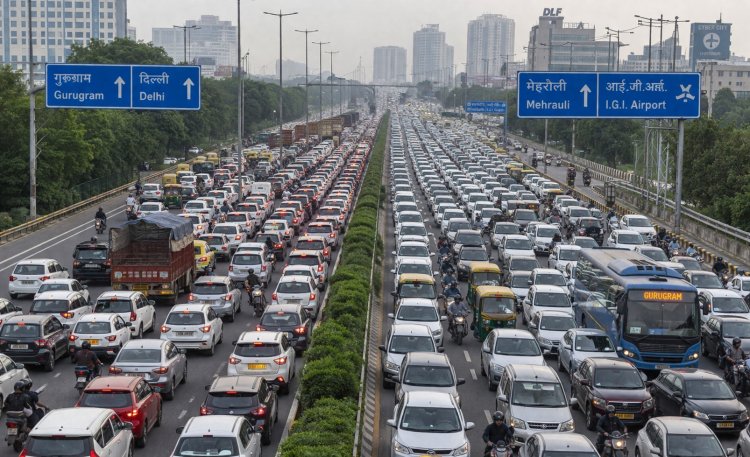
The daily travelling between Gurugram and Delhi are now extremely slow and frustrating due to unnecessary heavy traffic and constant red light stops. To fix this problem, the government is planning to removing traffic signals on busy roads like MG road and build flyover instead. After which vehicles won’t have to stop unnecessarily again and again at red signals. The aim is to enable uninterrupted traffic flow and drastically cut down travel time for lakhs of daily commuters so that people can reach faster without spending much time in traffic jams.
Union Minister of State for Road Transport and Highways, Harsh Malhotra, confirmed that major intersections like Ashram-Badarpur and Mehrauli-Gurugram will see the construction of multiple flyovers and advanced interchanges. He said, "Currently, because of congestion, it takes around one to one-and-a-half hours. This travel time will be reduced. Similarly, travel time between Mehrauli and Gurgaon will be reduced to barely 15 minutes instead of the current one hour after this stretch becomes signal-free," highlighting the government's focus on seamless mobility.
Meanwhile, Gurugram is gearing up to undertake massive modernization of its own road network. National Highways Authority of India is reportedly slated to construct a Model Road of a 5.5-km long MG Road section starting from IFFCO Chowk till the border of Delhi. The plan entails the creation of a multi-level interchange system at IFFCO Chowk, which is one of the most heavily congested crossings in the area. The purpose is to make it a signal-free junction so that vehicles can move seamlessly. Considering the imminent metro and RRTS connection to be established at IFFCO Chowk, it will become a significant multimodal junction.
How it benefits people
In the case of the people living in the Delhi NCR area, the first practical result that they would see would be that of time saved on commuting. Commuters who have been spending hours on end driving around in traffic would suddenly find themselves saving a lot of time. This time saved can then be used by people for doing some more work or spending time with their families rather than having to commute from one place to another. In addition to saving time, a smooth drive would also mean less consumption of fuel, which is also beneficial for people.
Environmental impact
As far as the environmental effects go, there could be some good effects but with their own constraints. In case cars drive at a constant speed and do not stop or accelerate frequently, they become fuel-efficient and have lower emissions for each trip that they take. It might result in the reduction of pollution in some parts of the city. But this will be true only for some time. The better roads and quicker driving speeds would eventually lead to increased traffic due to more car usage by the citizens.
Bigger picture
Such a step towards creating signal-free corridors can be considered an effort to integrate Delhi-NCR into a coherent regional urban entity instead of a collection of discrete cities. In case of successful implementation of such plans, there could be considerable improvement in terms of resolving existing problems of traffic congestion, enhancing economic efficiency, and altering the commuting patterns of the region as a whole. However, any shortcomings in the execution process would pose the danger of merely relocating the problem of traffic rather than eliminating it.
What's Your Reaction?