Renewable energy companies are increasingly adopting artificial intelligence to improve efficiency, optimise operations, strengthen grid reliability, and accelerate the global clean energy transition.
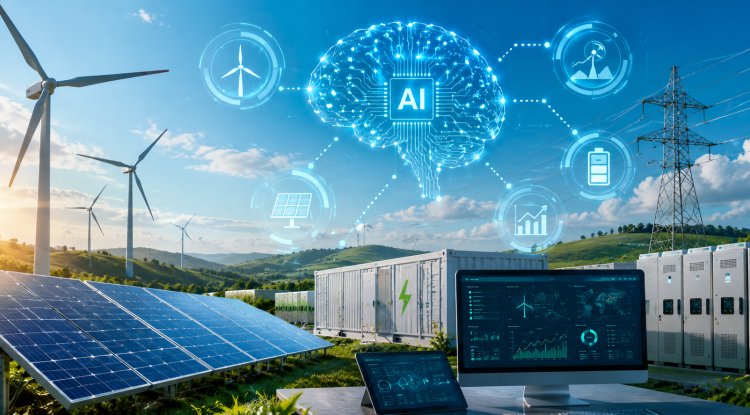
Artificial intelligence (AI) is rapidly becoming a key competitive advantage for renewable energy companies as the industry focuses on improving efficiency, reducing operating costs, and maximising the performance of clean energy assets. According to a recent report by Boston Consulting Group (BCG), AI is moving beyond experimentation and is increasingly becoming a strategic tool across the renewable energy value chain.
Renewable energy companies have started using AI technology to enhance their weather predictions, predict energy generation, manage grid, and even identify system failures before they become a problem. AI makes it possible for renewable energy companies to analyse huge amounts of data in real-time and make better decisions which improves energy production and plant performance.
AI Driving Smarter Renewable Energy Operations
The difference between traditional power production and renewable sources of energy is that the latter is highly dependent on weather changes. Using AI-driven prediction tools makes it possible to predict such factors as solar irradiation, wind speed, electrical load, and performance of the equipment, which enables one to ensure that the production matches the needs of the network.
Another example of using artificial intelligence in the energy sector is predictive maintenance, where AI-based tools allow for monitoring turbines, solar panels, inverters, and battery storage systems in order to detect problems at their earliest stages.
Companies are applying AI-driven digital twins, virtual models of the renewable energy systems to conduct tests.
Supporting Grid Stability and Energy Storage
With an increasing capacity for renewable energy production across the globe, the issue of balancing electricity generation has become even more challenging. The application of artificial intelligence enables utility companies to balance energy production and consumption through the better prediction of renewable generation and the optimization of battery energy storage systems.
AI algorithms are able to identify the optimal moments for charging and discharging batteries without any energy loss and at the same time ensuring the stability of the grid. Artificial intelligence is also enabling utility companies to incorporate distributed energy resources into their national grids.
From Automation to Business Strategy
As per the BCG report, organizations that use AI in large numbers may get competitive advantage through efficient operations, increased asset productivity, and quick decision-making. Instead of being an isolated technology, AI is becoming part of organizational strategy and enabling organizations in the renewable energy sector to be more effective in their planning, capital deployment, and overall financial management.
Experts in the industry expect that in the future, the competitiveness in the renewable energy sector would not only depend upon creating more capacity for renewable energy but would also depend upon smart operation of the already existing resources.
Challenges Remain Despite Growing Adoption
Despite its possible benefits, there are some obstacles on the way to widespread AI implementation. The use of artificial intelligence by renewable energy companies requires high-quality data, digital infrastructure, qualified specialists, and good cybersecurity solutions. Some small developers can have problems because of the cost of investments and the process of integration.
The increased consumption of electricity for AI data centres has become another challenge. With more widespread use of AI in different spheres, it is important to make sure that the increased infrastructure will be powered with clean energy.
AI and Renewable Energy to Shape the Next Phase of the Energy Transition
With the increasing adoption of renewable energy technologies, the use of artificial intelligence alongside renewables is set to have a greater impact on increasing efficiency, lowering emissions, and increasing grid resilience in the future. Not only is artificial intelligence being used to create more renewable energy, but it is also making the sector smarter and more efficient than ever before.
With investment in digital technologies continuing to rise, AI is expected to become a core capability for renewable energy companies seeking long-term growth and competitiveness in an increasingly data-driven energy landscape.
What's Your Reaction?