In only a decade, the share of the population protected by at least one central welfare scheme has jumped from only 22% to 65.3%, says the report
Think back to 2016. For a vast majority of Indians, especially the local vegetable vendor, the construction worker down the street, or the auto driver, life was a daily tightrope walk. One major medical emergency or a sudden loss of work could wipe out the entire life savings of the family. Earlier, social security was generally a privilege for salaried government employees or white-collar corporate workers, leaving approximately 80% of the population completely exposed to life's uncertainties.
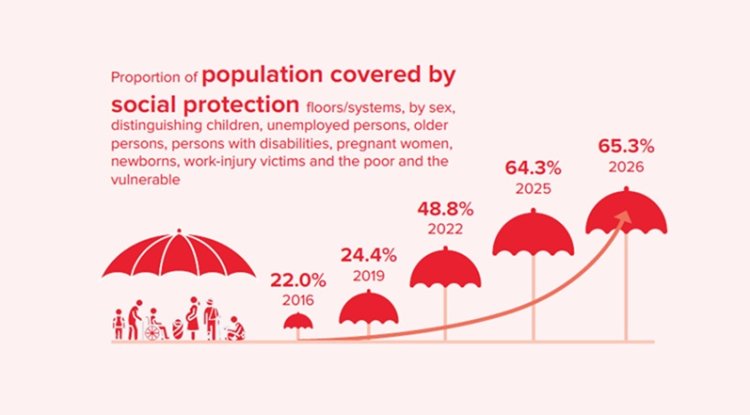
The latest Sustainable Development Goals (SDG) report released by the Ministry of Statistics and Programme Implementation tells a different story. As per the report, the social safety net of India now covers an overwhelming 94 crore Indians. In only a decade, the share of the population protected by at least one central welfare scheme has jumped from only 22% to 65.3%.
This is a massive 43.3 percentage increase that has drawn global attention. The International Labour Organisation (ILO) has called it one of the fastest expansions of social welfare in modern history, putting India second only to China in the sheer volume of people supported. This heavy lifting was done by the digital infrastructure of the country that most Indians now use daily; this is JAM Trinity. By linking Jan Dhan bank accounts, mobile numbers, and secure digital identity systems, the government managed to bypass a web of middlemen.
Instead of funds leaking through administrative cracks, financial aid now lands directly into the beneficiary's bank account with a single click. In fact, this transition to Direct Benefit Transfers (DBT) has weeded out crores of fake or duplicate profiles, saving the public exchequer over ₹3.48 lakh crore.
On the ground, this transformation is driven by a handful of mega-schemes that target the basic anxieties of daily life. The major contributor of this is the Pradhan Mantri Garib Kalyan Anna Yojana. Under this scheme, over 80.6 crore people receive free foodgrains. At a time when global inflation has made kitchen budgets tight, this has anchored daily food security for millions of households. The Ayushman Bharat (PM-JAY) scheme another anchored scheme that has now issued nearly 40 crore health cards, offering cashless treatment up to ₹5 lakh per year across 24,800 hospitals.
Apart from these flagships scheme The eShram portal has registered over 30.68 crore such workers, giving them a Universal Account Number and an identity within the formal economy. Notably, women make up more than 53.6% of these registrations, opening doors to critical maternity and financial benefits. The Pradhan Mantri Suraksha Bima Yojana has also given accident insurance cover to over 51 crore citizens on marginal cost, offering a vital safety net for high-risk manual workers.
The tangible impact of these interventions is visible in India's poverty metrics, with an estimated 24.8 crore people successfully moving out of multidimensional poverty over the decade. However, the job is only two-thirds done. Roughly 34.7% of the population—amounting to millions of citizens—is still outside this protective umbrella. The next phase of this welfare journey will require seamless integration between state-specific schemes and central databases, alongside deeper outreach to platform and contract workers.
With policymakers now aiming to cross the 100-crore beneficiary milestone, the goal is clear: ensuring that no Indian family is left to face a crisis entirely on their own.
What's Your Reaction?