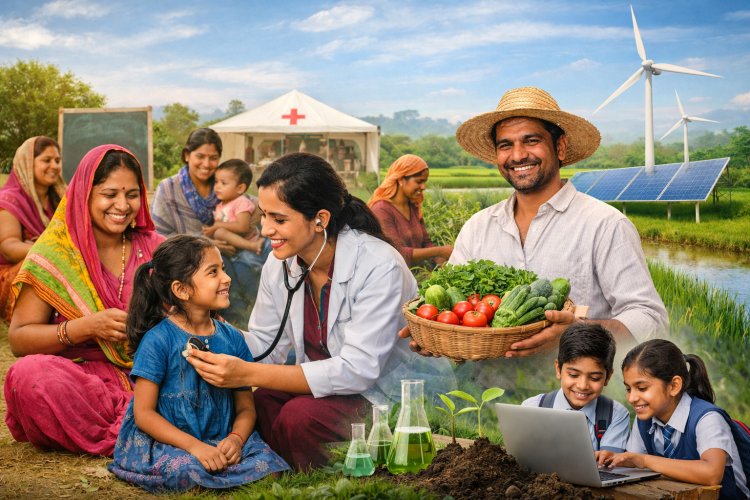
IFI Limited’s report highlights its efforts to improve livelihoods, health, education, and environmental sustainability, focusing on lasting benefits for communities.
India has made significant progress in expanding women’s access to formal finance through Self-Help Group (SHG)–bank linkages, which have emerged as one of the strongest pillars of the country’s financial inclusion architecture, according to the IFI Report 2025.
Over the years, SHG–bank linkages have evolved beyond basic savings accounts. Today, they function as a gateway for women to access institutional credit, government schemes, insurance, and entrepreneurship support. The report notes that women-led SHGs have demonstrated stronger repayment discipline and higher participation in community-level economic activities compared to individual borrowers.
However, the report cautions that access alone does not automatically translate into sustained economic security. While credit flow to SHGs has increased, a significant share of women members continues to depend on low-margin livelihoods, seasonal work, and informal agriculture-linked income. This limits their ability to build assets or withstand economic shocks.
Agriculture Remains the Backbone but Also the Bottleneck
Agriculture is the primary source of livelihood for many families connected to SHG. The IFI Report 2025 says that most women in SHGs are engaged in agriculture either as cultivators, agricultural labourers, or through related activities like dairy, poultry, and food processing. Loans from SHG has helped women invest in inputs, small equipment, and manage day-to-day expenses during farming season which has improved household cash flow.
However, this report underlines structural problems; most of the women have tiny plots of lands, rely on monsoons, expose themselves to unstable crop prices and hardly get to market. All these risks often make credits be utilized to meet basic needs or simply control difficult times instead of investing in activities that would increase productivity or income. More specifically, this can affect areas with uncertainties within climate conditions since farming incomes become very erratic.
What the report underlines is that in the absence of greater convergence between SHG finance and extension services, irrigation support, storage infrastructure, and assured market linkages, the impact of credit will continue to be uneven.
From Credit Access to Income Security
One of the key findings of the report is that women who are part of SHGs understand money matters better and are aware and more confident dealing with banks, but their incomes are still unstable. Many SHG members must manage farming work, household care, and informal jobs altogether. Which leaves them with limited time or support to grow.
The IFI Report 2025 says the focus should not be only on giving loans. What matters more is whether these loans help women earn more money on regular basis, build assets and handle financial shocks. To make this happen, skill development, value-chain integration, and local enterprise promotion are identified as critical next steps.
Institutional Support and Convergence Gaps
As per the report, the SHG programme is not functioning efficaciously in the same manner in all states. In some states, there is strong connectivity in SHGs and agriculture schemes, as well as procurement missions, resulting in women gaining better and more stable means of income. In other states, development is slower as institutions are weak, and banking services are also inadequate in the remote areas.
Banks have continued to play an important role in the SHG system. However, many women have continued to face challenges in the banks. Sometimes loans may not be delivered to women in time. Also, the repayment periods may not be aligned with the planting seasons. This may reduce the impact of the SHG programme.
The Road Ahead
The IFI Report 2025 makes it clear that SHG–bank linkages are no longer just a financial inclusion tool—they are a development platform. To unlock their full potential and benefit women, the focus must shift from just providing loans. What matters is whether women can earn stable income, improve their farming or livelihood activities and have real control over their economic decisions.
As India looks to strengthen rural livelihoods and support women-led growth, the report makes one thing clear that SHGs do empower women but only when finance is backed by markets, useful skills, and agricultural system.
Financial inclusion is not about how many women get loans. It is about whether those loans help them earn better, save for future, and live with dignity over the long term.
What's Your Reaction?