Extreme heat is no longer seasonal and needs India-specific solutions, said Jitendra Singh, Minister of State for Science and Technology
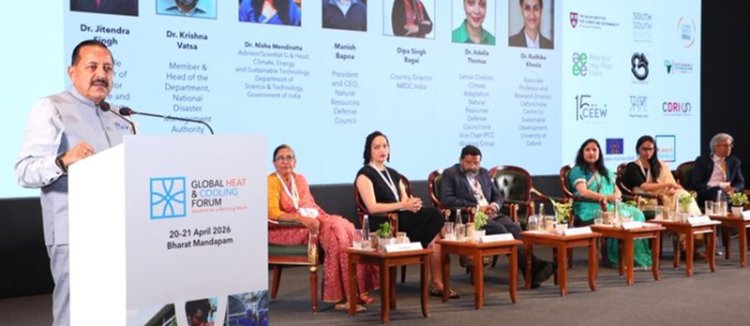
"It is no longer a seasonal phenomenon — Delhi now has winters in summer and summers in winter," said Jitendra Singh, Minister of State for Science and Technology, Government of India, addressing the Global Heat and Cooling Forum 2026.
He was not speaking in metaphors. Just weeks earlier, in the third week of March, Delhi had plunged into an unexpected cold spell — people out in woollen jackets at a time of year when the heat should have already set in. Three days later, the temperature swung back. That kind of volatility, he said, is the new reality. And it is the reason why India can no longer treat heat as something that arrives in May and leaves by July.
An Indian Problem Needs Indian Solutions
"We need Indian solutions for Indian people, for Indian buildings," he said plainly. India is not one climate. It is all climates at once — extreme heat in one corner, extreme cold in another, humidity on the coasts, dry heat inland. A person stepping off a flight from a cold region into a humid coastal city needs a different kind of protection than someone in Europe ever would. "Your remedy, your solution has to be different," he said.
He also pointed to something that rarely surfaces in global climate forums — the way heat interacts with diseases specific to tropical countries. India carries a burden of both tropical diseases and, increasingly, non-communicable diseases like heart disease. Heat affects both. There is evidence of a 20 percent increase in tuberculosis cases above 30 degrees centigrade. But those without an identified disease are equally vulnerable. A person with neuropathy may not even feel the heat properly — their threat sensors are not active — and could suffer a silent heart attack without realising it until it is too late. "We have to have very sustained Indian research as well," he said.
We Are Also the Problem
What made Singh's address stand out was a moment of pointed self-awareness — directed, almost literally, at the people sitting in the room with him. "Right now, in this auditorium, somebody should go and check what the temperature is," he said. "We are also subjecting ourselves to more cooling than required."
He was not being rhetorical. Air-conditioned rooms in India, he observed, are routinely cooled down to 15 degrees — colder than a hill station in winter. "Air conditioning is meant to keep away the summer heat. Not to recreate a winter score," he said.
And the economics of it are stark. Every one-degree reduction in an air conditioner's temperature setting costs measurably more in electricity. That electricity is a national resource — and every unit wasted on overcooling a room is a unit not available to those who have no cooling at all.
"We are neither doing justice to ourselves, nor to those who are deprived of comfortable temperatures," he said. "We are part of the problem. We are also, to an extent, part of the cause. And we are trying to look for the solution."
Why the World Has a Stake in What India Does
"If India falls sick, the rest of the world has to speak," he said. India is now the most populous country in the world — 1.4 billion people, representing, alongside its neighbours, roughly half the world's population. What India does or fails to do on heat, he argued, is not a domestic question. When COVID happened, the entire world watched India. What emerges from here in terms of research, policy, and solutions travels far beyond its borders. He ended not with a grand declaration but with something far more immediate — a request, almost a dare, to the people in that room with him. "I will be personally walking out," he said, "but you take care of yourselves" — and of the temperature setting for the next session. A small thing. But also exactly the point.
My address at "Global Heat and Cooling Forum" at Bharat Mandapam:
Takeaways:
"Global warming poses a threat to health, environment, and overall economy, across the world. "India Cooling Action Plan" has been rolled out, and is already implemented in over 250 cities across the… pic.twitter.com/mCsxqHFWxE — Dr Jitendra Singh (@DrJitendraSingh) April 20, 2026
What's Your Reaction?