At the Climate Asia Annual Conference 2026, speakers said India’s energy transition will be judged by one test: whether clean, secure and scalable systems work together on the ground
During the Climate Asia Annual Conference 2026, the message from industry and policy voices was clear. India’s energy transition is moving from intent to execution, but gaps remain.
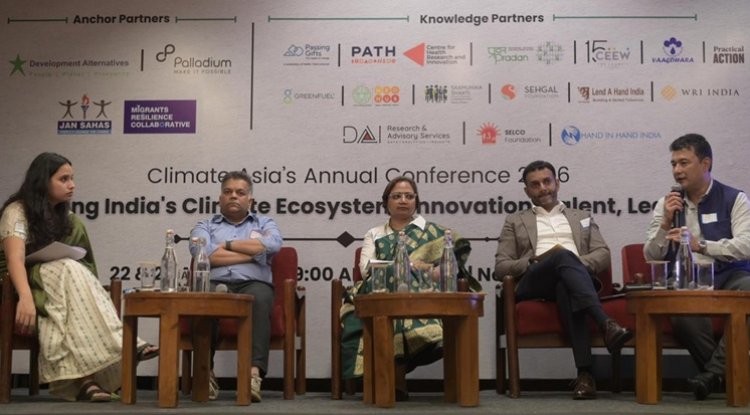
At Climate Group, the work with companies shows how collaboration can break silos, said Dr. Divya Sharma, Executive Director, India Chair and Whole-time Director on the India Board of Climate Group. Large businesses across sectors like textiles, food, real estate and automobiles have the scale to push change beyond their own operations. When they shift, suppliers and smaller firms tend to follow. That ripple effect across SMEs and MSMEs is where real impact begins.
Demand, she added, is a strong lever in India. As a large consumption market, the country can shape how systems evolve. Programmes like RE100 and EV100 focus on aggregating demand. When demand is organised and informed, markets respond faster and supply chains begin to move towards cleaner choices.
There is also a policy push that comes from industry itself. Corporate procurement commitments have helped drive renewable energy policies at the state level. But one barrier remains constant. Finance. At the state level, access to capital is still limited. Building bankable project pipelines and creating state-level finance platforms could help close that gap.
From an industry lens, the transition now hinges on alignment, said Akshay Kashyap, Managing Director, Greenfuel Energy Solutions. Clean energy is no longer the question. The focus is on how it supports energy security and remains viable for all stakeholders.
The CNG shift offers a clear example. It worked because infrastructure, policy push and market demand aligned. That same alignment is now needed across fuels. India is likely to follow a multi-fuel path, especially in transport.
Biofuels are one immediate option. Compressed biogas can turn waste into energy while adding to rural incomes. The potential is large, but supply chains are still uneven, especially in waste collection and processing.
For long-haul transport, LNG is emerging as a practical bridge. It can reduce emissions while remaining cost-effective, making it viable in many cases without heavy subsidies.
Policy, he noted, should act as a nudge. Clear signals like emission norms or targeted incentives can push adoption faster. The larger point is to back what works for India rather than copy global models.
Green hydrogen remains a longer-term bet, though early pricing signals are improving. It could play a role in sectors where emissions are harder to cut.
Cities sit at the front line of the transition, said Madhav Pai, CEO of WRI India, but most of the heavy lifting still rests with states. Regulation, power distribution, storage and transmission are largely state subjects. Cities are major consumers and can move fastest on usage.
He pointed to three areas where cities can act quickly. Transport, through electrification. Buildings, by managing rising cooling demand with better design. And waste, which links directly to air quality and circular economy outcomes.
Where cities struggle is support. They depend on states for power supply, pricing and grid upgrades. Without stronger transmission and storage, city-level efforts will stall. Financing is another constraint, as urban bodies often lack the capacity to fund large transitions.
At the state level, the picture becomes more complex in regions like Meghalaya, said Dr. Albert Chiang, Officer at the Meghalaya Basin Development Authority. The state’s heavy reliance on hydropower creates seasonal imbalance, with surplus energy during the monsoon and shortages in winter.
Plans for pumped storage, solar expansion and new capacity exist, but finance remains the key hurdle. Many projects depend on central support, while existing infrastructure often needs repair and extension.
Storage could help bridge the seasonal gap. Capturing surplus monsoon power for use in lean periods would improve reliability. But that requires both investment and planning.
There is also a governance dimension. Much of Meghalaya operates through community-led systems. Large projects need local approval, which takes time but also offers a more grounded approach. Planning at the village or watershed level could make solutions more practical.
At a broader level, energy transition is now closely tied to energy security, Sharma added. Subnational governments sit at the centre of this shift. They control land use, urban development and electricity distribution, making them critical to turning national ambition into action.
The discussion was moderated by Raisha Galib, Accelerator Design Specialist at Climate Asia.
Closing the session, the panel was asked a simple question. Five years from now, what would prove that India has moved from fragmented efforts to a coordinated transition?
For Sharma, the answer lies in a transition that is not just fast, but responsible and resilient. One clear signal, she said, would be electric mobility running on genuinely clean power, not just shifting emissions from tailpipe to grid.
Pai pointed to transport as the test case. If India can make its mobility system truly sustainable at scale, it would set an example globally. That means not just more electric vehicles, but cleaner electricity feeding them.
Kashyap framed it through energy security. If India can hold its energy import bill steady despite rising demand, it would show that domestic alternatives are scaling. Alongside that, visible, real-world deployment of cleaner fuels in heavy transport, especially trucking, would be a strong proof point.
For Chiang, the shift would show up in resilience on the ground. Systems that can balance seasonal demand, backed by storage and local planning, would signal that transition is no longer fragmented.
Across responses, the direction was clear. Coordination will not be measured by announcements, but by what works at scale on the ground.
What's Your Reaction?