Lithium Can Be Recycled Many Times Without Losing Value: Maxvolt Energy’s Vishal Gupta
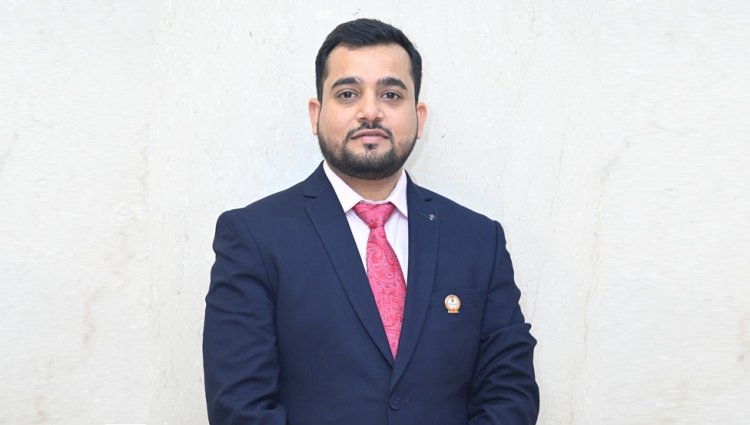
In an interview with ResponsibleUs, Vishal Gupta, Chief Technical Officer, Maxvolt Energy Industries, spoke about the innovations powering their battery solutions, the steps they are taking to ensure a circular lithium economy
India’s electric vehicle (EV) market is growing rapidly, having gained momentum after the government announced multiple policies to support the sector, along with rising consumer interest. Bharat Mobility Auto Expo 2025 witnessed around 26 new EVs unveiled by different automobile companies. According to ICRA's estimate, India's lithium-ion (Li-ion) battery industry will receive over Rs 75,000 crore in investments by 2030, with more than 150 GWh of battery cell production capacity expected to be operational. Maxvolt Energy has already entered the battery market with a focus on quality, reliability, and circularity.
But Maxvolt’s story doesn’t stop at performance. The company is also placing strong emphasis on sustainability—actively supporting recycling, aligning with India’s Extended Producer Responsibility (EPR) mandates, and preparing to launch its own recycling facility. In an interview with ResponsibleUs, Vishal Gupta, Chief Technical Officer, Maxvolt Energy Industries, spoke about the innovations powering their battery solutions, the steps they are taking to ensure a circular lithium economy, and the practical challenges of operating in a still-evolving EV and energy storage ecosystem.
Excerpts:
Many players offer lithium and storage batteries. What sets Maxvolt Energy apart?
Several factors differentiate us. While most focus on volume, our approach is different.
What are some common challenges customers face with battery performance, and how does Maxvolt address them through service, supply, and sustainability?
It's a non-chargeable situation. In such cases, what happens is that people assume different scenarios and then expect the same kind of performance, which doesn’t always work under certain conditions. That’s where a lack of understanding comes in, and sometimes wire-level issues arise. These issues can usually be resolved on-site by our service team.
Further, what also happens is that sometimes the battery goes into deep discharge. In those cases, we replace the batteries within 72 hours. These are two key differentiating factors—we offer 72-hour replacement for cell-level issues. We can also proudly say that our claim rate is very low—less than 3%.
Coming to the third point: service. Apart from the replacement, we also have software-enabled service support. Then there’s supply. In terms of supply chain, we usually place orders in advance based on regional demand. If a warehouse is nearby, the dispatch becomes easier and faster.
Right now, we have eight operational warehouses, and we are currently working in six states. We plan to expand this number to 15 states by the end of this financial year. The idea is to ensure better availability and reduce inventory pressure on dealers, making it a faster and smoother experience for them. This is another major differentiator.
The fourth one is recycling and environmental responsibility. We offer a buyback option for old batteries. Earlier, customers would get no value for used lithium batteries. We introduced a buyback program where we offer value even for used batteries. We realized there's still good value left in them, and they can be recycled effectively. In fact, most components from used batteries can be brought back into the lifecycle, just like new ones.
A recent study suggests that while EVs reduce tailpipe emissions, the mining of lithium and rare earth minerals can be environmentally harmful—sometimes even more so than the use of petrol or diesel. So, are EVs truly green, or are we simply shifting the problem elsewhere? What’s your take?
Yes, to some extent, I agree. This is one of the major challenges. However, there’s a big shift happening. For example, by 2030, almost all lithium used in China’s EV battery production is expected to come from recycling.
That’s the key advantage of lithium—it can be recycled many times. So while mining does have environmental impact initially, the circular nature of lithium usage is improving rapidly. If we manage the lifecycle properly—starting from manufacturing to recycling—we can reduce that negative impact significantly.
You mentioned the circular nature of lithium usage. Are we seeing meaningful progress in battery recycling? And how close are we to making recycled materials a mainstream source for EV batteries?
If you have the capability to extract the best material from used batteries, you can get high-quality output. That’s the core quality of recycling. I agree that earlier, it wasn’t very efficient. But now, the industry is clearly moving toward recycling—which is cleaner, more cost-effective, and faster compared to traditional extraction methods.
I believe we will start seeing the real impact of this shift soon. For example, we are also setting up a recycling plant, which should be operational by the end of this financial year. That will be one of the visible outcomes soon. Many other companies are also moving into recycling.
The government is introducing incentives and guidelines to further boost the recycling ecosystem. When lithium is extracted from used batteries, does it retain its original properties, or does it lose some of its qualities in the process?
If we look at the battery cell, lithium is just one part of the overall composition—approximately 20 % of the content. Other elements like cobalt, nickel, and graphite are also there. Well, in the recycling process, the battery is ground into powdery form, and then a variety of processes extract each material. The purity of materials will depend upon the efficiency of the process. For example, lithium can be recovered in 95, or even 98 or 99.99 % purity, depending on the extraction technology.
We do not retrieve all raw materials in perfect form. We must add fresh lithium or cobalt when making new batteries. But yes, to an extent, about 90% of components can be reused, which is quite significant.
It also depends on the battery chemistry. For example, LFP and NMC chemistries require their materials in different amounts and quality. Afterward, the extracted and upgraded materials undergo refining processes and then proceed for cathode and anode production, the crucial cell components.
How is Maxvolt ensuring compliance with India’s new Extended Producer Responsibility (EPR) regulations? Have there been any challenges in the implementation process?
We are aligned with EPR compliance. Currently, we are outsourcing the recycling part to external partners who help us fulfill our EPR obligations. We do manage some of the traceability and material handling in-house, but the actual recycling is handled externally for now. That said, we’re planning to set up our own recycling plant by the next financial year. Once that’s in place, we’ll be able to fulfill our own EPR directly and support other companies in meeting theirs.
[email protected]
What's Your Reaction?