"Our Technologies Enable Smarter Mobility & Efficient Energy, Including Products That Reduce CO2 Emission In The Use Phase"
In this interview, Edoardo Auteri, Head of Sustainability Programs, Sales & Marketing Asia Pacific Region (excluding China), STMicroelectronics, walks us through how ST is addressing the full scope of emissions—direct and indirect—while enabling customers to build more energy-efficient products
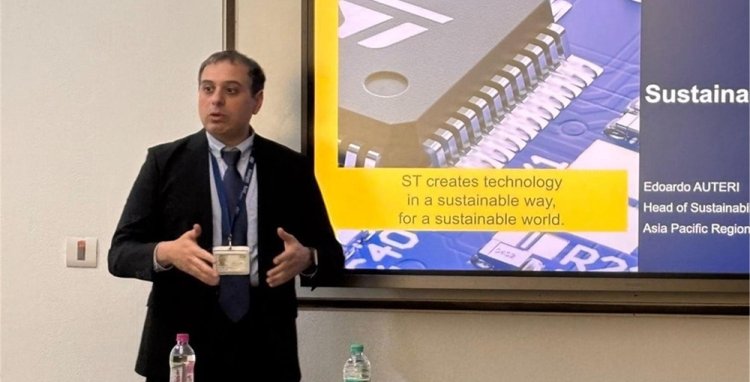
At STMicroelectronics, sustainability isn’t just a goal—it’s embedded in the company’s DNA. As the world races to tackle the climate crisis, ST is charting a clear path toward carbon neutrality by 2027. But beyond the headlines, what does this ambition look like in practice? From designing power-saving chips to cutting emissions across global operations, ST is taking a deeply integrated approach.
In this email interview with ResponsibleUs, Edoardo Auteri, Head of Sustainability Programs, Sales & Marketing Asia Pacific Region (excluding China), walks us through how ST is addressing the full scope of emissions—direct and indirect—while enabling customers to build more energy-efficient products. He talks about the power of innovation, the role of smart metering in water conservation, and why sustainability isn’t just the right thing to do—it’s a competitive advantage.
Can you explain ST's carbon neutrality goal for 2027 and what it covers?
STMicroelectronics aims to be carbon neutral each year from 2027 in all direct and indirect emissions (scopes 1 and 2), and product transportation, business travel, and employee commuting emissions (our scope 3 focus). The company's comprehensive strategy focuses on reducing greenhouse gas emissions, reducing energy consumption, sourcing 100% renewable energy by 2027, and investing in credible carbon offset programs which maximise sequestration.
What role does product design play in reducing carbon emissions for ST's customers?
Product design is where it all starts. Our technologies enable smarter mobility, more efficient power and energy management, including products that reduce power consumption right from the start. When our customers build devices using these components, the impact multiplies—whether it's in electric vehicles, industrial machinery, or consumer electronics. Better design means less resources wasted throughout a product’s lifecycle.
What factors contributed to being recognised among the top 100 most sustainable companies?
We are pleased to have received external recognition for our performance. In 2024, we maintained our presence in the Dow Jones Sustainability Index World and Europe indices. Additionally, we received MSCI AAA rating, CDP Climate A and water A- and were awarded a platinum medal by EcoVadis, placing us in the top 1% of companies assessed. Factors contributing to this recognition include transparent sustainability reporting, proactive reduction of greenhouse gas emissions, investment in renewable energy, and the development of technologies that contribute to addressing global environmental challenges.
How does innovation play a role in meeting ambitious sustainability targets?
Innovation is a crucial element that propels our growth and helps us achieve our business goals. The company invests in research and development, and through doing this creates advanced technologies that enhance energy efficiency and reduce environmental impact. By pioneering solutions in areas like power management and energy harvesting, ST enables its products and those of its customers to operate more sustainably, thereby supporting the achievement of its carbon neutrality and broader environmental goals.
Can you explain the significance of Scope 1, Scope 2, and Scope 3 emissions in the carbon neutrality journey?
In STMicroelectronics' carbon neutrality journey:
Scope 1 includes direct emissions from owned or controlled sources, such as manufacturing processes.
Scope 2 covers indirect emissions from the generation of purchased electricity consumed by the company.
Scope 3 covers product transportation, business travel, and employee commuting.
Acting on these three pillars ensures that both direct operations and associated activities contribute to reducing the overall carbon footprint.
What measures are being taken to increase the use of renewable electricity and reduce CO2 emissions?
STMicroelectronics is actively increasing its use of renewable electricity through on-site solar installations, power purchase agreements (PPAs), and the procurement of green energy certificates. For example, the company has entered into renewable electricity supply agreements with TotalEnergies in France, with Centrica Energy in Italy and with ENGIE in Malaysia for our sites in those countries. Additionally, ST is investing in energy-saving initiatives across its sites to further reduce CO2 emissions.
How do power-saving programs and wastewater management contribute to sustainability efforts?
Power-saving programs at STMicroelectronics focus on enhancing energy efficiency across operations, to reduce energy consumption and associated emissions. Wastewater management is another critical aspect, with the company implementing comprehensive strategies that include water stress assessment, conservation programs, and wastewater treatment before discharge into the environment. In 2024, STMicroelectronics recycled 54% of water and investing in water saving projects is a continuous focus.
What role do smart metering solutions play in conserving water, particularly in India?
STMicroelectronics is an Alliance for Water Stewardship member, supporting its commitment to managing water use in manufacturing processes responsibly and sustainably, thereby minimizing impact on water resources. Smart water metering solutions help spot consumption inefficiencies, detect leaks and water wastage which is critical for efficient water management in water-stressed regions like India. STMicroelectronics provides ultra-low-power semiconductors that power smart water meters, helping utilities track usage accurately, reduce losses, and extend battery life, all of which contribute to more sustainable water conservation efforts.
How is renewable electricity sourced, and what impact does it have on operations?
STMicroelectronics sources renewable electricity through a combination of on-site installations, power purchase agreements (PPAs), and the procurement of green energy certificates. In 2023, renewable sources provided 71% of the electricity the company consumed, helping to avoid approximately 636,000 metric tons of CO2 emissions. At the end of 2024, renewable sources provided 84% of electricity consumption. A notable example is the 15-year PPA signed with TotalEnergies to supply 1.5 terawatt-hours of renewable electricity to ST's operations in France. This agreement, which commenced in January 2025, supports ST's goal of sourcing 100% renewable energy by 2027. These initiatives reduce ST's carbon footprint, stabilize long-term energy costs, and support the broader transition to sustainable energy within the company's operations.
What technologies or tools are used to track and calculate carbon emissions in real-time?
STMicroelectronics utilizes a combination of internal systems and industry-standard tools to monitor and calculate carbon emissions. These systems integrate data from various operations to provide real-time insights, enabling the company to make informed decisions and track progress toward its sustainability goals effectively.
How are transportation emissions being managed and offset?
STMicroelectronics aims to be carbon neutral each year from 2027 in product transportation, business travel, and employee commuting emissions (scope 3 focus). The company addresses transportation emissions by optimizing logistics, promoting efficient transportation methods, and encouraging sustainable commuting options for employees. For emissions that cannot be eliminated, the company will invest in credible carbon offset programs, combining nature-based solutions with technological solutions, maximising carbon sequestration.
How does the company ensure transparency and accountability in reporting sustainability data?
STMicroelectronics demonstrates transparency and accountability by publishing detailed sustainability reports aligned with international standards and regulations, such as the Global Reporting Initiative (GRI) and from 2025 the Corporate Sustainability Reporting Directive (CSRD). These reports are externally verified, providing stakeholders with confidence in the accuracy and integrity of the disclosed information.
In what ways does reducing emissions contribute to both environmental impact and business success?
Sustainability has been a guiding principle at ST for more than 30 years and is at the core of our company value proposition. Reducing emissions is not just about environmental responsibility but it’s also a smart business move. For STMicroelectronics, cutting emissions helps lower operational costs, especially through energy savings and more efficient processes. It also reduces exposure to regulatory risks and carbon-related costs, which are becoming increasingly relevant globally.Our commitment to reduce emissions strengthens our reputation with customers, investors, and partners who are prioritizing sustainability. It also opens doors to new markets, especially as demand grows for low-carbon and energy-efficient technologies. So, in essence, reducing emissions helps ST operate more responsibly while driving innovation and long-term competitiveness. STMicroelectronics is keen to cooperate with stakeholders to accelerate their transition to carbon-neutral designs and manufacturing, towards a carbon-neutral economy.
[email protected]
What's Your Reaction?