SAEL Industries announces a drive to procure 20 lakh tones of paddy stubble to convert into electricity, aiming to reduce stubble burning pollution and create a sustainable Agri-waste supply chain.
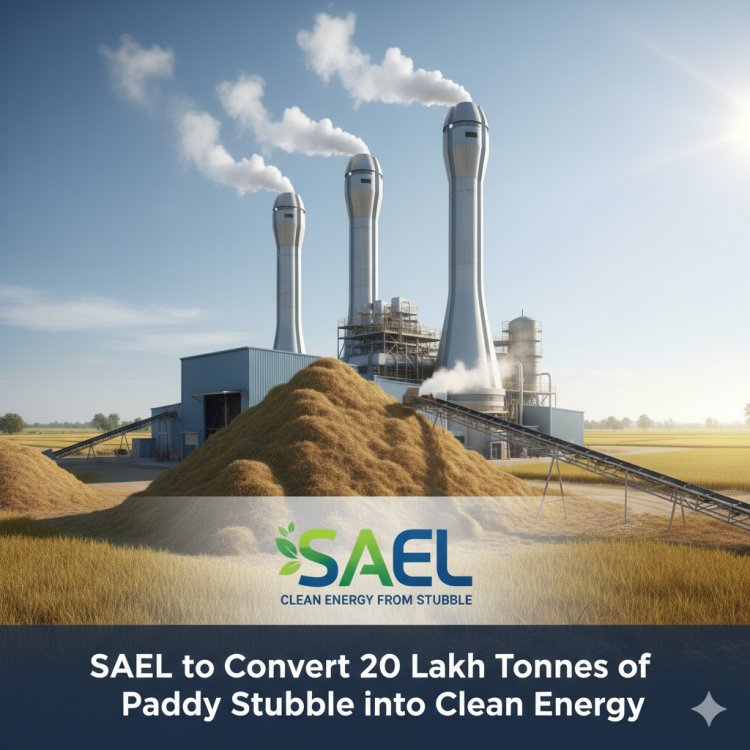
SAEL Industries Ltd., a company involved in renewable energy, has launched a large-scale program to procure approximately 2 million tonnes of paddy stubble during this year's harvest season. The ultimate goal for SAEL is to process this agricultural waste, which farmers often burn, into clean electricity generated at its waste-to-energy facilities.
SAEL's procurement program is focused on the very real environmental problem that stubble burning causes air pollution in northern states in India during the winter months. By developing a commercial value for this otherwise-residual waste, SAEL hopes to provide farmers with a sustainable alternative to open-field burning that results in both poor air quality and ill public health.
The problem is big. Based on past research referenced in the Indian Journal of Agronomy, India produces approximately 500 million tonnes of crop residue every year. Of this, approximately 92 million tonnes are burnt in the open because it lacks economic value for farmers, as well as contributing to a host of environmental and public health problems.
SAEL's model relies on procuring the paddy straw via fuel aggregators and shipping it to its specialized plants. The company currently has a fleet of 11 waste-to-energy plants in Punjab, Haryana, and Rajasthan, with a total generating capacity of 165 megawatts. This capacity allows it to utilize large amounts of agricultural waste over time.
The environmental benefits are significant. Projections based on IPCC estimates for carbon emissions savings from the use of paddy stubble show that using a procure-and-use scale of approximately 20 lakh tonnes could prevent close to 300,000 tonnes of carbon dioxide-equivalent emissions compared with emitting from open burning of the residue and result in positive climate outcomes for India while improving air quality.
Beyond environmental benefits, the initiative has socio-economic benefits. It develops an additional stream of income for farmers, converting an agricultural waste product into a saleable commodity. It also provides jobs for local residents, first in the collection and then in the transport of the paddy straw, and then carries on to creating more jobs in their plants.
This undertaking is part of a well-defined commitment SAEL is making to the waste-to-energy ecology system as a whole, with prior work demonstrating measurable success with 390,000 tonnes of CO2e emissions having been avoided, as identified as part of SAEL's CY24 Greenhouse Gas Report.
This initiative advances a pragmatic proposal for establishing a circular economy in agriculture to ensure its waste is not a nuisance to discard but a fuel that can support homes and businesses while addressing an ongoing pollution dilemma.
What's Your Reaction?