A new study reveals how changes in sea levels influenced ocean phosphate availability, carbon burial, and Earth’s climate regulation system over the past 60 million years.
For several decades, scientists have known that Earth has a natural mechanism which allows its climate to stay neither too hot nor too cold over the very long term. However, how the mechanism works was not clear. A new study published in the Proceedings of the National Academy of Sciences (PNAS) reveals one important piece of that puzzle, namely the changes in sea level that affected the concentration of an essential nutrient, phosphate, in the oceans, which in turn had implications for carbon dioxide levels in the atmosphere and thus for Earth's climate over the last 60 million years.
The study was conducted by a team that included Ros Rickaby (professor of Earth sciences at Oxford), Zunli Lu (Syracuse University), along with researchers from the University of Copenhagen. Rickaby said the carbon's fate has been “remarkably poorly known.” “According to our results, increased burial of organic carbon into marine sediments was a much larger factor than previously thought,” he said.
The study focuses on phosphate, a type of phosphorus that is essential for the growth of all living things. Phosphate is a nutrient in the ocean for tiny marine organisms. The ocean has another way of removing carbon dioxide from the atmosphere through the growth of small marine organisms, which remove carbon as they grow, and when they die, their remains settle on the ocean floor and are preserved in sediments for millions of years.
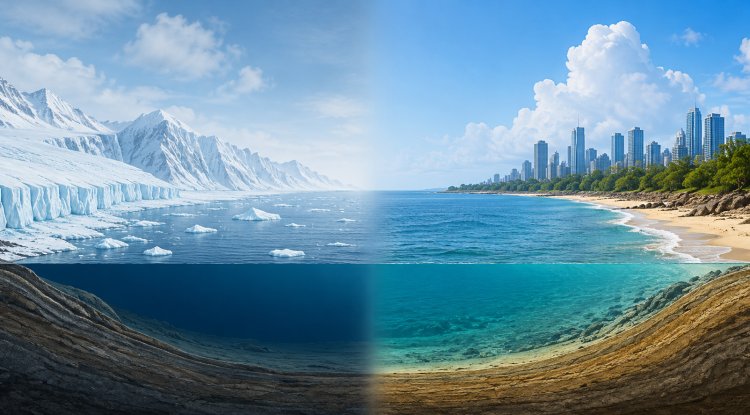
During periods of warm climates and high sea levels, the shallow coastal continental shelves expanded and held back the spread of phosphate into the open ocean through coastal sediments. Having less phosphate, fewer marine organisms grew, less organic matter fell to the seafloor, and less carbon was buried—acting as a natural brake on cooling.
In contrast, during times of Earth's cooling and falling sea levels, lower sea levels reduced continental shelves and increased the availability of phosphate in the open ocean, resulting in more growth of marine life and carbon burial, and further cooling of the atmosphere.
The scientists also discovered that the carbon burial areas with low oxygen moved to deeper waters over millions of years, making the natural climate regulation system more difficult to disrupt. The results help improve understanding of Earth's carbon cycle and contribute to long-term climate projections.
What's Your Reaction?