South Korea funds CO₂ conversion projects to develop sustainable fuels and reduce fossil fuel dependence.
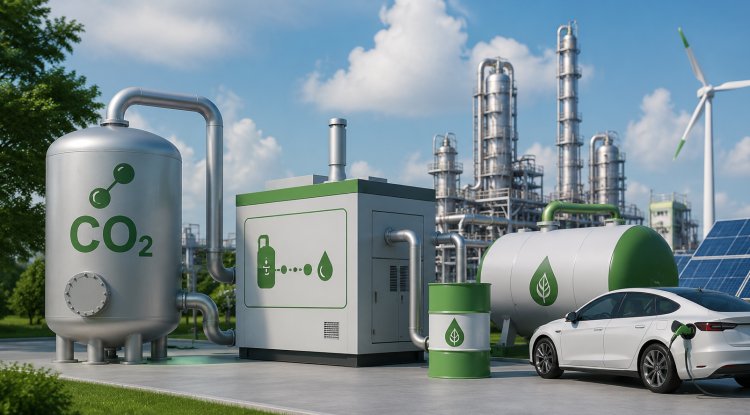
South Korea has begun a big industrial-scale carbon capture and utilisation (CCU) project, with a 238 billion (174 million US dollars) investment plan until 2030 for carbon dioxide (CO₂) converted into sustainable aviation fuel, synthetic crude oil and marine fuel as well as industrial materials.
The Korea Institute of Energy Research in Daejeon was the venue for the announcement of the CCU Mega Project by the Ministry of Science and ICT (MSIT). The project aims to tap into CO₂ emissions from significant industrial processes such as power generation and steelmaking, and develop low-carbon substitutes for traditional fossil fuel-based products.
Carbon Capture and Utilisation (CCUS), Sustainable aviation fuel (SAF), South Korea energy policy, Carbon dioxide conversion, Synthetic crude oil
Researchers in Korea are aiming to convert CO₂ to products on an industrial scale.
Project will be interested in bringing carbon utilisation technologies from R&D labs to commercial demonstrations. CCU is different from conventional carbon capture and storage (CCS) for CCS in which captured CO₂ is stored permanently, CCU thinks of CO₂ as a resource that can be converted to useful products.
The government will showcase technologies for the production of e-SAF (electronic sustainable aviation fuel), synthetic gas, methanol and sustainable marine fuels. The programme will last for the period 2026-2030 and be funded by the government in the form of support for the industrial deployment of the programme.
South Korea regards CCU as a part of its energy security and climate strategy. Self-sufficiency in crude oil and industrial raw materials is essential for the country, which has been facing challenges in the global energy market.
All the above projects are LG Chem and POSCO Label Demonstration Projects.
Initially the CCU Mega Project will concentrate on two major industrial applications: power generation and steelmaking. These industries generate large amounts of carbon emissions and are regarded as some of the most challenging sectors to decarbonise.
The demonstration of power generation will be led by chemical company LG Chem. The company will apply captured CO₂ from thermal plants towards sustainable aviation fuel and other carbon-based products.
The steel sector demonstration will be led by steel company POSCO Holdings. The project will analyze the possibility of using the CO₂ produced in the steel-making process for producing synthetic fuels and industrial feedstocks.
These two companies are projected to have technology demonstrations by 2030. If implemented successfully, it can pave the way for establishing a domestic supply chain of low carbon fuels and decreasing reliance on fossil fuels imports.
Our DET is a part of the Programme.
Direct air capture (DAC) technology was also mentioned at the project launch by the government of South Korea. DAC is a direct capture of CO₂ directly from the atmosphere, which is technically difficult due to the low concentration of CO₂ in the air.
Much energy, sophisticated materials and effective conversion techniques are needed to make the technology commercially viable. Scientists are developing techniques that can also use the CO₂ they capture to make synthetic crude oil with hydrogen.
Scales up large-scale deployment of such technologies are projected to be part of future fuel and industrial material supply according to government assessments. A pathway to the production of synthetic crude oil that is currently being considered may yield as much as 900,000 tonnes of crude oil per year by 2040.
The CCU is a Korean government organization that is linked to Korea's climate targets.
The government wants to use carbon utilisation as a means to achieve South Korea's emission reduction targets. The country has set itself a climate target for 2035, which is expected to be achieved with advanced CCU technologies, such as DAC.
South Korea needs to dramatically cut emissions of greenhouse gases by mid-decade under the country's national emissions reduction plan. The government projects that CCU technologies can meet a part of the demand for aviation fuel and synthetic gas by 2050.
The future growth of CCU, however, will require a number of factors to consider, such as the production costs, availability of clean hydrogen, measurement of lifecycle emissions, and demand in the market.
Government establishes a framework for the CCU market.The government sets up a framework for the CCU market.
MSIT is creating policies to promote the development of an indigenous CCU industry. The ministry's CCU Initiative is a process of collaboration between companies, research organisations and academic institutions to create technology pathways and markets.
The government is also developing certification and verification systems for the CCU technology and products. In industries where emissions standards and lifecycle assessments are gaining importance, like aviation and shipping, these systems are expected to give more clarity.
Lately the project received further government financing. Total support for such activities rose by 22.4 billion won to be included in the budget.
Industrial and Investment Challenges Remain
Carbon management is clearly becoming an increasing part of planning in industry, as evidenced by the growth of CCU technology. The technology has the potential to affect future strategies for energy security, manufacturing competitiveness and CO2 reductions for businesses.
Whether CCU projects can be commercialized will be a key focus for investors and companies. Reliable CO₂ supply, low carbon H2 availability and long-term supply contracts and robust regulations are among the most important.
The investment by South Korea is part of a worldwide push to find alternatives to emissions in fields like aviation, shipping and heavy industry, where it is hard to curb emissions. The nation is exploring if capture carbon can be a viable industrial resource that meets the country's climate and energy goals.
What's Your Reaction?