Sustainable Farming Must Be Practical, Not Ideological: Shenoy Mathew
Shenoy Mathew explains how Arya.ag grew into a platform that helps farmers with storage, finance, and selling their produce in one place.
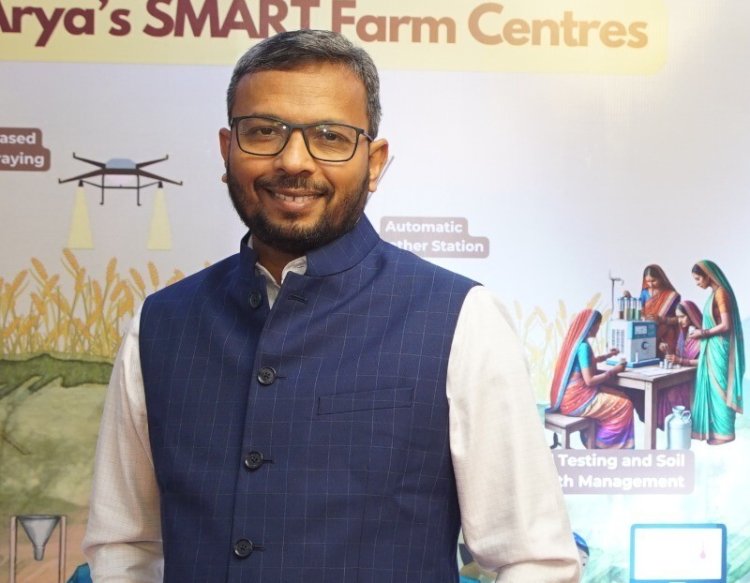
In a conversation with ResponsibleUs, Shenoy Mathew, Chief Strategy Officer at Arya.ag, explained how the company evolved from a single warehousing service provider to a full-stack agriculture platform. He spoke about the early gaps in India's agri value chain, the rise of farmer-producer organisations (FPOs), the role of NBFCs in farmers' liquidity, and why the shift toward sustainable production must be practical rather than ideological.
The name Arya.ag feels broad and different from typical warehousing companies. Can you explain the profile and journey of Arya?
The co-founders were part of ICICI Bank’s agri-commodity finance division long before Arya was born. Prasanna led Agri Commodity Finance, and Anand was National Product Head for the same vertical. Their work placed them deep inside India’s agricultural markets, where one insight became impossible to ignore: formal finance largely served big traders, not the farmers who needed it most. At the farm-gate, storage was scarce, liquidity was a struggle, and producers seldom had the power to choose when or whom to sell to.
Back then, there already existed Arya Collateral Warehousing Services, servicing just one private bank. In 2013, Prasanna and Anand acquired a controlling stake from the JM Baxi Group to reimagine what the business could become — a market enabler for farmers, not just a collateral manager. Their approach from day one was simple and stubbornly practical: identify the problem first, then build a business model to solve it. Create value, sustainably. Not charity — empowerment.
The early focus remained collateral management for ICICI Bank, with limited warehousing for a few clients. As operations expanded and more partners joined, the FPO movement gathered momentum. A clear next step emerged: finance. This led to the creation of Arya Financing Solutions, the NBFC arm, to unlock liquidity for producers at the point of storage.
Then came the pandemic — digital adoption surged, trust gaps widened, and commerce needed a smarter bridge. AryaTech stepped in, enabling tech-driven market linkages that connected farmer collectives directly with buyers.
With storage, finance, and market access now functioning as one continuum, the original name no longer captured the breadth of the vision. Today, a farmer doesn’t see three companies, only one seamless experience enabling them to store, access credit, and sell with choice and confidence – Arya.ag.
You mentioned FPOs. Do you work directly with individual farmers or only through FPOs?
We work with both, but the model naturally leans more toward FPOs. Large individual farmers (20–40 acres) sometimes deal with us directly; they function like enterprises themselves. But smallholder farmers (2–3 acres) face multiple constraints and are better served when aggregated.
FPOs thrive where holdings are fragmented and small, and farmers depend on collective benefits like storage, input purchase, finance, and market linkage. For us, dealing through FPOs is more efficient because we can work with 200–500 farmers at once, instead of engaging each individually. So, we are agnostic; we serve both, but the majority engagement is through FPOs.
What is the typical size of your warehouses?
Compared to industry averages, ours are smaller because we are present closer to the farm-gate. On average, our warehouse capacity is around 1,500–2,000 tons.
Precise numbers fluctuate due to seasonality during lean season; the number of active warehouses is lower, and during the peak season, it increases. The exact operational numbers will be shared separately by our team.
What is the minimum and maximum financing size you provide?
We have different financial products. For warehouse receipt financing to FPOs, the range is typically ₹25 lakh to ₹1 crore. For Arya Mitra, which is a working capital support product offered before storage, the range starts as low as ₹5 lakh.
This is available only to FPOs with prior engagement and repayment history with us. We lend more confidently when the produce is already stored because it acts as collateral.
How many institutions relate to you?
We work with 1,500–2,000 FPOs, though not all stores produce every season. Around 30–40% typically stored in a year due to natural agricultural cycles.
On the finance side, we work with almost all private sector banks and facilitate about ₹25,000 crore of credit to the ecosystem. Out of this, about ₹2,000 crore is from our own NBFC book. On the demand side, we work with approximately 100 major corporates, 2,500–3,000 processors, and multiple aggregators and traders.
How do farmers manage repayment during extreme price fluctuations or climate challenges?
This is where NBFCs like us become important. Farmers’ alternatives are often local moneylenders charging 24–30% interest. We provide a more reasonable option and help optimise income through storage, better pricing, market linkages, and flexible liquidation timing. We don’t trade or take commodity positions ourselves; we facilitate choices such as selling immediately, storing produce, raising finance against stored stock, or selling partially while storing the remaining quantity. These options help farmers build resilience during volatile years.
Have you received grants?
We don’t call them grants; many are technical assistance agreements. The most important assistance we received is from Tata Trusts. In 2017. They supported us with ₹1 crore to study the ecosystem and come out with models of building businesses with farmer organisations. We have been getting multiple assistances across. We receive support from institutions like Rabo Foundation, responsAbility investments etc. We also received help from UNDP because they work in strengthening the women farmer ecosystem. These contributions helped build capacity, models, knowledge, and infrastructure during the early stages.
What kind of farmer training do you provide?
We run continuous programs across three thematic areas: food loss reduction, climate-smart and sustainable farming, and women and youth leadership. We currently work with 105 farmer producer institutions, with trained teams deployed on the ground.
Are you working on marketing organic products?
We believe India cannot transition to 100% organic farming overnight, given the imperatives of food security. A stepwise and pragmatic approach is essential.
At present, we see significant opportunity in produce grown using sustainable agricultural practices. For instance, we already have agreements in place or discussions underway for water-efficient rice, low-emission wheat, heavy-metal residue-free rice, and pesticide residue-free spices.
Rather than advocating for pure organic farming, our focus is on sustainable, scientifically validated practices that minimise residues and emissions, reduce input costs, and enhance productivity. Farmer adoption is driven by economic incentives, not ideology—because incentives, not philosophy, ultimately determine scale and impact.
Are you planning to enter the carbon market?
We won't say yes or no immediately. The opportunity exists, and we are already in discussions. But growth will happen through collaboration, not by stretching ourselves thin.
What's Your Reaction?