VinFast plans to invest ₹7,000 crore to expand its Tamil Nadu facility into a large-scale manufacturing hub for electric cars, scooters and buses, strengthening its position in India's growing EV market.
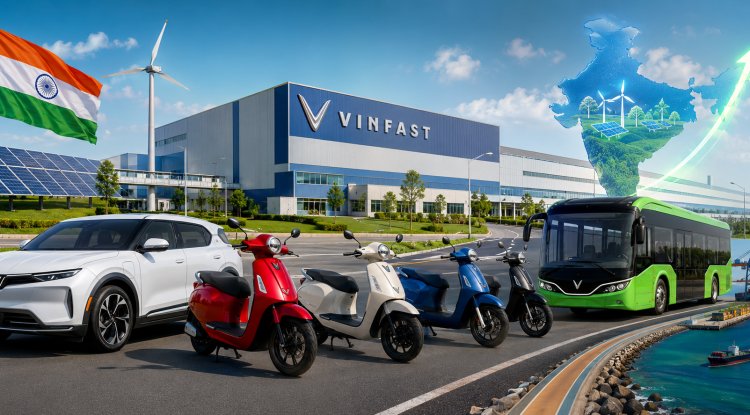
VinFast's ₹7,000-crore expansion plan could reshape India's electric vehicle market by broadening its presence across multiple mobility segments.
There is a big industrial change on the horizon when it comes to green mobility in southern India. VinFast, the Vietnamese electric vehicle manufacturer, has submitted plans seeking government approval a make-or-break expansion phase for their plant in Tuticorin, Tamil Nadu. The automaker is spending about 7,000 crores to convert its newly built factory into a multi-segment factory, according to an in-depth analysis by ET Sustainability. VinFast is taking a bolder approach to its offerings with electric scooters and commercial buses, pursuing a very well-planned bottom-up strategy to establish a presence across multiple segments of the Indian electric mobility market, which is constantly evolving.
The size of the proposed expansion, which is currently undergoing environmental clearance, is staggering. VinFast has already sunk approximately 1,200 crores into building the 408-acre assembly facility in Tuticorin with a capacity of 50,000 electric cars per year. The second phase will significantly expand the facility's production capabilities. When fully operational, the upgraded multi-mobility complex will be able to support the deployment of 200,000 electric cars, one million electric scooters and 2,000 electric buses per year. This is a massive physical scale-up that will involve construction of new assembly workshops, advanced battery integration lines and specialised testing tracks under one roof that will support completely different battery configurations and the entire weight of the vehicles.
To begin with, VinFast's recent investment follows a strategy that is fitting with the unique context of the Indian market. The transformation to EVs in Western economies and China has been a top-down phenomenon, with much emphasis placed on premium passenger cars and family SUVs. But in India, the green revolution is taking place on the ground. Industry statistics reveal that well over 50% of battery-powered vehicles sold in the country are either two-wheelers or public transport. The
Vietnamese company is aimed at capitalising on large demand volumes and daily commuters, who are the primary customers for the new mass-market-based scooters, and the public transport sector, which is currently using more high-capacity municipal buses. The Vietnamese company is targeting the high volume of demand in the mass market e-scooters and high-capacity municipal buses, which are being used by daily commuters and public transportation fleets.
This trend towards two-wheelers fits in nicely with prevailing macro-economic conditions. The electric two-wheeler sector has officially stepped into a structurally new growth phase and experienced a flight to quality, according to financial experts from the regional credit rating agencies. The momentum is driven by the fact that the cost economics is becoming increasingly competitive, the delivery and logistics industry is booming, and there is a flood of OEMs embedded right inside the country.
Meanwhile, electrification projects in public transportation have been underway at the central and state levels, creating a very predictable market for electric buses, where VinFast is now making headway to secure consistent corporate earnings.
The decision to make the choice among Tamil Nadu for the multi-billion-rupee expansion is well thought out. In the past few years, the state has been trying their best to become the primary electric vehicle hub in India. The area has a high concentration of specialised auto component suppliers, a large pool of highly skilled technical labour force and a proactive attitude of local government that provides facilitated single window clearances. In addition, Tuticorin's strategic location in the port city provides
VinFast with enormous logistical advantages, enabling the company to drastically reduce shipping expenses for domestic sales and leverage the production facility as a major distribution base for the export of vehicles into emerging markets in Southeast Asia, the Middle East and Africa.
The takeover initiative is a serious attempt on the home front, following a remarkable operational success at the start of the year, for this brand in India. VinFast officially opened its factory gates and has already surpassed an early milestone by producing more than 10,000 EVs locally in the first year, with its premium electric SUV models.
This represents a rapid transition in terms of the automaker getting from project announcements to operational execution. In addition, the multi-segment expansion reflects the central government's broader environmental objectives, further aligning the country towards becoming self-reliant in green technology manufacturing.
In conclusion, VinFast's $700 million investment marks a significant milestone in the journey toward clean transportation electrification. It shows that capturing the future of the EV market will not happen via one type of vehicle, but through the creation of flexible, fully integrated mobility ecosystems. The massive Tuticorin project will be a key test case as the company finishes its regulatory application and begins breaking ground on these new, multi-segment assembly lines in the coming months, to determine whether a global newcomer can overcome the hurdles of localisation, scaling up and re-imagining the way people move their home country of more than one billion people.
What's Your Reaction?