Government measures and strict policies have significantly reduced stubble burning in North India, but the issue still persists and requires long-term solutions.
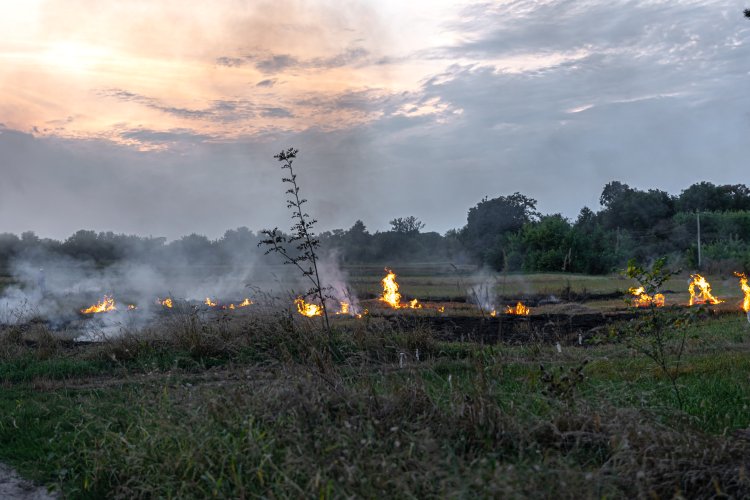
Crop residue burning is still one of the major causes of air pollution. This is especially seen in the Delhi NCR area during the winter season after the harvesting period. This has a major impact on the Air Quality Index for the area.
The government has initiated several steps to reduce the burning of crop residues. Fire incidents are monitored with the help of satellite remote sensing by following a standard protocol developed by the Indian Council of Agricultural Research – Indian Agricultural Research Institute, New Delhi.
Farmers are being helped through other alternatives such as in-situ crop residue management, which includes mulching as well as incorporating residues into the soil through machinery, along with ex-situ options such as industrial uses of paddy straw. For this purpose, a Central Sector Scheme on Crop Residue Management (CRM) has been operational since 2018-19.
Under this scheme, 50% financial support is given to farmers to procure machinery, whereas 80% financial support is given to rural entrepreneurs, cooperatives, SHGs, FPOs, and panchayats to set up Custom Hiring Centers (CHCs). Financial support of 65%, up to ₹1.50 crore, is also given to paddy supply chain projects involving machinery such as tractors, balers, rakers, and loaders.
Between 2018-19 and 2025-26, as of March 10, 2026, the amount of ₹4,237.47 crore has been released, with more than 3.53 lakh machines having been distributed among farmers, while more than 43,535 CHCs have been established across the states.
Policy Push and Enforcement Measures
The CAQM Act passed in 2021 established the Commission on Air Quality Management (CAQM) for the purpose of coordinating activities to enhancing the quality of air in the National Capital Region (NCR) and surrounding areas. In July 2022, the CAQM created a comprehensive policy with sector-specific plans of action for improvement of air quality, and included agricultural practices to address issues of farm burning of crop stubble/ residues.
CAQM has also issued many instructions to control stubble burning. In May 2025, it said that crop residue management machines must be available for free of cost for small and marginal farmers. On the orders of Punjab and Haryana Governments, in June 2025, the Central Government directed brick kilns to use biomass instead of burning agriculture waste.
Subsequently, in October 2025, the Central Government authorised district officials to initiate legal proceedings against those who would breach the stubble burning regulations.
Thermal power plants within 300 km of Delhi (approximately) have received orders to mix biomass pellets with coal when generating electricity. Under regulations that the Ministry of Environment, Forests and Climate Change issued in 2023, these power plants must use a minimum of 5% agricultural crop residue fuel. If they don’t follow rule, they will have to pay a penalty.
The Central Pollution Control Board also issued guidelines for the use of environmental funds for palletisation and torrefaction plants. Furthermore, 31 flying squads of the CPCB were deployed from October 1 to November 30, 2025, in hotspot districts of Punjab and Haryana.
Sharp Drop in Fire Incidents
Most of the stubble burning incident happens due to crop waste which are not managed properly. Because of better measures, Punjab and Haryana have seen over a 90% drop in burning cases as compared to earlier years.
Even after this improvement, stubble burning has not completely stopped. It is clear that there remains a serious need for ongoing monitoring, long term solutions to fully control the problem.
What's Your Reaction?