ICLEI South Asia’s CapaCITIES programme completes 10 years of supporting Indian cities with climate planning, low-carbon solutions and urban resilience initiatives.
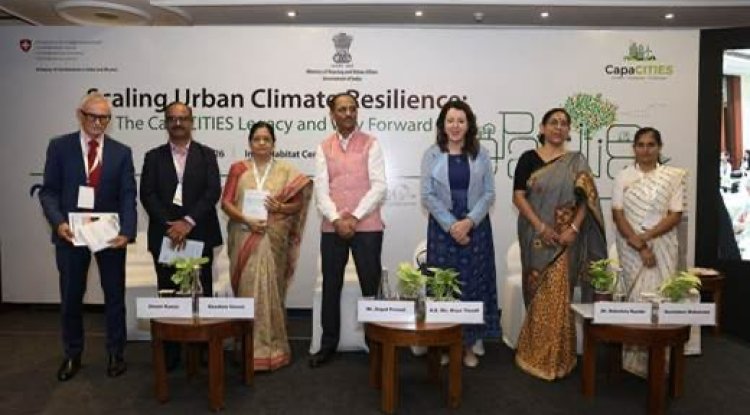
ICLEI South Asia organised an event on 14th July at India Habitat Centre, New Delhi, to commemorate 10 years of building urban climate resilience, named ‘Scaling Urban Climate Resilience: The CapaCITIES Legacy and Way Forward’.
Since its launch in 2016, funded by the Embassy of Switzerland to India and Bhutan, the CapaCITIES programme has provided Indian cities with knowledge, tools and institutional capacity to integrate low-carbon and climate-resilient approach into existing urban governance. The programme was launched through a collaboration between ICLEI South Asia, South Pole and econcept with NIUA as the knowledge partner. Direct support was given to cities of TamilNadu and Gujarat like Coimbatore, Tiruchirappalli, Tirunelveli, Ahmedabad, Rajkot, Vadodara, Udaipur and Siliguri.
It facilitated Net-Zero Climate Resilient City Action Plans in eight cities across four states, set up permanent Climate Action Cells in six cities, and rolled out high impact projects such as a solar e-bus charging station in Ahmedabad, a floating solar plant of 154 kWp in Coimbatore, 100 subsidised e-autos in the Green Mobility Zone in Rajkot, lake restoration in Tiruchirappalli, early flood warning system in Tirunelveli and a Green Mobility Zone in Vadodara through the Miyawaki urban forestry project. The programme has also scaled up its capacity development processes to Global South neighbouring countries such as Bhutan, Bangladesh, Sri Lanka and Malaysia.
This has resulted in 35+ cities implementing the Climate Resilient City Action Planning methodology, 1000+ persons trained in climate planning and financing, 12 climate action plans developed, and identification of ₹7,142 billion worth of climate investments through Net-Zero CRCAPs.
At the event, three knowledge products were launched, including a Net-Zero Climate Resilient Cities Methodology Toolkit, an Energy Transition Practitioner's Guidebook for Urban Local Bodies and a white paper on facilitating low-carbon finance flows, in addition to the Video Training Series which is now available on the National Urban Learning Platform.
Gopal Prasad, Economic Adviser, Ministry of Housing and Urban Affairs, emphasised that the model being developed under this programme can be replicated across the rest of India, highlighting that urban local bodies should have dedicated climate cells which would integrate climate action to their planning and budgeting processes.
What's Your Reaction?