A landmark Indian wheat genetics study has identified climate-resilient and disease-resistant traits that could help develop stronger wheat varieties for future food security.
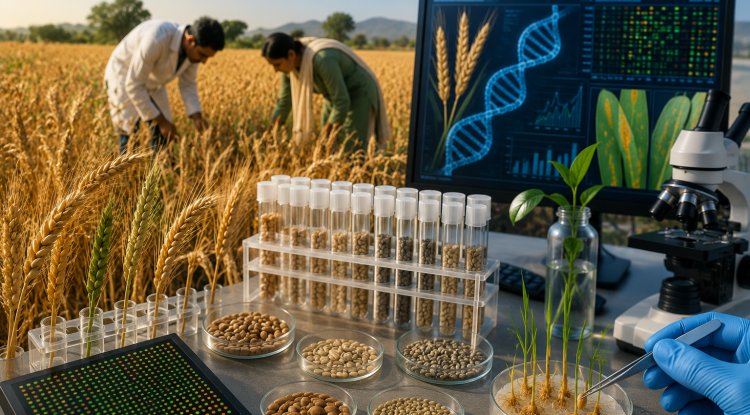
In one of the largest wheat genetic research projects in India so far, researchers say they have identified the genetic traits to protect wheat from the effects of climate change in traditional wheat varieties that could provide hope for food security in hot and dry times to come.
The study, coordinated by the Indian Council of Agricultural Research – National Bureau of Plant Genetic Resources (ICAR-NBPGR) and supported by the Department of Biotechnology, brought together over 7,000 wheat varieties from remote villages, gene banks across the globe and generations of preserved seeds to evaluate the varieties at 20 locations across the wheat belts. The trial sites were selected in Kashmir for cold tolerance, Ludhiana for heat tolerance, and Wellington in Tamil Nadu for stem rust evaluation.
Even the scientists were surprised by the results. A fungal disease known as stem rust, which in the past destroyed entire harvests, was readily resisted by nearly 770 samples. Hundreds were resistant to leaf rust, stripe rust and spot blotch. In combination with their resistance to several diseases, some were also drought-, heat- and salt-tolerant in a single germplasm line.
GP Singh, who coordinated the project till February this year and is now Vice Chancellor of Acharya Narendra Deva University of Agriculture and Technology, Ayodhya, said while speaking to a leading media outlet, "This is the type of multi-tasking resilience that is rare and valuable, as farmers use fewer chemical sprays and production is more stable despite unpredictable weather conditions."
Using a technique known as Genome-Wide Association Studies, the wheat's genetic makeup was scanned, and hundreds of gene markers associated with disease resistance, heat tolerance and improved nutrition were identified. One exciting finding was a cluster of genes on chromosome 5B that helps wheat deal with heat stress. The researchers have now developed genetic tests similar to a blood test, but for plants, so that breeders can check a young seedling for these desirable traits without waiting for it to mature into a full plant, Sundeep Kumar, principal scientist at ICAR-NBPGR, Pusa, New Delhi, said while speaking to a leading media outlet.
The team also developed a chip that can simultaneously scan almost 89,000 genetic markers, a curated "core" seed collection that captures the wheat diversity of India, and the first prediction model for breeding rust-resistant wheat. The most promising seeds have already been dispatched to 35 centres across the country for testing under actual farming conditions as part of the National Genetic Stock Nursery before the traits are transferred to farmers' fields.
What's Your Reaction?