The time is now. Only innovation, collaboration, and common commitment to sustainability can lead India toward the charge globally in this transition toward a circular economy
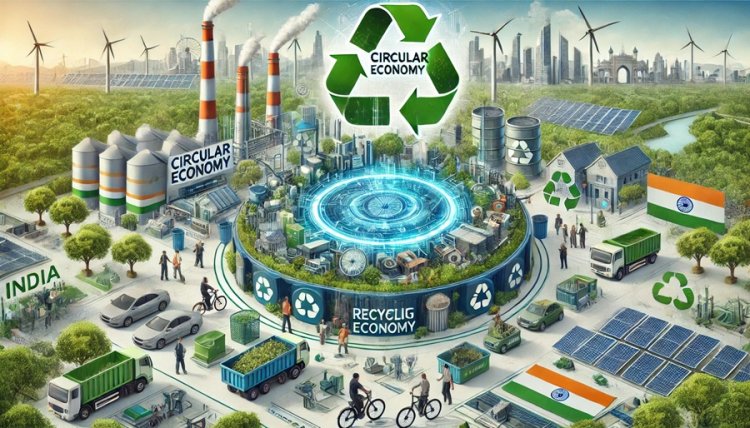
India's path to a zero-waste future depends on a collaborative approach that connects technology, policies, and innovations across industries. Many businesses and consumers have already begun making efforts to reduce pressure on landfills by following policies and practicing waste segregation. In Indore, many residential societies are recycling their waste within their own premises. Those who haven't must take action and coordinate to drive a sustainable transition as waste generation continues to rise.
With electronic trash on the rise globally and India's municipal solid garbage generation expected to exceed 436 million tonnes by 2050, there is an increasing need to reconsider waste. The most practical way ahead is through a circular economy, in which materials are collected, reused, and reintegrated into the supply chain.
Chaitanya Kalia, Partner and National Leader, Climate Change and Sustainability Services, EY India, said, "Effective waste management in India requires a holistic approach, from responsible production to sustainable disposal. Businesses should invest in green materials, advanced recycling technologies, and waste-to-energy solutions while AI-driven waste sorting enhances efficiency. However, true transformation starts with awareness and education. Citizens and consumers play a pivotal role—by adopting responsible habits and making sustainable choices, they can drive the shift toward a cleaner, greener future for India."
Nitin Gupta, Co-founder & CEO of Attero, considered waste an opportunity rather than a burden on the environment and emphasised the need for responsible disposal. "Waste becomes one lost opportunity. Future sustainability relates to a circular economy, where critical materials are recovered, reused, and reintegrated into the supply chain. For that, Attero is leading change-action to ensure that e-waste and lithium-ion batteries are recycled at a resource recovery efficiency of 98%, while producing more than 99.9% pure metals. Operating entirely on renewable energy while also reducing GHG emissions and using intellectual property for sustainable innovation-the new benchmark for responsible recycling. One cannot achieve true zero waste unless an industry, governmental policies, and consumers come together for sustainable practices. The time is now to move forward with action and innovation building for a future where waste becomes a resource rather than an ever-increasing crisis," he said.
Technology is creating very fast strides in actualising transparency and accountability through waste management. As Nimit Aggarwal, Founder, EcoEx, pointed out, "Digital solutions can really drive efficiency". "This Zero Waste Day will remind us all that waste, itself, is an undeveloped resource rather than just a problem for the environment. Global waste generation is expected to increase from 3.4 billion metric tonnes by 2050, making a circular economy even more vital and urgent. Countries like India, which have fast blood flow patterns of consumption and increased urbanization, are rapidly generating thrash cans. Solutions to effective waste management become the keys to sustainability. We bring transparency and accountability to the waste management sector at EcoEx with technology on the waste producer side, ensuring that they fulfill their Extended Producer Responsibility (EPR) without a glitch. Integration of blockchain and AI-driven traceability tools will eliminate inefficiencies and prevent fraud in a truly circular economy. Along with that, the future of waste management is in the collaboration of policymakers, industries, and innovators," he added.
Abhishek Agashe, Co-founder & CEO of Elima, said that the recent policy developments as a defining moment for India’s circular economy. "But most of all, it represents a defining moment for India's circular economy," said the Ministry of Environment, Forest and Climate Change, in its policy statement dated December 3, 2022. By 2050, as per the estimates, total municipal solid waste generation is likely to touch 436 million tons, and EPR can no longer be just a regulatory checkbox-it has to be the backbone of sustainable waste management. Through formalizing waste recycling and promoting accountability, this policy makes India's commitment to resource efficiency, industry engagement, and climate resilience even stronger.
India’s circular economy could generate a market value of over $2 trillion and create close to 10 million jobs by 2050, said Bhupender Yadav, Union Minister for Environment, Forest & Climate Change, during a Circular Economy Forum in Asia and the Pacific. He added that the ‘circular economy’ may be about to drive one of the biggest transformations in business since the Industrial Revolution 250 years ago. Through a radical departure from the traditional 'take, make, waste' production and consumption models, the circular economy could provide a potential $4.5 trillion in additional economic output by 2030 world over.
Agashe further said that beyond just compliance, EPR could propel circularity at scale. Studies show that a perfect EPR model has the potential to generate more than 15 million green jobs by 2047 in driving India's Viksit Bharat vision while unlocking about $500 billion in economic opportunity. Digitalisation and online marketplaces for EPR will take the major step forward, assuring higher transparency, efficiency, and fair market access to recyclers and producers alike. But, of course, to become truly realized and reap the benefits of circularity, India has to engage with strong policy interventions to speed investment in recycling infrastructure and skill development, and localised material recovery systems.
On the way to a zero waste future, the confluence of technology, policy, and industry leadership will be critical in scaling solutions. Whether it is through advanced recycling, AI-driven waste sorting, or iron cast EPR implementation, businesses and policymakers must work all out at bringing waste out of being an environmental challenge and into the fold of a valuable resource. The time is now. Only innovation, collaboration, and common commitment to sustainability can lead India toward the charge globally in this transition toward a circular economy.
What's Your Reaction?