Iran-Israel Conflict Pushes Balochistan’s Fishing Industry Toward Collapse
The Iran-Israel conflict has halted Pakistan-Iran border trade, crippling Balochistan's fishing economy. Without fuel or markets, local fishers face rising poverty, debt, and food insecurity amid collapsing livelihoods.
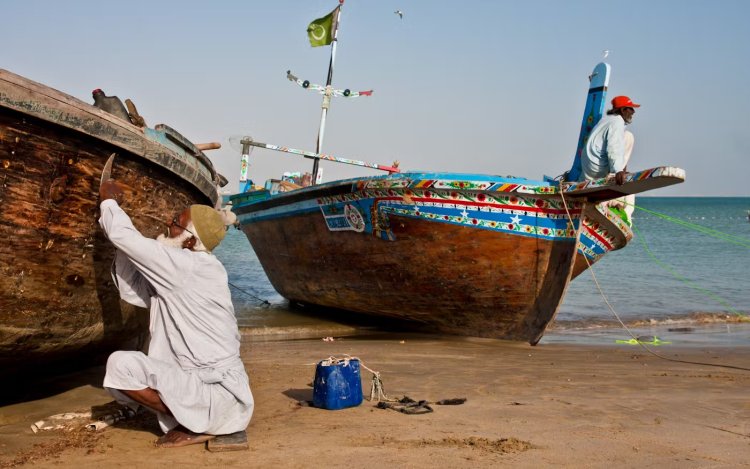
Iran-Israel conflict has initiated a domino effect that is causing a heavy price to the fishing community of south-western Pakistan's Balochistan province. Closed is the border between Iran and Pakistan, frozen now is fish and petrol trade—a source of livelihood for thousands of fishermen—keeping the local economy in dire straits.
Small-scale fishing also gives employment and food security to towns such as Jiwani, Gwadar, and Ormara. Closure of the border shut down barter trade with Iran where Pakistani fishermen sold their haul in exchange for petrol and diesel through Iranian speedboats. It maintained coastal economies dependent on poor infrastructure such as cold storage or traditional export channels intact.
Balochistan's 770-km Arabian Sea coast is one of the country's key sources of fisheries. Official reports indicate the province producing some 340,000 tonnes of fish worth almost PKR 19.9 billion (US$70.1 million) every year. The high-value catches are tuna, Spanish mackerel, croaker, Indian oil sardine, and Indian mackerel.
But the industry is still undercapitalized and lightly regulated. The redirection of trade away from Iran is revealing the weakness of this off-the-books economy. If not for Iranian markets, where tuna sells for PKR 300–700 (US$1.06–2.47) per kilogram, the entire Iranian tuna fishery would fail. Export of tuna to Iran is worth approximately PKR 15–35 million (US$52,900–123,300) per year.
It's not just an economic crisis. It's also a deeply social crisis. Women making a living from post-catching activity such as grading, drying, and selling fish are losing their income. Fuel shortages are rendering the cost of running fishing boats unaffordable. The majority of boats have had to suspend sailing, reducing supply and denying local markets of cheap fish. There is no secondary income for families, so they're piling up debt and missing meals. Children are withdrawing from school.
Small-scale fishers are especially exposed. The fuel price for one journey has doubled, sometimes reaching over PKR 30,000 (US$106) or even higher, while the sales proceeds have plummeted by half. Vessels bring back the leftovers of fish, and there is no mechanism to store or maintain the leftovers because no freezing houses or ice factories are available. The local market does not absorb the leftover, and wastage is involved.
This dislocation is hitting a whole value chain comprising fish processors, mechanics, traders, and local transporters. Prices of staple fish such as sardines and Indian mackerel are going up, denying poor families cheap sources of protein. The non-availability of affordable fish, combined with the spiking cost of poultry and meat, is raising alarm about a looming food security crisis.
Local governments and NGOs are pressuring the government to move. Anonyms on the table include fuel emergency subsidies and fishermen's compensation. A PKR 380 million (US$1.34 million) endowment has been proposed to support pronto. Measures in the longer term involve investment in cold storage, canning, and formal trade channels to develop the industry's resilience.
Experts believe that making the fishing sector industrialize can turn it into a sustainable and lucrative enterprise. But this should be done quickly in coordination with provincial and federal governments. The economic and social fate of coastal Balochistan people hangs on a timely move.
As fighting in other parts of Pakistan continues to change, its unforeseen consequences echo through fragile coastal areas. Depletion of the Balochistan fisheries sector, if not dealt with at a single point in time, has serious implications not only in the region but throughout Pakistan's economy as a whole.
Source & Credits:
First published by Dialogue Earth under a Creative Commons license. By Shabina Faraz and Abdul Rahim.
What's Your Reaction?