In an interview with ResponsibleUs, Amit Kapur, Chairman, Founder & Managing Director of IOTA Group Co, NICO Nanobubble India Co. and IOTA Water, talks about the new water technology and how it can clean water bodies in just 15 minutes.
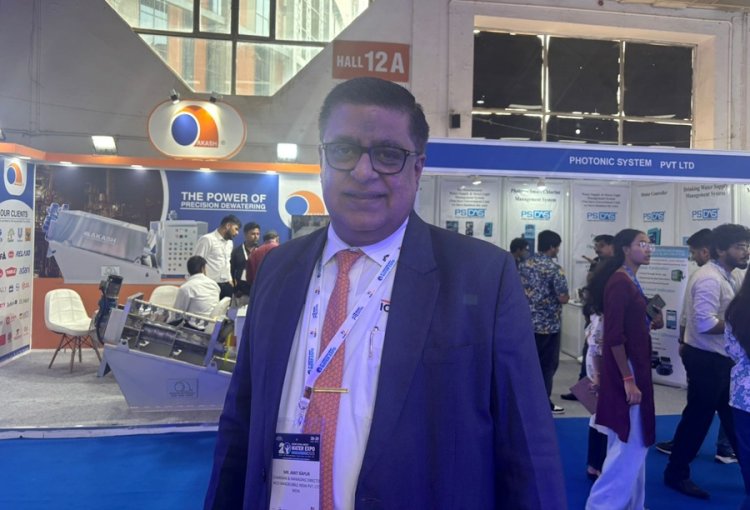
In an interview with ResponsibleUs, Amit Kapur, Chairman, Founder & Managing Director of IOTA Group Co., NICO Nanobubble India Co. and IOTA Water, discussed the new water technology and how it can clean water bodies in just 15 minutes.
Interview excerpts:
Could you explain how your nanobubble technology works in cleaning rivers, and what are your future plans for the Yamuna and Hindan rivers?
We conducted a pilot with the Haryana State Pollution Control Board on our Mangeshpur drain, which passes through Bahadurgarh and ultimately merges into the Najafgarh drain. The Najafgarh drain then enters the Yamuna, and now we are trying to work with authorities in Delhi for its revival as well. Most of the technologies currently being proposed, or adopted by the government, are DSTPs—decentralised STPs. But DSTPs are meant for the incoming water into the drain. The challenge is with leakages and with water that is already present in the drain. You may treat the inlet, but what about the leakages and the stagnant water already in the drain?
Specifically, in the case of the Najafgarh drain, it starts all the way from Rajasthan and ends up in the Yamuna. What we proposed to the government is a nanobubble technology that can do in-situ drain treatment—meaning the running water in the drain can be treated directly. We conducted a pilot of roughly 0.5 MLD in association with the Haryana State Pollution Control Board, who kindly supported us throughout, and we achieved fantastic results.
The treatment time was 15 minutes for a batch of water, and it was a continuous process. We were drawing out drain water, treating it, and pumping it back. Within 15 minutes, the water became fit for irrigation use (Class C water). The BOD and COD levels met CPCB norms, and dissolved oxygen levels rose from negligible values to about 5 ppm, which is the irrigation requirement.
This is what we wanted to demonstrate to the government—that our nanobubble technology is a beautiful solution for existing STPs and ETPs that are struggling to meet revised CPCB norms, as well as for running drains like Najafgarh or others in UP and Noida that flow into the Yamuna and have become a major concern.
I was reading that due to the monsoon and increased water release, the Yamuna’s state has improved slightly because of dilution. But once the rains end, the condition will again become alarming for all of us and for aquatic life in the Yamuna. This is why we are working with various government departments, who are listening to us and supporting us in adopting this latest technology.
You mentioned that your nanobubble technology is completely made in India, patented globally, and chemical-free. Could you explain how oxygen nanobubbles work to clean ponds so much faster—within just one or two months—compared to traditional methods?
We have developed 5 nanobubble generation methods, patented globally, and we are a very proud Indian company. This is completely made in India. There is no imported product that goes into it.
Everything is made in India. It is a completely sustainable, chemical-free technology, which is the future of aeration.
We can clear or rejuvenate any pond with our technology in just 1 or 2 months. We are introducing oxygen nanobubbles into the pond, which take care of all the impurities and algal bloom. All those problems are solved.
How do you scale your nanobubble technology from small ponds to large water bodies like Delhi Zoo and Krishna Math Temple?
For example, we did one in South India, Karnataka—the Krishna Math Temple, a very famous temple in Udupi. They have a huge water body, crores of litres of water, and we revived that.
This technology is basically for treating pond water and reviving it back, maybe in 1–3 months, so you don’t have to wait years.
How much investment does one person have to make for one pond?
Our smallest system starts at about Rs 2.5 lakhs. Then it depends on the volume of the pond—it can be a small pond, a huge lake, or even a running drain. It depends on the volume of water to be treated, and the cost increases accordingly. But yes, we start from about 2.5 lakhs.
Our systems are also widely used for farming, and we have seen fantastic results in the yields for farmers. That is the dream of our Prime Minister—that farmers’ incomes should be doubled. This is one of the tools to achieve that.
We are in talks with the Agriculture Ministry to see if we can subsidise it for farmers, so that even a small farmer with 1–2 acres of land can use this technology and double production.
This is good for the country at the end of the day. If today we are producing X tonnes of wheat or rice, and in the next season we can produce 1.5 to 2X, that is a big achievement. In this time, we need to be self-reliant and adopt innovative, sustainable, chemical-free technologies.
In India, there are all kinds of farmers—wealthy farmers as well as small and marginal ones. Rich farmers are already adopting this technology and achieving good yields. We have worked with farmers growing wheat and rice, and the results have been fantastic. We’ve also applied it to coloured capsicum and strawberries. But our goal is for every farmer in India to adopt this technology.
It’s similar to when solar came in. Prime Minister Modi’s dream was that every farmer should have solar pumps. In the same way, our vision is for this technology to reach every farmer in India.
That’s why we are in discussions with the Agriculture Ministry about introducing subsidies, especially for small farmers with one or two acres of land who cannot afford this technology right now. For them, even spending two and a half to three lakh rupees is a big challenge. If the government supports them with some subsidy, we can break the vicious cycle of poverty and move toward sustainable development.
How has your experience been in working with government departments to push this technology forward? Was collaboration challenging or relatively smooth?
We have already spoken to different government departments, and the response has been positive so far. We believe this will happen. The government officials are very cooperative. They are also looking for new technologies. For example, the Irrigation Department, PHED Department, and Haryana State Pollution Control Board all receive notices from the NGT. They are actively seeking genuine solutions—not just paperwork or token initiatives, but real interventions that work on the ground. They have supported us in every way possible.
They even paid for our POCs, because we told them we couldn’t absorb the entire cost. So, in that sense, the departments are supportive, and collaboration has been smooth and encouraging.
What's Your Reaction?