New Plasma Trick Makes Hydrogen Production Faster and Cheaper
Researchers have enhanced water-splitting catalysts using argon plasma, making green hydrogen production faster, cheaper, and more energy-efficient.
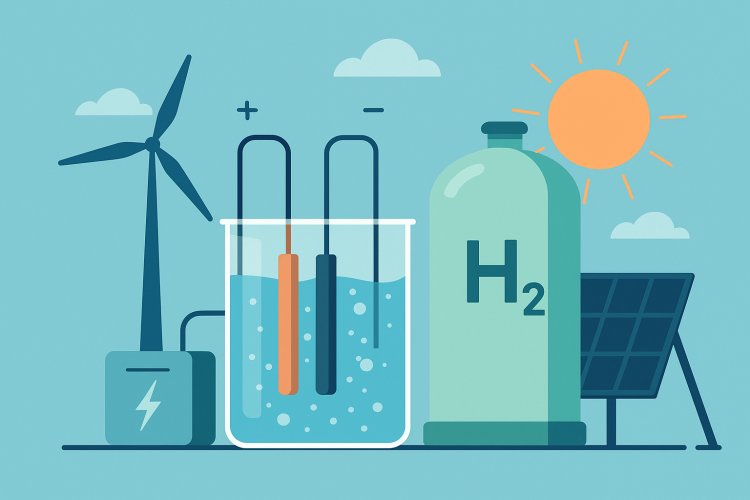
A new strategy has been developed for enhancing the activity of catalysts used to split water for generating Hydrogen, one of the cleanest known fuels. In water electrolysis which is one of the key methods for producing clean hydrogen, the oxygen evolution reaction (OER) has long been viewed as the difficult step. Compared to the hydrogen evolution reaction (HER), OER is slower and requires higher overpotential, making the development of efficient, noble-metal-free catalysts a major research priority.
Limits of Existing Coordination Polymer Catalysts
Among the materials explored, coordination polymers (COPs), formed using metal ions and organic molecules, have shown promise. However, most of their metal centres are fully coordinated with solvent and water molecules, leaving very few active sites available for electrocatalysis. This structural limitation restricts their effectiveness in driving OER.
Researchers at the Centre for Nano and Soft Matter Sciences (CeNS), Bengaluru—an autonomous institute under the Department of Science and Technology (DST), aimed to solve this challenge. They developed a novel method to enhance the catalytic activity of COPs without compromising their overall structure.
Argon Plasma Treatment Creates Active Metal Sites
The team used argon plasma treatment to activate the COPs. This process generated coordinatively unsaturated metal sites (CUMSs), effectively exposing more active regions of the material. Importantly, this activation improved catalytic performance while preserving the bulk integrity of the polymer.
Structural Analysis Confirms Stability and Improved Activity
Detailed structural studies confirmed the success of this approach. Both Ni- and Co-based COPs showed consistent results across single-crystal and bulk powder X-ray diffraction (XRD). While the untreated materials displayed high onset potentials and sluggish oxygen evolution in alkaline media, their performance improved significantly after plasma activation. Powder XRD, TEM, XPS, and contact-angle measurements verified that the plasma process created CUMSs without altering the underlying framework.
Enhanced Efficiency Paves the Way for Better Hydrogen Catalysts
The plasma-activated Ni- and Co-COPs demonstrated substantial improvements in electrocatalytic performance. The study published in ACS Applied Nano Materials, shows a smart way to coordination-polymer catalysts work much better without damaging their structural modification while maintaining their stability. By improving these materials from the inside, scientists can create cheaper and more efficient catalysts for water splitting, contributing to global efforts toward clean and sustainable hydrogen energy.
How this helps the environment and the planet
Hydrogen made using renewable energy does not release carbon, so it is a clean fuel. But today it is expensive because splitting water needs a lot of electricity, mainly because the oxygen evolution reaction (OER) is slow and inefficient. If we Improve the catalysts that help this step happen faster, the process will reduce electricity waste and hydrogen becomes cheaper to make and easier to adopt as a clean energy source. Secondly, hydrogen makes large-scale green hydrogen more practical, it cuts carbon dioxide emissions massively, hydrogen supports National Green Hydrogen Mission and India’s net-zero 2070 timeline. It also reduces dependence on rare and expensive metals
Conclusion
Scientists used argon plasma to improve the water-splitting catalysts to expose more active metal sites. As a result, clean hydrogen becomes cheaper, faster production, and using less energy. The breakthrough boosts India’s green hydrogen push, reduces carbon emissions, and helps the earth stay cleaner.
What's Your Reaction?