Prakriti 2026 brought together global and Indian stakeholders to discuss carbon markets, climate finance, and sustainable growth.
The International Conference on Carbon Markets – Prakriti 2026, organised by the Bureau of Energy Efficiency, Ministry of Power, and the Ministry of Environment, Forest and Climate Change, has been concluded in New Delhi.
This conference brought together experts, policymakers, industry leaders, researchers, and practitioners from India and around the world to share insights on how carbon markets are changing, why they are important for climate action and how they can help India grow in a cleaner and more sustainable way. The theme for the conference this year was “Unlocking Carbon Finance for NDC Implementation through Global Partnerships and Digital Pathways.”
On the first day of the event, the Indian Carbon Market Portal, (www.indiancarbonmarket.gov.in), which is a focal platform to execute and manage the Indian Carbon Market, was launched by the Union Minister of Power and Housing & Urban Affairs, the Minister of State for Power, and other officials.
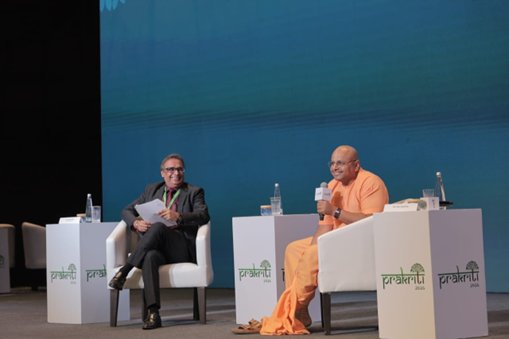
On the second day of the conference, the motivational speaker Gaur Gopal Das took part in the fireside chat session and discussed the topic of sustainability as an external factor as well as an internal process. He emphasised that empowerment in sustainability requires distinguishing between “Pi”- the unchangeable constants and “X”, our personal power to act. By focusing on “X”, individuals can move beyond helplessness and embrace proactive commitment, where even small actions contribute to meaningful impact.
He urged participants to cultivate an “internal Net Zero of the spirit” to prevent burnout, explaining that resilience is essential for effective climate action. He introduced the concept of the “3 Ps”- Pausing to rejuvenate, practicing gratitude for what works, and Processing challenges through facts—as tools to maintain balance and mental strength in a fast-paced world.
Das reminded the audience that technology, while vital, remains “dead matter” without the guiding force of human intention. True sustainability, he said, depends on activating “real intelligence”- our conscious choices and ownership of outcomes rather than blaming machines. Using vivid metaphors, he compared the environment to the road and society to the car, stressing that our lifestyles cannot survive if the road itself disappears. He called upon everyone to treat Earth as a mother, deserving of respect, protection, and care.
In his concluding remarks, he outlined the principles of sustainable living: take only what is needed, restore what is used, and protect what cannot be restored. He urged celebrating progress over perfection, reminding that every incremental step builds hope and contributes to a lasting green legacy. His message reinforced that sustainability is not only about policies and technologies but also about personal responsibility and mindful living.
The conference included sessions on topics such as global carbon markets under the Paris Agreement Crediting Mechanism, compliance frameworks, digital MRV technologies, carbon border policies, integration of buildings and cooling into India’s carbon trading framework. It also covered support for farmers, funding for clean technologies and the role of companies in climate action.
The discussions showed India’s approach to developing carbon markets in line with global systems with focus on transparency, credibility, and innovation. The conference also highlighted ongoing efforts to support the transition towards a low-carbon economy.
What's Your Reaction?