Reliance Industries is accelerating its clean energy transition through large-scale investments in battery manufacturing, green ammonia, solar power and clean fuel technologies to support India’s renewable energy goals.
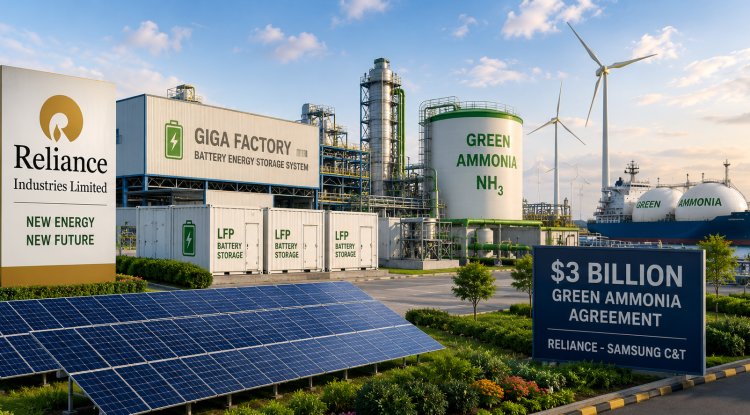
The shift to sustainable energy is accelerating worldwide, and India's largest private sector conglomerate is making a major move to strengthen its position in the energy transition. Reliance Industries Limited has announced a major expansion of its clean energy business, moving rapidly from planning and development to commercial deployment. According to media reports, the company has significantly expanded its long-term battery manufacturing plans and signed a green ammonia agreement worth approximately $3 billion with Samsung C&T Corporation of South Korea.
These developments provide a clearer roadmap for the commercialisation of India's clean energy sector, and the company appears to be positioning itself for future revenue generation from its green energy investments as projects move towards commercial operations.
The company's plans for advanced energy storage have expanded significantly, with a threefold increase in planned battery manufacturing capacity forming a key part of its new roadmap. During its annual general meeting, the management announced that its battery production target has been increased by 120 gigawatt-hours per year from the original target.
The first phase of the project—a 40-gigawatt-hour battery energy storage system and battery cell gigafactory—remains on track for commissioning by the end of this calendar year. Major equipment has already been delivered to the manufacturing facility, and the plant is preparing to begin large-scale production of lithium iron phosphate (LFP) batteries. The facility is expected to focus on cost-efficient manufacturing while supporting the company's broader strategy of expanding clean energy and energy storage solutions.
At the same time, Reliance has made a significant move in the global green chemicals market through a major contract with Samsung C&T valued at more than $3 billion, under which the company will begin exporting green ammonia from the second half of fiscal year 2029. This agreement is among the largest green ammonia offtake contracts announced globally.
Green ammonia, which is increasingly viewed as a low-carbon fuel and hydrogen carrier, is emerging as an important commercial opportunity within the company's clean energy business. In addition to the Samsung agreement, company executives said Reliance is actively engaged in discussions with industrial buyers in Japan, South Korea and Europe regarding potential long-term export agreements, although they declined to disclose the names of the companies involved.
Importantly, the large-scale manufacturing expansions will form part of an integrated clean energy ecosystem centred around the Dhirubhai Ambani Green Energy Giga Complex in Jamnagar. The complex is spread across 5,000 acres and will manufacture solar modules, hydrogen electrolysers and energy storage systems.
To support these advanced chemical and hydrogen manufacturing facilities, Reliance is developing a large solar energy generation facility spread across 5.5 lakh acres in Gujarat's Kutch region. Combined with the battery storage system, the project is expected to generate more than 40 billion units of clean electricity annually, which the company estimates would be equivalent to nearly one-third of India's current power demand.
The broader economic impact of this structural shift extends beyond corporate balance sheets, as it also influences national energy security and economic resilience. India has historically relied significantly on energy imports to meet more than 70% of its energy needs, making energy-intensive industries vulnerable to fluctuations in global energy markets.
The conglomerate is participating in the government's National Green Hydrogen Mission and is working towards supporting India's ambition to become a leading exporter of clean fuels by developing a domestic ecosystem for solar panel manufacturing, energy storage systems and clean fuel production. The company estimates that the green energy ecosystem could create around 200,000 jobs in specialised manufacturing, construction and related infrastructure development.
The investment highlights how economic growth and climate responsibility can progress together, with commercial revenues expected from solar module sales this year and battery production scheduled to begin next year.
What's Your Reaction?