Researchers have developed a new electrochemical process that converts captured CO₂ and water into climate-neutral methane, offering a sustainable solution for clean fuel production and long-term energy storage.
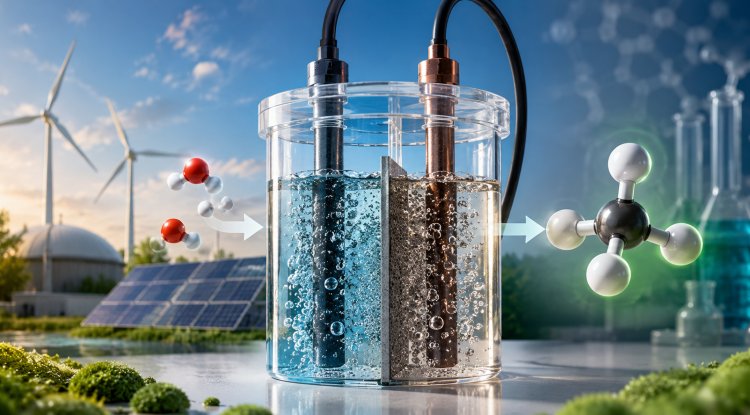
The team of researchers from TU Wien and the University of Innsbruck has found a side reaction that could make the synthesis of climate-neutral methane, or natural gas, possible without the use of fossil fuels, using captured CO₂ and water vapour instead.
The breakthrough was the result of the MECS Austrian Cluster of Excellence, which works to discover special materials for sustainable energy conversion. The team studied nickel on yttria-stabilised zirconia and discovered it could catalyse the complicated series of chemical reactions to create methane – a process that has been fully understood for the first time.
In conventional processes, CO₂ is converted into CH₄ with the assistance of hydrogen, most of which is currently generated by fossil fuels, which is not a climate-neutral process. The new pathway avoids this challenge by splitting CO₂ to supply carbon and splitting water to produce green hydrogen, all in one electrochemical process. This methane can be fully renewable and may be further processed to liquid fuels.
One of the major findings of the research was the importance of the zirconia. Zirconia was once thought to be primarily an oxygen-ion transporter; it was found to be much more active than originally believed. Upon applying an electric voltage, the carbon first deposits on the nickel atoms – as would be expected. However, some of this carbon is then transferred onto the surface of the zirconia, where it reacts with the zirconia to form a reactive carbon zirconium compound. In the presence of small amounts of water vapour, this compound can react to form methane through a previously unknown mechanism.
The finding opens up exciting possibilities in the field of energy storage. This electrochemical reaction could be used on sunny days when solar panels produce excess electricity, and the resulting methane would be a more practical way to store it for a longer time to meet demand in industries.
What's Your Reaction?