Researchers at INST Mohali have developed a method to generate spin currents using sound waves, offering a potential pathway for lower-energy computing and spintronic technologies.
A group of researchers from the Institute of Nano Science & Technology (INST), Mohali, has come up with a technique to produce and regulate spin currents in magnetic materials by means of sound waves, as mentioned in a press release issued by the Ministry of Science and Technology.
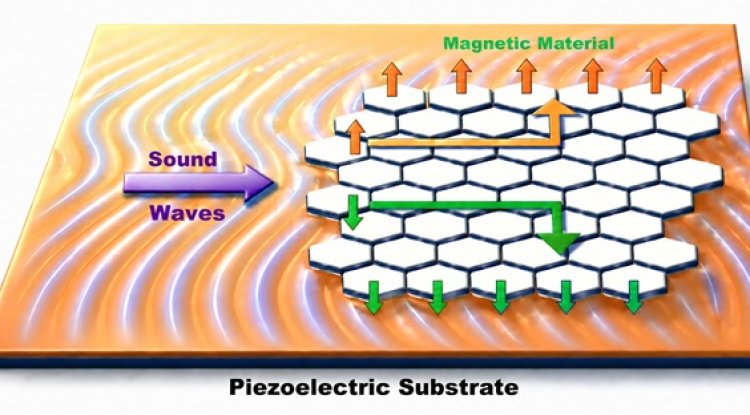
This research, published in the journal Physical Review B, focuses on the effect of surface acoustic waves on magnons in two-dimensional magnets. Magnons are magnetic particles that transport information without the help of an electric current.
Shivam Sharma, a PhD candidate at INST, carried out this research under the guidance of Abir De Sarkar.
For the study, scientists devised a theoretical model using ultrathin magnetic materials similar to graphene, layered on piezoelectric substrates. Piezoelectric substrates convert mechanical energy into electrical signals.
It was found that the propagation of surface acoustic waves across the substrate leads to distortions within the magnetic substance. These affect the magnon dynamics and give rise to spin currents.
In this case, information is carried not by charge but by the particles' spin. Scientists asked themselves whether it was possible to produce spin currents by means of sound wave interactions with magnetic substances.
This research relied upon previous work analyzing the effect of surface acoustic waves on electronic processes and the effect of quantum geometric factors on magnon transport. A potential connection between these phenomena has been proposed.
Spintronics, the science of using the spin of particles for information transfer and storage, is an active area of research. Spintronic devices are expected to replace classical charge-based electronics.
The researchers said the mechanism could be relevant for information-processing technologies, strain-controlled electronic and magnetic devices, and other applications involving magnon transport.
The findings add to ongoing efforts to understand how magnetic excitations behave in quantum materials and how they can be controlled using external stimuli such as sound waves.
What's Your Reaction?