Vietnam's electricity grid is under growing pressure as an intense heatwave drives record power demand and prompts nationwide energy-saving measures.
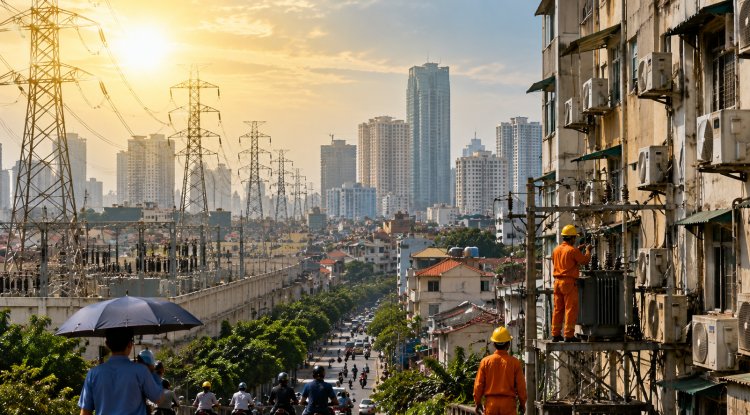
It’s not just the heat of the summer; it has become a daily challenge. As temperatures climb to 40°C and the real-feel temperature approaches a suffocating 48°C, people's comfort depends largely on the uninterrupted hum of air-conditioning. The situation in Vietnam has put the country's power infrastructure under severe strain. State utility EVN and the National Power System and Electricity Market Operation Company (NEMPCO) have issued a strong call to businesses and households to consciously reduce energy consumption before the system reaches a tipping point as an intense summer heat wave spreads across the country, especially in the northern provinces.
Electricity demand has reached unprecedented levels. Vietnam's peak electricity load reached 58.46 gigawatts (GW) on Wednesday, June 24, 2026, the highest recorded level to date. To put this into perspective, the same grid that met demand in previous summers is now being pushed to its limits to support a rapidly industrialising economy. The need is especially severe in the north, where demand exceeded 30,000MW for the first time in history, climbing to 30,209 megawatts late in the evening. Engineers expect electricity demand to rise further in the north, with weather forecasts indicating that the heat will continue.
The unique aspect of this particular energy challenge is the shift in energy consumption patterns. Grid operators have reported that the hottest part of the day is no longer the period of greatest stress on the system. Rather, the grid is most vulnerable between 5:30 p.m. and 10:30 p.m. During these evening hours, millions of people return home from work and simultaneously switch on cooling units, household appliances and electronic devices. At the same time, solar power generation declines sharply after sunset, while many reservoirs in the region are already experiencing water shortages following a prolonged dry spell.
Energy officials are calling on the public to act responsibly, recognising that technical measures alone cannot address the challenge. The basic appeal is straightforward: keep air-conditioned rooms at or above 26°C and avoid leaving doors open. While a colder indoor environment may seem attractive during extreme heat, even small reductions in thermostat settings can significantly increase pressure on local substations. Authorities are also urging factories and large businesses to shift operations away from peak evening demand hours and make greater use of natural light and ventilation during the day where possible.
Behind the scenes, the state is using every available measure to avoid rolling blackouts. Nationwide, power plants are operating at full capacity, and maintenance crews are diligently inspecting transmission lines to ensure transformers do not overheat or fail under high thermal loads. In addition, Vietnam is increasing electricity imports from neighbouring grids and expanding the use of domestic gas, liquefied natural gas and oil to maximise power generation. Operators are also carefully managing water levels in available reservoirs to maintain sufficient hydropower reserves capable of supplying additional electricity during peak evening demand.
After all, the unusual demand serves as an indication of a problem which goes beyond a week of abnormal weather. The fact is that days like these are becoming more commonplace in the current scenario with climate abnormalities and El Niño becoming more frequent, making the occurrence of abnormally hot summers highly likely. The sustainability of the economy will require improvements in the grid as well as changes in the way energy is consumed, going forward. Before that happens, demand management through conservation becomes a necessity.
What's Your Reaction?