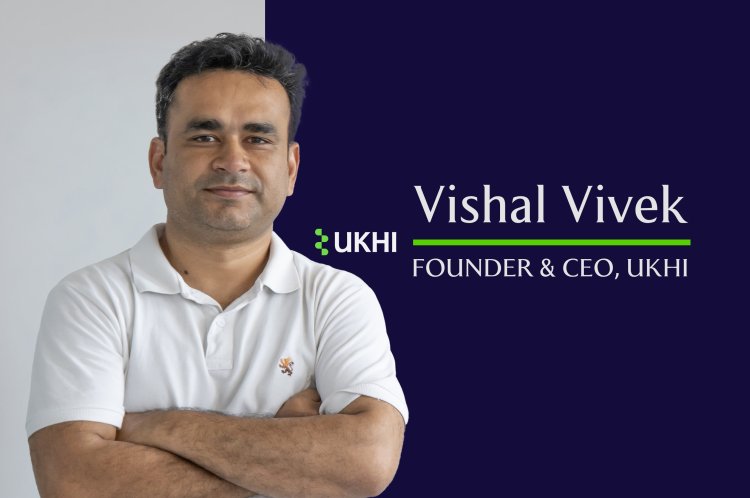
Vishal Vivek, Founder & CEO of Ukhi India, shares the tale of EcoGran, the determination to convert agrowaste into worth, and the challenges in making sustainable materials widely used in a country that is overburdened with plastic
India’s struggle with crop residue burning and plastic waste has created an environmental crisis hiding in plain sight. Every year, the country generates more than 500 million tonnes of agricultural residue, much of which goes up in smoke, while nearly 20 million tonnes of plastic pile up in landfills and water bodies. In the middle of this dual challenge, a quiet but determined materials revolution is taking shape.
At the centre of it is Ukhi, founded by Vishal Vivek, which has developed EcoGran — a biopolymer made from agrowaste such as hemp, nettle, flax and rice husk. It acts like regular plastic, but its life cycle ends with nature, allowing manufacturers to switch to the eco-friendly alternative of non-recyclable plastic without sacrificing performance. After considerable scientific research, fieldwork with farmers, and a firm dedication to the circular economy, Ukhi is presenting itself as one of the uncommon Indian startups striving to rectify the global problem of materials through the basic principles.
In an interview with ResponsibleUs, Vishal Vivek, the Founder & CEO of Ukhi India, shares the tale of EcoGran, the determination to convert agrowaste into worth, and the challenges in making sustainable materials widely used in a country that is overburdened with plastic. His narrative is not only about technology; it is also about endurance, taking risks, and the view that India can be the front-runner in the next generation of eco-friendly alternatives.
Excerpts:
How did this journey begin, and why did you choose such a challenging sector?
We started Ukhi in 2019 with hemp products. We used to make clothes, accessories and medicines out of hemp. The concept was to substitute cotton and polyester because the fashion sector is responsible for one billion tonnes of greenhouse gases. Pesticide pollution from cotton is enormous, and about 500 people die daily in India as a result of it. To give society at least a start to eradicate hazardous waste, the goal was to produce an alternative that would be less harmful to the environment than the present fashion industry.
In your early days in Uttarakhand, what were you actually doing on the ground during that first year?
We have been in Uttarakhand for three years and have been to over 2,000 villages. We used to go to villages and tell farmers that hemp is legal there. they could grow hemp and increase their income. Uttarakhand has more than 2,000 ghost villages because of migration, with many men working in cities, so we tried to support the remaining communities. We campaigned across places like Garhwal and Urgam Valley and explained that hemp farming was legal; animals wouldn’t destroy the crop, and it could help raise income. At the same time, we used to buy hemp thread from China and get fabrics woven on handlooms by village women.
Why was scaling hemp difficult, and what made you shift to biopolymers?
We couldn’t scale hemp because production was limited, and it was legal only in one state. Policies made it hard to grow. So, there were 2 polyesters and cotton. Polyester is made from plastic, so we thought that there were some alternatives to it which are biodegradable. The fibre of the cotton is 10% fibre and 90% cotton, which is a very good material. It is basically cellulose and lignin. And if we could make a polyester-like material from these, it would be a big disruption. So, we shifted to developing biopolymers.
How did biopolymer development change between 2019 to 2024?
We researched without machinery or funding for years. Later, we borrowed money and even took loans just to survive. In 2023, the prototype was made. IIT Madhya Pradesh gave us Rs 25 lakh. An angel investor, ex-CMD of a big PSU, invested Rs 70 lakh. In 2024, we got the first venture funding at the pre-seed stage. We registered funding, which is very good because, usually in the US at the pre-seed level, venture capitalists don’t invest; only 0.2% startups achieve. Our factory started operating in August 2024, and we successfully displaced 1 lakh kg of plastic waste.
What raw materials do you use, and from where do you source them?
Currently, we take rice husk through a vendor who collects from farmers. Earlier, we used to work directly with farmers; now we have a POC. Our biopolymer allows us to mix any secondary agro waste like rice husk, banana fibre, pine needles and nettle. All our materials are fully biodegradable and compostable.
Who are your clients and what applications use your biopolymer?
Our clients are B2B packaging and sustainable-product companies — Good Earth, Moti, Fabric, Cotton Chai, Nolkart Plastic, DCD Pack and others. We’ve also done pilots with Indian Railways through IIT Guwahati. Our materials are used for packaging, bags, cutlery and many other applications.
What certifications, research partnerships and sustainability checks have you adopted?
We have ISO 14001, GMP and ASTM certifications. Our life-cycle assessment is being done by IIT Mandi and IIT Guwahati. We have an MoU with IIT Guwahati where research scholars work on our compositions. We also collaborate with the Indian Institute of Packaging for testing and migration analysis. Under India’s Plastic Waste Management Rules, we are classified as a plastic-waste-compliant manufacturer, and our EPR approval is in process.
What impact have you created so far, and what’s the bigger vision?
In August, we started production, in which we displaced around 1 lakh kg of plastic waste and generated about ₹1.43 crore in revenue in 3 months. If we talk about one quarter, around Rs 1.5 crore is our revenue. This is a plastic industry of 400 million tons. Half of the total is made of single-use plastics. Among single-use plastics, flexible packaging takes up 50%, which amounts to 100 million tons. This way, we are tackling the problem. Recycling for non-recyclable flexible packaging is over. All the materials are going to landfills and will stay there eternally. The world should accept Ukhi, a name that sounds Indian, and show that deep-tech from India can indeed be a huge disturbance worth a trillion dollars.
How did you manage financially during the difficult early years?
We struggled a lot. We went to a lot of trouble, our bank expenses, our personal savings, took loans, maxed out credit cards and borrowed from every source possible just to survive. At one point, we even depended on free credit apps. Despite all this, we kept going because we were passionate about innovation.
How do you manage your research activities, and who supports your R&D?
Our research is very solid. We work with IIT Guwahati under an MoU, where research scholars are on our payroll and work daily on our compositions. IIT Mandi is doing our life-cycle assessment. We also test our packaging materials at the Indian Institute of Packaging. Along with that, we have top advisors, an IIT Guwahati professor and the Additional Director from the Indian Institute of Packaging, both guiding our material development and applications. Our entire R&D foundation is built on authentic, scientific work.
What's Your Reaction?