Garbage near Pune airport is creating a dangerous bird strike risk
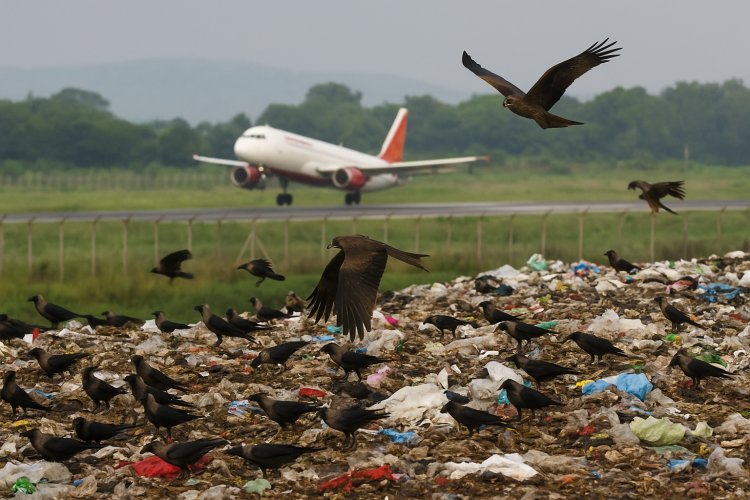
A serious safety issues has been reported at Pune airport which is under threat. Garbage is being dumped in open plots and vacant lands near Pune airport. This waste, especially leftover food, attracts birds like crows, kites, and pigeons which is increasing the risk of bird strikes. Over the last three years, the airport has recorded 120 bird strike incidents, with most of them happening because birds are drawn to waste lying in nearby open plots.
Officials said the garbage is not directly inside the airport but on vacant lands and dumping areas within two kilometres of the runway. Food waste and open trash become easy feeding grounds for birds, especially kites, crows, and pigeons, which then cross flight paths. The Indian Air Force (IAF), which manages part of the airport’s operations, has warned about this growing hazard. Experts explained that bird strikes can damage aircraft engines and parts, putting passenger safety at serious risk.
Residents and activists say the problem is poor waste management. They say garbage from nearby housing societies and markets is often dumped in the open area instead of being properly disposed of. Complaints have been already made, but the situation is yet to be improved.
Airport authorities have asked the Pune Municipal Corporation (PMC) and other civic bodies to act quickly. Measures have suggested regular clearing of garbage, setting up waste segregation systems, and stricter enforcement against illegal dumping.
Experts add that this is not only a safety issue but also an environmental concern. Unmanaged garbage also spreads foul smells, breeding of insects, and health risks for nearby communities. Unless quick action is taken, Pune airport may continue facing frequent bird strike risks, which could force airlines to delay or divert flights, causing inconvenience to passengers.
Bird strikes Is a global threat
While many bird strikes only cause flight delays but history shows they can sometimes lead to catastrophic accidents. In India, several flights have suffered engine damage due to bird strike. In 2019, a SpiceJet Boeing 737 had to make an emergency landing in Ahmedabad after a bird hit to the plane which leads to severely damage to the engine. In 2009, US Airways Flight 1549 struck a flock of geese after take-off from New York. Both engines failed, and the captain made an emergency landing on the Hudson River and saved the life of 155 people. The incident, famously called the “Miracle on the Hudson”, remains the most well-known bird strike case worldwide.
Global prevention measures
Airports worldwide use a mix of innovative methods to reduce bird strike risks. The radar systems to detect flocks of birds near runways, Falconry units, where trained falcons scare away smaller birds naturally, Laser and sound systems that create disturbances to prevent birds from nesting near airports, Strict no-garbage zones around airports, enforced through legislation, Grass management, ensuring that the type of vegetation near runways does not attract insects and, in turn, birds. Experts suggest that Pune airport and the PMC could adopt some of these global best practices in addition to better waste management.
Not just safety, but also public health
Apart from aviation safety, the garbage piles are also an environmental hazard. They produce foul smells, attract stray animals, breed insects, and pose serious health risks for residents in surrounding areas. This makes the issue one of both public health and aviation safety.
What's Your Reaction?