The Ministry of Statistics and Programme Implementation's National Indicator Framework Progress Report 2026 highlights India's progress across social, economic, environmental, and digital indicators under the Sustainable Development Goals.
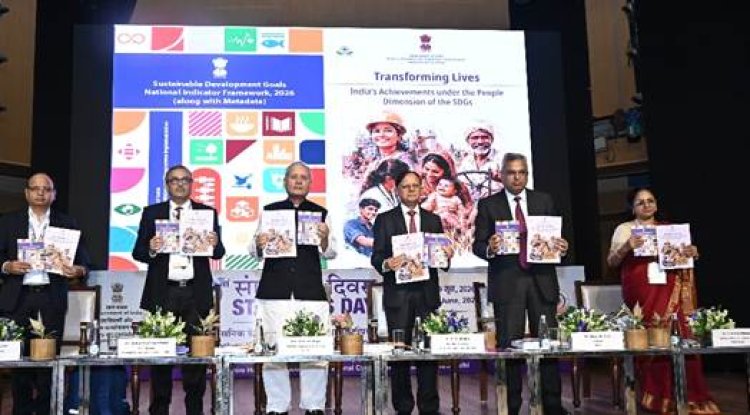
India has recorded progress in different social, economic, and environmental areas related to the SDGs for India, as per the recent "Sustainable Development Goals-National Indicator Framework (NIF) Progress Report 2026" that has been launched by the Ministry of Statistics and Programme Implementation (MoSPI) on the 20th Statistics Day.
This report, along with three other reports concerning SDGs, is the latest national data regarding India’s performance in terms of achieving the 17 Sustainable Development Goals and works as an important source of information for the authorities, researchers, and development agencies monitoring the sustainable development of India.
List of reports released: Sustainable Development Goals – National Indicator Framework Progress Report 2026; Data Snapshot on SDGs – National Indicator Framework Progress Report 2026; Sustainable Development Goals – National Indicator Framework 2026 with Metadata; Transforming Lives: India’s Achievements under the People Dimension of the SDGs thematic bulletin.
National Indicator Framework Tracks 277 SDG Indicators
National Indicator Framework has been formulated by MoSPI in consultation with different ministries, NITI Aayog, United Nations and other organizations in order to design an effective monitoring mechanism to evaluate India’s performance in achieving SDG targets. The national indicator framework for the year 2026 consists of 277 national indicators for all 17 SDGs.
Social Protection and Health Indicators Improve
The study reveals that there has been an increase in the share of the Indian population under social protection systems, from 22 per cent in 2016 to 65.3 per cent in 2026, which demonstrates greater accessibility to welfare programs and social security schemes.
There were also improvements in the health parameters. The Maternal Mortality Ratio of India fell from 122 per 100,000 live births in the period 2015-17 to 87 per 100,000 live births in the period 2022-24. On the other hand, the Sex Ratio at Birth improved from 896 females per 1,000 males to 918.
Conservation and Renewable Energy Continue to Expand
It should be mentioned that the report shows significant achievements regarding the conservation of genetic resources for agriculture. The number of plant genetic resources has grown from 432,564 during the period 2014-15 to 491,864 during the period 2025-26. As far as animal genetic resources are concerned, their number has increased from 140,364 to 361,794. Fish genetic
India's renewable energy capacity also continued to grow. Installed renewable energy generating capacity increased from 64.04 watts per capita in 2014–15 to 193.36 watts per capita in 2025–26, representing a threefold increase over the decade.
Employment, Recycling and Digital Connectivity Show Growth
Labour market witnessed positive progress with the national unemployment rate dropping from 6.1% in 2017-18 to 3.1% in 2025. There was a further increase in women participation in professional and technical professions with the ratio of female to male participation going up from 48.7% in 2023-24 to 51.3% in 2025.
There were extensive developments in the area of environmental infrastructure with an increase in the number of waste recycling plants from 829 in 2019-20 to 3,236 in 2025-26. The proportion of wetlands declared as Ramsar Sites went up from 4.15% in 2016 to 8.66% in 2026.
The country also saw remarkable digitisation during the decade with internet subscriptions tripling from 302.36 million in 2015 to 969.10 million in 2025.
Thematic Bulletin Focuses on the 'People' Dimension
Apart from furnishing statistical information, MoSPI has also released a thematic bulletin regarding the ‘People’ dimension of the SDGs. The document includes an analysis of how far India has come in realising SDGs 1 (No Poverty), SDG 2 (Zero Hunger), SDG 3 (Good Health & Well-being), SDG 4 (Quality Education), and SDG 5 (Gender Equality). Besides, the importance of different government policies in connection with human development has also been highlighted within the framework of the 2030 Sustainable Development Agenda.
Evidence-Based Monitoring for the 2030 Agenda
National Indicator Framework (NIF) Report is still being used as an evidence-based framework to measure the progress of India with respect to all 17 SDGs. With its up-to-date national indicators and thematic analyses, the NIF report enables policymakers to make decisions regarding where they have made some improvements and where more work is needed.
What's Your Reaction?