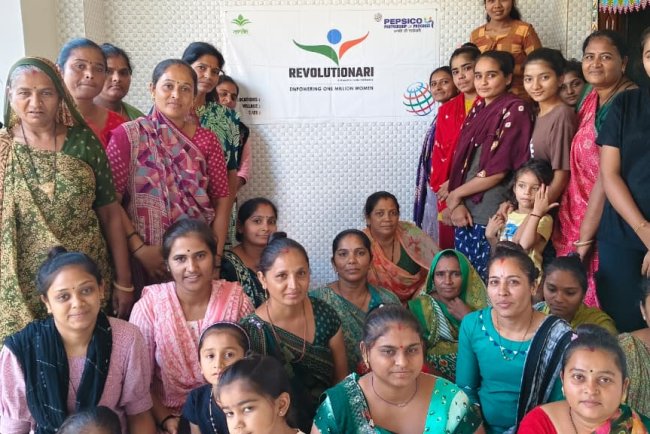
PepsiCo India, in partnership with HSRLM and Indus Action, has launched an initiative to help over 1.1 lakh women in Haryana access government livelihood schemes, loans, training and income opportunities under the Lakhpati Didi Yojana
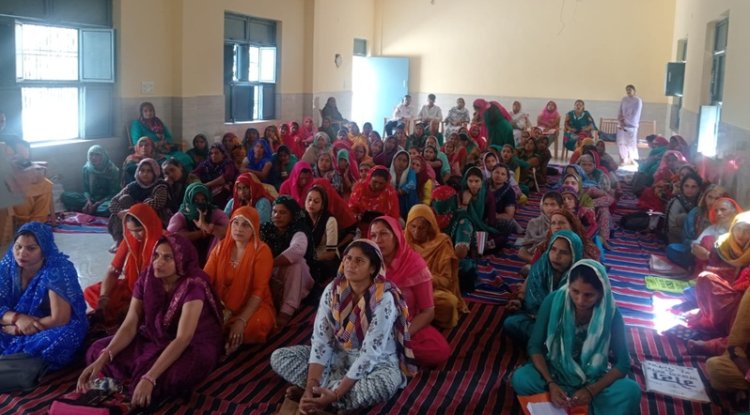
Manjeet remembers exactly what it felt like to need something and have to ask for it. A school bag for one of the children. A new pair of shoes. Small things that shouldn't require a conversation, shouldn't require permission, but did. That's over now. "Ab mere bacho ko koi bhi samaan chahiye hota hai to papa ki jagha mujhse maangte hai," she says. Now, when her children need something, they come to her — not their father.
Manjeet is part of the Narishakti Self-Help Group in Gurugram. She took a training programme, got a loan, and used it to expand her home business — papad, achar, ladoo. Things she already knew how to make. What she didn't have before was the capital to make them at scale, and the confidence that came from standing on her own feet financially. Both arrived together.
A few kilometres away, Saroj tells a quieter version of the same story. Her daughters have jobs now. The household income has gone up. "Bache padha paaye," she says simply — the children got educated. That sentence carries thirty years of what Indian rural women have wanted and not always been able to reach.
These are not exceptional women who beat the odds through some extraordinary personal quality. They are women who were given access to something that should have been available to them years earlier — a government scheme they were eligible for, a loan process that didn't collapse under its own paperwork, a person who showed up at their door and explained what was possible.
That last-mile gap — between what policy promises and what actually reaches a woman sitting in a village in Haryana — is exactly what a new partnership between PepsiCo India, the Haryana State Rural Livelihoods Mission, and Indus Action is trying to close.
The initiative sits under PepsiCo India's RevolutioNari programme and connects to the Government's Lakhpati Didi Yojana — a national scheme designed to help Self-Help Group women build household incomes of over ₹1 lakh a year through a combination of skill development, subsidised assets like cattle, access to finance, and linkages to markets. The scheme touches departments across Animal Husbandry, Fisheries, Dairy Development, and Women's Development. On paper, it is comprehensive. In practice, getting a woman in a rural block to navigate all of that — to know what she's eligible for, apply correctly, follow up, and actually receive what she was promised — has always been the hard part.
The partnership is targeting 1.1 lakh women over three years. But the more interesting question is not the number. It's the machinery being built to reach it.
The starting point was an honest assessment — over 100 stakeholders consulted, problems mapped without the usual softening that happens when organisations are reluctant to admit their own gaps. What came back was a familiar but sobering list: departments that don't talk to each other, loan processes that differ across financial institutions for no good reason, training that isn't tailored to what individual women actually want to do, and grievance mechanisms that exist on paper but don't function when something goes wrong.
None of this is surprising to anyone who has spent time working at the intersection of government schemes and rural women's livelihoods. What is less common is a three-way partnership willing to build systems specifically designed to fix those gaps rather than work around them.
The technology piece is practical rather than flashy — a Scheme Eligibility Matching Engine that maps an individual woman's skills, circumstances, and aspirations against what she actually qualifies for, so that the first conversation a Community Resource Person has with her is already personalised rather than generic. A digital portal to track where applications are in the system. An IVRS and call centre layer for women who aren't comfortable with smartphones or apps. A grievance mechanism with actual teeth — not just a number to call, but a system that tracks whether the complaint was resolved.
Suraj Bhan, CEO of HSRLM, describes the eligibility engine as a way to reach out more proactively to beneficiaries, which is a measured way of saying that the old model, where women had to find the scheme themselves, was leaving enormous numbers of eligible people behind.
What PepsiCo India is doing here is not charity. Yashika Singh, the company's Chief Corporate Affairs Officer and Sustainability Head, is clear that the logic is about multiplier effects — economically empowered women who make decisions differently, spend differently, invest in their children differently. The company's RevolutioNari initiative has been building toward this kind of structural intervention for a while, and this partnership represents the most ambitious version of it yet.
Tarun Cherukuri of Indus Action uses the phrase "last-mile delivery", which has become something of a development sector cliché, but which describes something very real. The distance between a scheme being announced in Delhi and a woman in a Gurugram village block actually benefiting from it is not measured in kilometres. It is measured in institutional coordination failures, in paperwork that doesn't match across departments, in Community Resource Persons who are well-intentioned but under-supported, in women who don't know their rights and have nobody to tell them.
Closing that distance, consistently, at scale, is unglamorous work. It doesn't make for a dramatic headline. But it is the work that actually changes whether Saroj's daughters stay in their jobs, and whether the next Manjeet gets a loan or goes home empty-handed.
The goal is ₹1 lakh a year. That's the Lakhpati threshold — the point at which a household moves from precarious to stable, from dependent to self-sustaining. It is not a large number by most measures. But for a woman who has spent years asking her husband for money for her own children's school supplies, it represents something that numbers don't fully capture. It shows the satisfaction of an urge when a person no longer has to ask for money.
What's Your Reaction?