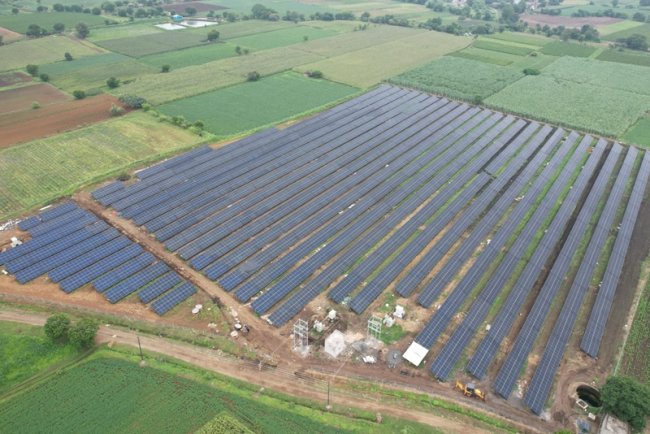
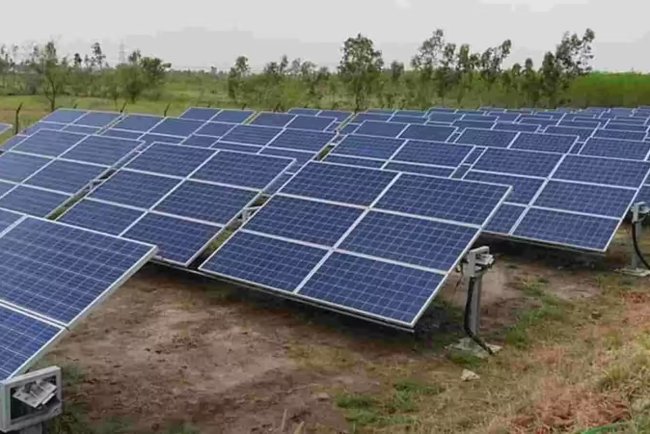
India plans a massive grid expansion to support rising clean energy and future power demand
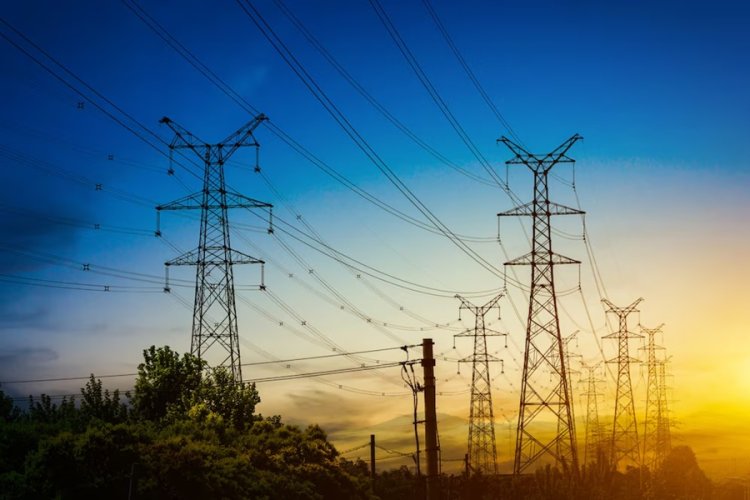
To underscore India’s unwavering commitment to a green energy future, the Central Electricity Authority (CEA) under the Ministry of Power, on Thursday, released a detailed “Transmission Plan for Integration of over 900 GW Non-Fossil Fuel Capacity by 2035-36” at Bharat Electricity Summit 2026. The 65-page report, released by Chairperson Ghanshyam Prasad, lays out an ambitious roadmap to build the massive transmission infrastructure needed to evacuate clean power from solar, wind, hydro and nuclear sources well ahead of generation additions.
The numbers are staggering. As of February 28, 2026, India’s non-fossil installed capacity stood at 275 GW — already 52.5% of the country’s total 524 GW generation base. By 2035-36, peak electricity demand is projected to hit 459 GW and annual energy requirement 3,365 billion units. Generation expansion studies suggest the country’s total installed capacity could reach 1,121 GW, with 786 GW coming from non-fossil sources. Yet the CEA has deliberately planned the transmission network for over 900 GW of non-fossil capacity — a deliberate buffer to account for implementation challenges and faster-than-expected renewable rollout.
Solar and wind projects come up in 18–24 months, but transmission systems take 3–5 years, the report notes. Therefore, there is a need to plan well in advance. The plan maps key renewable energy zones across India. Rajasthan leads with about 259.8 GW potential, followed by Gujarat at 136.1 GW, Andhra Pradesh at 88 GW and Karnataka at 32.7 GW. Smaller zones have also been marked in Ladakh, Assam and offshore wind areas in Gujarat and Tamil Nadu.
To support this, a massive grid expansion is planned. Between 2026–27 and 2035–36, India aims to build over 1.37 lakh circuit km of transmission lines and add 8.27 lakh MVA substation capacity. The total investment is estimated at around ₹7.9 lakh crore. This includes dedicated high-voltage corridors, HVDC links for Rajasthan’s desert REZs, and 1150 kV AC technology options for ultra-large power evacuation.
State-wise, Rajasthan dominates the narrative. The report details phased ISTS schemes already under implementation (46.7 GW by 2027-28) and under tendering/planning (12 GW more), plus future HVDC corridors for another 60 GW. Gujarat’s Khavda mega-park — already a global talking point — will see multiple phases up to 64.8 GW total, including offshore wind integration via 220 kV and 400 kV submarine cables. Southern states like Andhra Pradesh (53.4 GW), Karnataka (31.24 GW) and Telangana (13 GW) get dedicated pooling stations and lines, while Tamil Nadu’s offshore wind plans are also on the drawing board.
Intra-state evacuation gets equal attention through the Green Energy Corridor schemes. GEC-II (already under implementation) will integrate 19.4 GW, while the proposed GEC-III aims to add 134.7 GW of solar, wind and hydro plus 25.2 GW of pumped storage across 13 states, requiring 51,126 ckm of lines and 2,28,903 MVA of transformation capacity. Another 33.6 GW of dedicated intra-state lines are planned for Rajasthan, Gujarat and Karnataka.
The report also factors in 12.7 GW of additional hydro (with 13 GW more under planning) and 7 GW of new nuclear capacity evacuation. Importantly, it highlights 31.5 GW of spare margins already available in existing non-RE ISTS substations that can be immediately used for RE integration, and notes that 176 GW of non-solar-hour margins at current RE pooling stations are open for wind and battery storage projects.
CEA Chairperson Ghanshyam Prasad, in his foreword, called the document “a strategic roadmap” and “a blueprint for India’s green industrial revolution”. He thanked MNRE, CTUIL, Grid India and state utilities for their collaborative effort and stressed that the plan gives “essential visibility” to RE developers, investors and grid operators.
The timing is significant. India had earlier targeted 500 GW non-fossil by 2030; the 2022 CEA plan covered 537 GW RE by that year. This new report extends the vision to 2035-36, aligning with updated demand forecasts that include green hydrogen, data centres and EV charging. It also incorporates the Central Electricity Regulatory Commission’s new Solar Hour and Non-Solar Hour access rules, encouraging hybrid solar-wind-BESS projects for round-the-clock supply.
Experts say the proactive approach will prevent the curtailment and congestion seen in some states today. “By planning transmission for 900 GW when studies show 786 GW, India is ensuring no RE project is ever stranded for lack of evacuation,” a senior power sector official told this correspondent on condition of anonymity.
The report says that once the grid is upgraded, it can support India’s net-zero goals and also meet the growing demand for clean and reliable power.
It gives detailed maps of planned lines and substations. It will help developers and lenders plan future projects. Work will happen in phases. Some projects have started, some are in the tender stage, and many are planned for 2028 to 2036.
The message is clear. India is not just setting green targets. It is building the system needed to achieve them.
With detailed annexures mapping every proposed line, substation and corridor, the CEA document is now a ready reference for developers bidding in upcoming auctions and for lenders evaluating project bankability. Implementation will be phased — some schemes are already under construction, others in tendering, and many slated for 2028-36 — but the message from Shram Shakti Bhawan is loud and clear: India is not just chasing green targets; it is engineering the transmission backbone to deliver them.
What's Your Reaction?